
Red Sea Battle Lines Are Being Drawn
Iran is targeting your wallet.
In the wake of America’s Saturday attacks, Tehran shut down oil and gas plants in Qatar and Iraq, destroyed a massive Saudi Arabian oil refinery, and worst of all, closed the vital Strait of Hormuz. One fifth of the world’s oil travels through that strait, and now 150 tankers are stranded there.
The result? Gas prices have skyrocketed.
This affects not only everyday citizens at the gas pump but also the cost to ship goods around the globe. Vidya Mani, a visiting professor at Cornell University who focuses on supply chains, said, “You’re going to see spikes come up, each one will feed into another. That is something neither are we looking at nor prepared for.”
As bad as that sounds, things may be about to get a whole lot worse.
Unbeknownst to many, war is brewing elsewhere that could put much more pressure on the global supply of liquefied natural gas. Pieces are moving, players are preparing, and battle lines are being drawn. Like a gas stove, switched on and forgotten, it may take but a tiny spark to erupt the whole region—and your gasoline budget—into disarray.
The Problem
On February 22, a rumor emerged that shocked the Red Sea region. Horn of Africa specialist Martin Plaut reported allegations that Eritrea, Sudan and multiple Ethiopian rebel groups signed a military alliance against the Ethiopian government, and he speculated that the groups could be planning an offensive. Although unconfirmed, these reports illustrate a major trend in the region.
Two competing power blocs are rising around the Red Sea. “Growing competition between these factions has raised the risk of a full-blown regional proxy war on both sides of the Red Sea,” reported the American Enterprise Institute, a think tank based in Washington, D.C., on February 24.
An estimated 15 percent of global trade travels through the Red Sea and Suez Canal. With Hormuz closed, if the Red Sea destabilizes, the worldwide impact of events in the Middle East would grow. The American Enterprise Institute was so concerned by these developments that it called on the United States to employ a much more hands-on approach to maintain stability in the region. However, that seems unlikely from Washington, especially with President Donald Trump in office.
The future of Red Sea geopolitics may be decided only after these two power blocs battle and a leader emerges. We must know what’s going on in the region because events there will affect everyone, one way or another.
The Competitors
Though two clear sides are rising in the region, identifying the two blocs in the interlocking Sudan/ Ethiopia conflict is somewhat complicated. The situation isn’t as black and white as Ukraine vs. Russia. Rather than two distinct unions, the region is comprised of two separate alliance networks. The alliance network has some powers on the same side in this conflict, even while they fight elsewhere in the Middle East.
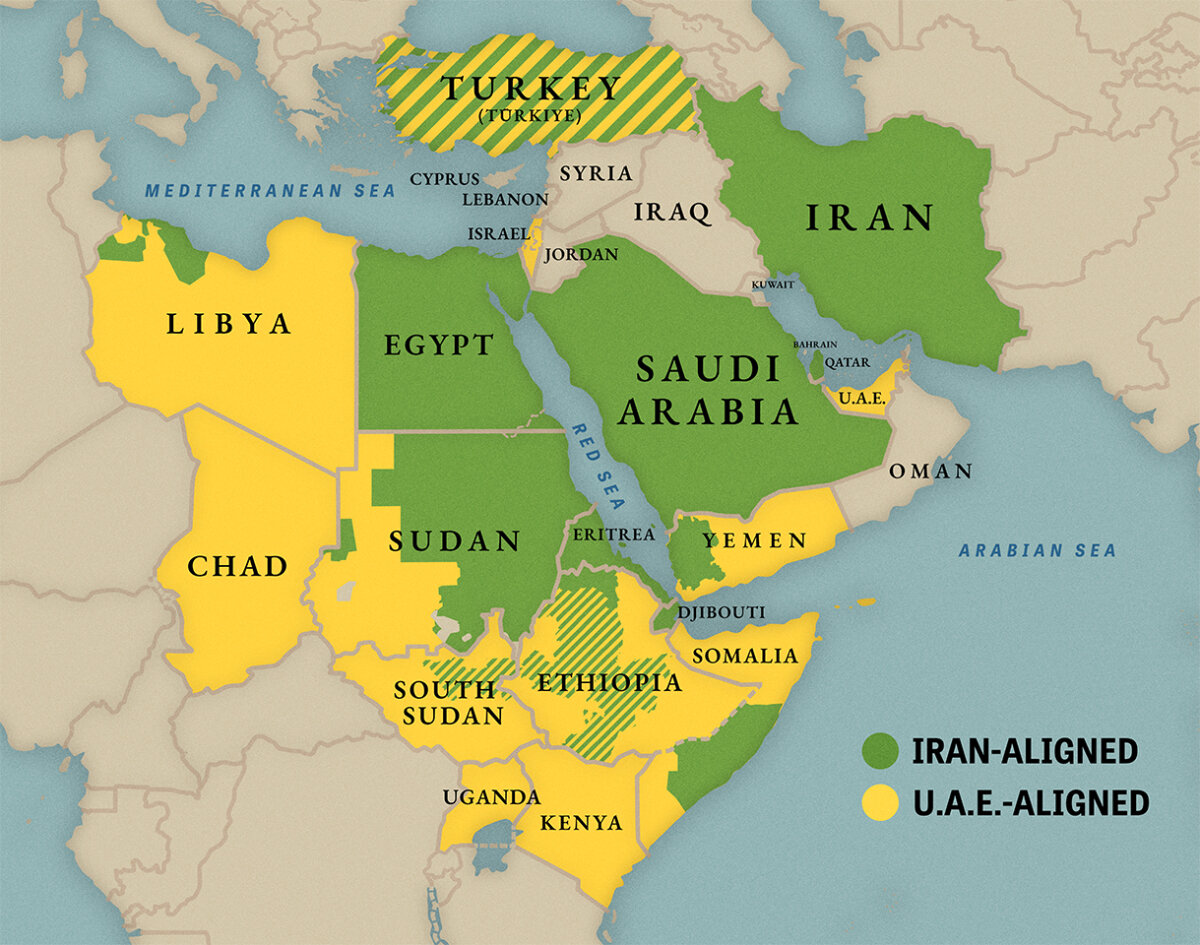
Not every power can be placed neatly into the alliance framework. But in general, on the one side, we have the Iran-aligned bloc (the nations in green), and on the other, we have the bloc aligned with the United Arab Emirates (the nations in yellow).
Note: It’s unlikely, both historically and strategically speaking, that the U.S.-Israel war against Iran will topple Tehran’s regime. So for the sake of this article, expect Iran not only to survive this war but to rebound as it did following the 12-Day War.
Below is a list of which nations or groups are part of which group. We will later cover why we can trace these factions back to Iran and the U.A.E.
Iran-aligned:
- Djibouti
- Eritrea
- Egypt
- Ethiopian opposition movements
- Fano militias
- Oromo Liberation Army
- Tigray People’s Liberation Front
- Libyan government
- Qatar
- Saudi Arabia
- Somali government
- Somalia’s al-Shabaab
- South Sudanese opposition movement
- Sudanese government
- Yemen’s Houthis
U.A.E.-aligned:
- Chad
- Ethiopian government
- Israel
- Kenya
- Libyan opposition government
- Somalian opposition governments
- Jubaland
- Puntland
- Somaliland
- South Sudanese government
- Sudanese opposition movement
- Uganda
- Yemeni government
Turkey is also a major player. It is more closely aligned with Iran but supports players on both sides.
We can better understand how we got here by breaking things down into three regions.
1) Sudan
Sudan is the epicenter of the tensions brewing in the region and where this all started. Sudan erupted into civil war between the government (saf) and the opposition movement (rsf) in April 2023. Since then, it has developed into a heated proxy war between several major players.
The saf’s most effective supporters are Iran and Egypt, and also includes Turkey, Qatar, Saudi Arabia and Eritrea. Before Iran got involved, the saf was losing; but after Iran threw its hat in the ring, the tide dramatically turned. Egypt has supported the saf throughout the war, but recent increased military support from Cairo helped turn the saf into a near-unstoppable force.
Meanwhile, the U.A.E. is the rsf’s main supporter. It sends funds through Chad, the Ethiopian government and Libya’s opposition government.
Beyond having foreign backers involved, Sudan’s war risks spreading to neighboring countries. Currently, war is brewing in South Sudan; its opposing sides are drawing closer militarily to Sudan’s opposing factions. This could pull in Uganda, which is a major ally of South Sudan’s government. Likewise, Sudan’s war has exposed divisions in neighboring Chad, which some say may be spreading violence even further.
The most terrifying threat is that Sudan’s war will both heighten and be heightened by the growing tensions in Ethiopia.
2) Ethiopia
The situation in Ethiopia is dire. From 2020 to 2022, the government killed 600,000 people to quash a rebellion in the nation’s Tigray region. Now, a much worse war seems on the horizon.
Not only have tensions with the Tigray returned, but Ethiopia is also on the verge of war with Eritrea and its native Amhara people (represented by the Fano militias). Both these new enemies were on Addis Ababa’s side in the 202o war, but have now turned. In addition, if an anti-Ethiopian alliance has formed between the Tigray, Fano, Oromo Liberation Army (another anti-government Ethiopian group), Eritrea and the saf, it could spell disaster for the government and the region as a whole.
https://x.com/martinplaut/status/2026219442171006998?s=20
An often-overlooked player in Ethiopia’s troubles is Egypt. Egypt has long been hostile to Addis Ababa and is known to fund movements against the Ethiopian government. Any major Ethiopian enemy would, almost by default, have Egypt’s economic and perhaps military support.
This is also where Djibouti enters the picture. At least 90 percent of Ethiopian trade passes through Djibouti, and Egypt is working to exploit that. A Sept. 5, 2025, article from Horn Review argues that Egypt is encircling Ethiopia militarily by allying with surrounding countries and militias. On Dec. 27, 2025, Egypt’s deputy prime minister for Industrial Development and minister of Industry and Transport visited Djibouti to sign three cooperation agreements. Many saw this as a ploy to turn Djibouti against Ethiopia. Ethiopia seemed so concerned about this visit that Prime Minister Abiy Ahmed quickly paid his own visit to Djibouti just a few weeks later to discuss “geopolitical dynamics, regional peace and security, and strengthening bilateral cooperation.”
This isn’t to say Ethiopia doesn’t have supporters. The U.A.E. is a major supporter of the Ethiopian government. But in many ways, this international support makes the situation more threatening. Should war break out in Ethiopia, it could set the whole region on fire.
In the midst of all this, Iran lurks in the shadows. Through its Yemen-based terrorist proxy, the Houthis, Iran is taking advantage of Africa’s violence and gaining more and more influence in the region. Danny Citrinowicz, researcher at the Institute for National Strategic Studies, described Iran’s growing influence in the region as its “axis of resistance 2.0.”
This is arguably most terrifying when considering the destabilization of Ethiopia. Should the situation deteriorate, it could allow Iran to gain a foothold in this strategically significant country. Multiple commentators recognize that Iran’s takeover of Yemen reveals its overall strategy in the Middle East is to control the Red Sea. Ethiopia would be a major prize for the Iranian regime. Tehran is well practiced at taking advantage of violence to assert its influence.
There is one nation we have yet to discuss that not only serves as a great example of this fact but could act as a gateway for greater Iranian influence throughout the region.
3) Somalia
The Somali government has essentially no control over its borders. It is the textbook definition of a failed state. Somalia is home to three essentially autonomous regions. Somaliland, one of these regions, received its first official recognition by a nation in late December—from Israel.
In addition, Mogadishu may soon fall to the terrorist organization al-Shabaab. Al-Shabaab has grown more powerful recently and has gained much territory since launching a major offensive about a year ago, though it has much further to go to control the nation. Al-Shabaab also faces resistance in Kenya.
Looking at the big picture, the real threat here, once again, is Iran. Iran, through the Houthis, is tied to al-Shabaab. In fact, Israel largely recognized Somaliland in an attempt to combat Iran’s growing influence in the region.
What Comes Next?
For over a decade, the Trumpet has warned that Africa, especially the Red Sea region, would devolve into a proxy war. In 2024, we specifically gave this warning in reference to Sudan.
The Trumpet made these warnings, not because of analytical prowess, but because there is a God in heaven who makes known what will come to pass in global events (Daniel 2:28).
The biblical book of Daniel is for our time today. Daniel 12:4 and 9 speak of “the time of the end”—the time Jesus Christ referred to when He said, “And except those days should be shortened, there should no flesh be saved …” (Matthew 24:22). This could only refer to the modern nuclear age.
Daniel 11:40-43 prophesy of the destruction of “the king of the south,” and Trumpet editor in chief Gerald Flurry has proved that this “king” refers to an alliance of radical Islamist nations and groups led by Iran. Verses 42-43 show that Egypt, Libya and Ethiopia (likely including surrounding nations) will be allied with Iran in this coming war. This shows that Iran is about to gain great influence in the Red Sea region.
With that in mind, look at Psalm 83. We know this psalm is also for our day because the alliance described has never existed in history. By identifying each of the names mentioned in verses 6-8, one can prove that this refers to a coming alliance between a unified European power and several Arab states: Turkey, Saudi Arabia (and surrounding nations like the U.A.E.), Jordan, Syria, Palestine and Lebanon. Notice how none of those allied countries are among those destroyed with the king of the south. In fact, some of them are specifically prophesied to escape Iran’s destruction (Daniel 11:41). By putting these prophecies together, we can expect to see two distinct power blocs in the Red Sea region: one led by Iran and the other led by Europe.
Could the two blocs rising around the Red Sea today develop into these prophesied powers?
Many of these nations are already aligned with the power the Bible says they will ally with. Egypt, Eritrea, Djibouti and the Libyan government already support Iran’s side in the region. Likewise, the U.A.E. is working to form a regional alliance against Iran. Europe may not be fully in the picture yet, but it is involved and will not surrender the vital Red Sea without a fight.
In addition, it would not be surprising to see the nations currently on the “wrong side” switching allegiances before all is said and done. Saudi Arabia is a stark example of this. Right now, it is supporting the saf, largely for humanitarian and stability reasons following the rsf’s massacre at El Fasher. However, once Iran—Saudi Arabia’s sworn enemy—begins asserting itself in the region, it’s highly unlikely Riyadh would continue supporting that side. Ethiopia is in a similar boat. Right now, the government supports the U.A.E.’s side; however, the Bible prophesies that Egypt will be responsible for shifting Ethiopia to Iran’s camp. The stage is being set for this dramatic fulfillment of prophecy!
Finally, notice how Daniel 11:40 says the king of the north destroys Iran and its allies: “like a whirlwind.” Mr. Flurry has shown that this means Europe and its allies will surround Iran and its allies. Look at the above map one last time and notice how the yellow nations largely encircle the green—especially once Turkey and Saudi Arabia are firmly on the U.A.E.’s side!
Regardless of how events play out, know that Bible prophecy is sure. The Red Sea region will soon be thrown into a proxy war, directly affecting everyone on Earth!
For a more in-depth look at these prophecies and what the Bible says will come after this clash, read Mr. Flurry’s free booklet The King of the South.