

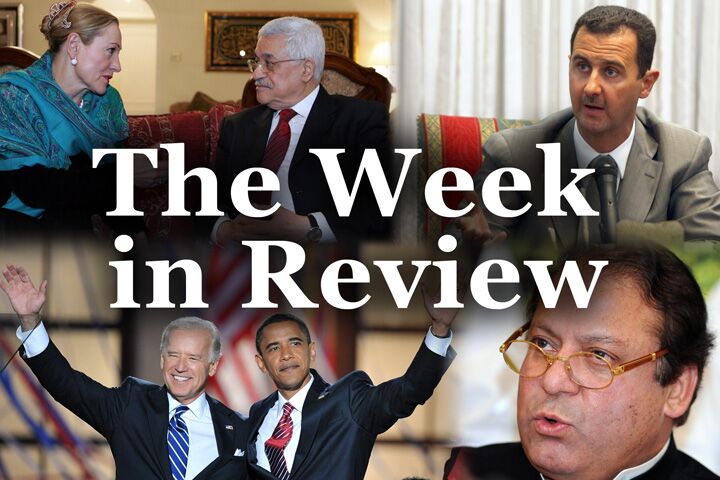
The Week in Review
Middle East
Last week, Syrian President Bashar Assad visited Russia to meet with President Dmitry Medvedev and discuss the possibility of a weapons agreement. Russia agreed to strengthen military ties with Syria and, according to the Russian press, Assad offered to host a Russian missile base. Indications are that the current Russian-U.S. impasse is leading Russia to provide more weapons and diplomatic aid to countries and terrorist groups that are opposed to America. “The Russian move into Georgia has begun a tectonic shift in the (Mideast) region,” said Joshua Landis, a Syria expert in the United States. “It has emboldened Syria, Hezbollah and Iran to push harder against Israel and the U.S.”
The war in Afghanistan is escalating, with the Taliban mounting their most serious attacks in six years last week. Multiple suicide bombers struck Camp Salerno, one of the largest American military bases in the country, wounding three U.S. soldiers and six members of the Afghan Special Forces. In a separate attack, near Kabul, insurgents killed 10 elite French paratroopers.
The Taliban has also intensified attacks in Pakistan, claiming responsibility for a wave of suicide attacks over recent days. In the deadliest, on August 21, two suicide bombers attacked Pakistan’s biggest weapons factory, close to the capital of Islamabad, killing at least 67 people and wounding more than 200. Islamist militant group Tehrik-i-Taliban Pakistan claimed responsibility for the attack, which was the deadliest since the Taliban started targeting government sites in Pakistan 18 months ago.
On August 25, Pakistan’s government announced it was banning several groups affiliated with the Taliban movement. The ban, however, does not include all Taliban groups, but only those the state has lost control over and that are connected to foreign terrorists. As such, the ban, according to Stratfor, is no more than a formality, since it is difficult for anyone to distinguish between the various types of Taliban.
Highlighting the Pakistani government’s inability to bring Islamist terrorists under control—and worsening the country’s political crisis—just hours after the ban was announced, the second-largest party in the ruling coalition pulled out of the government. Former Prime Minister Nawaz Sharif’s Pakistan Muslim League accused the government of failing to reinstate judges ousted by former President Pervez Musharraf as promised. Sharif’s party had been pushing for negotiated settlements with militants, so, as an opposition party, it is likely to try and thwart any tough moves against militants by the government.
Meanwhile, the offensive over recent weeks by Pakistani security forces against Islamic extremists in the northern Swat valley and in Bajaur, which has displaced thousands, is further turning public opinion against the state and its use of force against the Taliban.
In other Mideast news this week, the Middle East Timesreported that Hamas and Jordan are talking—the Jordanian Intelligence Department chief has just held political talks with a top Hamas official. This, says the Times, suggests that both parties are preparing for changing circumstances in the region—specifically a more empowered Hamas: “The likelihood is that Hamas will do well in upcoming elections for parliament, and perhaps even for president, in the Palestinian territories.”
Europe
The Lisbon Treaty made it back into the news this week. Ireland currently has no plans for a second referendum on the issue, an anonymous government spokesman revealed. “People who are saying ‘another referendum or legislation,’ they are all jumping ahead to an outcome, and the government isn’t anywhere near that,” he said. The Financial Times reported that the government has decided that even if a second referendum takes place, it would not happen before Europe’s parliamentary elections in June 2009.
If these reports are true, then the Lisbon Treaty as we know it appears dead. But even as it gasps its dying breaths, a powerful organization has stepped forward with a solution. The Lisbon Treaty failed because it did not bring Catholicism into the picture, said Ireland’s top Catholic figure, Cardinal Sean Brady. “Successive decisions which have undermined the family based on marriage, the right to life from the moment of conception to natural death, the sacredness of the Sabbath, the right of Christian institutions to maintain and promote their ethos, including schools—these and other decisions have made it more difficult for committed Christians to maintain their instinctive commitment to the European project,” he said this week. Translation: Catholics will support you if you enforce their Sabbath day and religious views. “Without respect for its Christian memory and soul, I believe it is possible to anticipate continuing difficulties for the European project,” said Brady. The Lisbon Treaty may appear to be finished, but Europe is not. Watch for a power bloc of 10 nations or groups of nations, led by the Catholic Church, to rise out of this mess. For more information, see our article “Is a World Dictator About to Appear?” in the special sample issue of the Trumpet.
On August 20, officials in Brussels announced that the European Union will provide the Palestinian Authority (PA) with an extra €40 million (us$60 million) in financial aid. This money comes on top of the €440 million (us$660 million) in aid the EU pledged last December. In addition to covering some of the PA’s salary and pension costs, part of this cash has been earmarked for the construction of a new Palestinian security force headquarters in Nablus. While European leaders may pledge commitment to the Jewish state, their monetary support of the Palestinians—much of which has been used for anti-Israel activity—is just one factor indicating Europe does not have Israel’s best interests at heart.
Germany is shoring up its borders economically. Last week Angela Merkel’s government proposed a new law that will enable Germany to stop foreign investors outside the EU from buying up more than 25 percent of any company, when “public order and security” are threatened. “The wording creates an elastic definition that goes far beyond the current law, which is restricted to the defense industry,” wrote the Telegraph August 19. At the same time, Germany is busy buying up foreign companies. For more, read our November/December 2006, Trumpet article “Germany’s Corporate Blitzkrieg.”
Asia
In the aftermath of the recent Russian invasion of Georgia, polls show that a majority of Russians fully support the Putin-Medvedev government and are excited about the return of Russia as a superpower. According to a recent survey by the Russian Public Opinion Research Center, 58 percent of Russians put their faith in Prime Minister Vladimir Putin, while just 40 percent say they prefer President Dmitry Medvedev. Seventy percent of Russians say they are “in full and complete agreement” with the statement that Russian leadership had “done everything it could to prevent an escalation of the conflict” with Georgia. Only 4 percent of Russians believe Moscow precipitated the crisis.
Yet, the Russians are not the only people toeing Putin’s line. According to the Turkish daily newspaper Referans, Kazakhstan may soon decide to pump its oil through Russian pipelines instead of shipping it in tankers to the Baku-Tbilisi-Ceyhan pipeline in Azerbaijan, which bypasses Russia. As the oil and natural gas of Kazakhstan fall further under Russian control, the Kremlin will become even more powerful. This, in turn, will only cause more Russians to support the authoritarian practices of Vladimir Putin as he makes their country even more of a global power.
China also has voiced its support of Russia’s “active role” in resolving the conflict in Georgia. China, along with Kazakhstan, Kyrgyzstan, Tajikistan and Uzbekistan, expressed support for Russia this week during a meeting of the Shanghai Cooperative Organization, a regional group set up in 2001 to counter nato influence in the strategic Central Asia region. With China and the nations of Central Asia backing it, Russia will emerge as a formidable counterforce to Western power.
Africa
Along with despots, famine, hiv and terrorism, add flooding to the list of Africa’s perils. About 150,000 people have been displaced in Benin alone, with tens of thousands displaced in other African countries as well. The World Health Organization (who) described rising floodwaters across West Africa as a health risk to millions, and said that flooding will add to the impact of the food crisis. “West Africa’s annual floods bring with them not only the threat of vector-borne and communicable diseases, but it further endangers the lives of people already malnourished by the food price crisis,” said Dr. Eric Laroche, assistant director general of who’s Health Action in Crises cluster. There has been “widespread damage to bridges, roads, railway lines and other infrastructure vital for delivering health services and humanitarian supplies,” according to who’s statement. People may see weather disasters as coincidental—or even as a man-made problem caused by rising carbon emissions—but watching the weather can provide us a deeper lesson and insight into the Almighty God’s awesome power and the plan He has for mankind. To understand how God uses the weather, read our July 17 article “Weather: God’s Bullhorn to Mankind.”
Anglo-America
This was a busy week in American politics. At their national convention in Denver, Colorado, Democrats officially nominated Sen. Barack Obama as their presidential candidate Wednesday, just days after Obama announced his running mate: Joe Biden, a fellow senator, known for his foreign-policy experience. The race continues to be close, and eyes are now turning to the upcoming Republican National Convention in St. Paul, Minnesota. John McCain announced his choice for vice president today: Alaska Governor Sarah Palin.
Meanwhile, the White House and the McCain campaign are digesting remarks by Russian leader Vladimir Putin, who has accused “someone in the United States” of creating the Georgian conflict intentionally “to stir up the situation and create an advantage for one of the candidates in the competitive race for the presidency in the United States.” Putin added, “They need a small victorious war.” The New York Timesreports that McCain is “loathed in the Kremlin because he has a close relationship with Georgia’s president, Mikheil Saakashvili, and has called for imposing stiff penalties on Russia, including throwing it out of the Group of Eight industrialized nations.” Putin has offered little support for his charge, and the White House said his ideas were absurd. “But they underscored the depth of the rift between Moscow and Washington over the Georgia crisis,” the Times wrote. “They also suggested that the Russian leader was deeply concerned about the possibility that McCain, widely viewed here as having a strong bias against Russia, could become president.”
New Orleans residents are preparing for the onslaught of another tropical storm, Gustav. Gustav blew through Haiti and the Dominican Republic with hurricane-speed winds and hammered Jamaica. Meteorologists expect Gustav to gain windspeeds of 111 mph and become a Category 3 hurricane before smashing into the American Gulf Coast almost three years to the day after Hurricane Katrina.


