Did AI Just Solve the Biggest Unsolved Problem in Mathematics?
Did AI Just Solve the Biggest Unsolved Problem in Mathematics?
When I was a kid, I was fascinated with math problems that asked you to look at a series of numbers and predict what comes next—2, 6, 8, ?, ?, etc. Yes, I was a nerd.
One series stumped me: 2, 3, 5, 7, 11. I tried to predict the next number and always failed. I asked for a few more numbers to be given: 13, 17, 19, 23. Still, there seemed to be no discernible pattern.

I had failed to note that these numbers are simple prime numbers, which can be divided only by themselves and by 1. But I had encountered one of the great mysteries of mathematics. Prime numbers are simple. We learn about them in elementary school. You can think of them as the basic building blocks of numbers: All other numbers can be made by multiplying prime numbers together. But how can something so simple and foundational be so unpredictable?
This has puzzled mathematicians for centuries. Early Internet cryptography relied on the unpredictability of prime numbers. This apparent randomness is also at the heart of one of the greatest unsolved problems in mathematics: the Riemann hypothesis. Mathematicians have been trying to solve it for 150 years. Hundreds of would-be theorems could be proven true—if the Riemann hypothesis is proven true.
The actual hypothesis is fairly complex. (There are some good videos out there to explain it. The book The Music of the Primes, by Marcus du Sautoy, is excellent.) It revolves around something called the zeta function. Bernhard Riemann was able to use it to answer the question, How many numbers between 0 and a given number are prime?
If the Riemann Hypothesis is true, then the primes behave as if they were scattered at random along the number line, though dropping off in frequency the higher you go. If false, it is uneven—as if a careless farmer sowed seeds more heavily in one part of his row and was then forced to spread them more sparingly later to compensate.
The hope was that solving the Riemann hypothesis would provide new deep insights into the fundamental properties of numbers, that it would help explain the apparent randomness at the core of something so regular, ordered and predictable as mathematics.
Now it might be solved—with no insights provided.
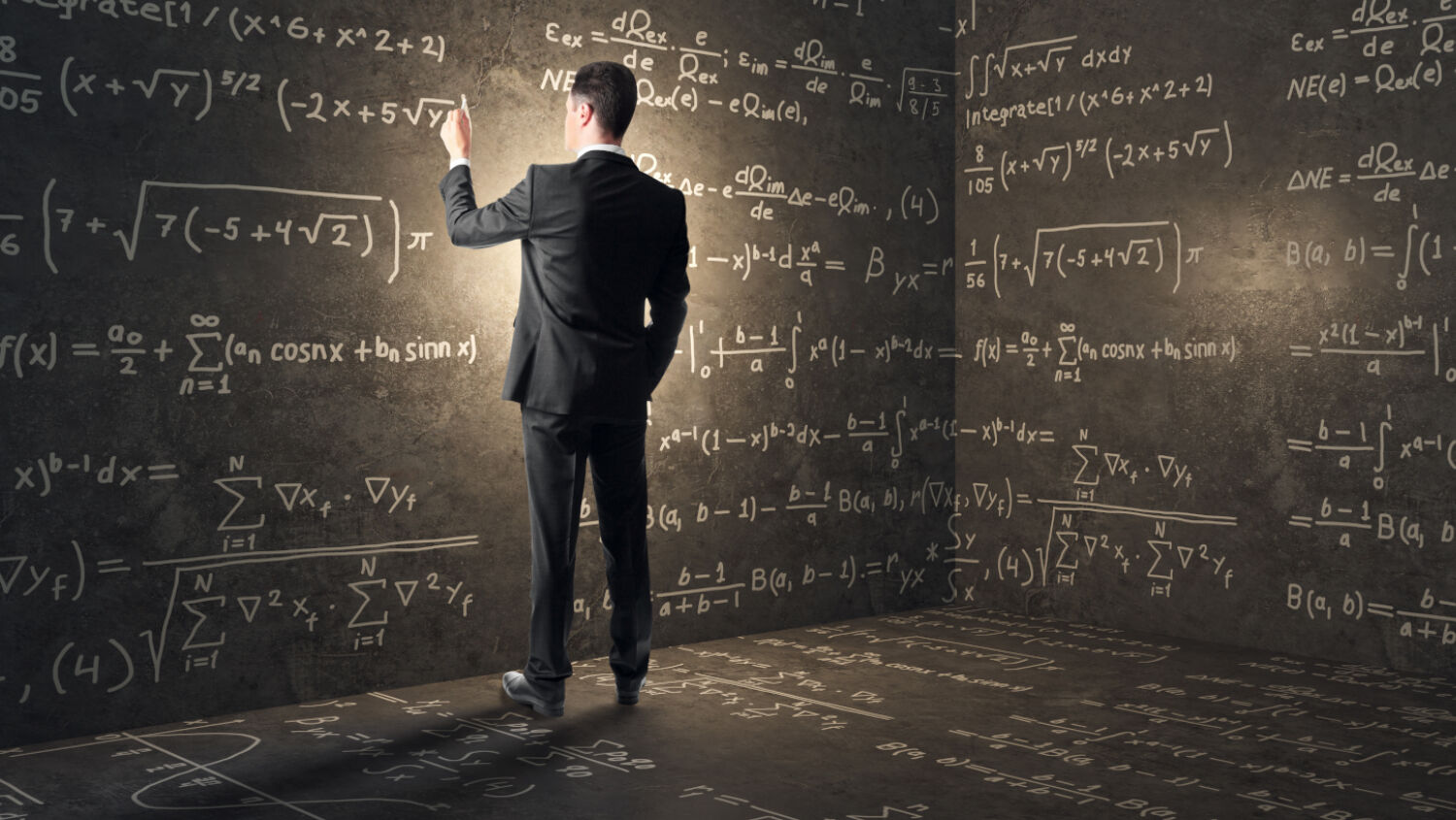
Levent Alpöge, a mathematician with Anthropic, claims to have proved the Riemann hypothesis using one of Claude’s artificial intelligence models. Its complicated 250,000 pages in the Lean programming language will require time to verify and even longer to see if it shows deep insights into the nature of numbers.
But if accurate, it is the most powerful proof to date of the potential of AI. Fundamental problems that we struggled with for decades are being solved. What’s next? Cheap clean energy? The solution to world peace? Abundance for all? After all, if problems that are hard for us can be solved by AI, where’s the limit?
Here, there is a hard and fast limit. Man has an incredible mind for learning about the physical creation. He can even invent powerful tools to help him in learning and to perhaps even do that learning for him.
Yet the Bible reveals we are fundamentally and woefully incomplete. We lack understanding of spiritual knowledge. Man, on his own, has no way of discovering that knowledge. No experiment, no measurement, no chain of deduction can reveal spiritual truth.
So we solve problem after problem, on the physical plane, while being unable to solve war, unite families or bring tranquility. Herbert W. Armstrong wrote that “all our seemingly unsolvable problems and the evils in this world are spiritual in nature.”
AI is just as limited. It is accelerating our understanding of the physical world—without adding anything to our spiritual understanding. We have more power at our disposal but no additional character to regulate that power.
Even with physical knowledge, this may not be a good thing. AI’s proof of the Riemann hypothesis has yielded no deeper insights yet. Perhaps we’ll gain them as mathematicians follow the trail AI blazed. It probably saved us from exploring a bunch of other promising paths that wouldn’t, in fact, prove the hypothesis. But who knows what other discoveries lie down those paths? Are they lost to us forever?
But if AI accelerates our physical knowledge without adding anything to the spiritual, the consequences are grave. Jesus Christ Himself warned of a time when man would wipe himself off the Earth unless God intervened, a time when “not a soul would be saved alive (Matthew 24:22; Moffatt). That must have seemed absurd to His audience 2,000 years ago.
Since then, man has discovered incredible things about the world around him—and gained the power to wipe himself out in the process. Could AI accelerate that with its exciting discoveries coupled with more powerful weapons and destructive potential?
Unlike prime numbers, this is a very predictable sequence: Man grows in knowledge, man creates new inventions, man weaponizes the inventions. We’ve done it throughout history, and AI will be no different.
With discoveries like this, AI is looking more fundamentally groundbreaking and revolutionary than ever. It’s exciting—but without spiritual guidance, very dangerous.
Jensen Huang: Morals Don’t Matter—Only Money
Jensen Huang, nvidia’s disgraced ceo, is back. After being forced out over multiple extramarital affairs, he was unanimously reinstated by the board just 11 days later. He was simply too important to the company and to the U.S. economy. After he was fired:
- nvidia’s stock lost more than $1 trillion in market value.
- The Nasdaq-100, an index largely made up of tech firms, dropped 2 percent.
- Other computer chip manufacturers saw their stock fall between 5 and 10 percent.
- The Telegraph called it “a bruising week that looked set to burst the AI bubble for good.”
President Trump called for Huang’s return publicly on his social media and privately in a phone call with nvidia’s board.
Do morals matter in modern America? Not if you’re rich, apparently. Huang managed to commit crimes that typically outrage the left and right. “Ordinary” adultery is now common; it barely registers a response. But Huang went much further:
- Huang slept with a woman suspected to be an agent of the Chinese Communist Party.
- He also turns a blind eye to nvidia chips being smuggled to China, in direct contravention of President Trump’s rules, propelling China’s progress in the AI race.
- He also slept with at least two of his own employees, a cardinal sin even to liberals in the post #MeToo era.
Yet apparently, if you make the stock market go up, you can ignore any rule you like.
President Trump didn’t just tolerate Huang’s transgressions—he celebrated them. Remember the iconic photo of President Trump, fist in the air, shouting, “Fight! Fight! Fight!” just after surviving an assassination attempt? He posted a revised version on his Truth Social account—Jensen Huang, defiant but bloody, holding high a red bra.
God saved Donald Trump that day. He intervened to save America, temporarily, to provide a reprieve from all the decline. Trumpet editor in chief Gerald Flurry wrote:
God wants to make America’s temporary resurgence permanent. But that will happen only if we as a people truly, genuinely repent and turn to God—and that includes the president.
Celebrating sin if it saves the stock market is not the way to lasting prosperity. Sins like adultery are directly causing America’s decline. Mr. Flurry writes in his free booklet Character in Crisis:
When Americans go from proclaiming that a free society can only exist when founded on private morality to thinking that character doesn’t matter, it is time to ask some hard questions about the future of this nation.
He called America’s lack of response to Bill Clinton’s scandals “a frightening portent of our nation’s future.” We are now decades downstream from that. Morals matter less than money. This will destroy and bankrupt America.
Iran: Europe Is Now Within Range
Iranian missiles can now strike targets within 2,800 miles, Ahmad Bakhshayesh Ardestani, a member of Iran’s National Security and Foreign Policy Committee, said yesterday. This means they can now reach Europe.
- This is an increase from Iran’s previously stated self-imposed 1,240-mile range, which it set to allay fears of Iranian aggression against Europe in 2017.
- Also on Monday, Tehran’s Hamshahri newspaper published an image featuring a missile launch with the text “All of Europe within Iran’s range.”
The announcement follows recent orders from Supreme Leader Motjaba Khamenei to boost its missiles’ range and accuracy.
- Referencing Khamenei’s orders, Ardestani said on Monday, “This means we have Europe within our grasp.”
Although specifics are lacking and other sources have not confirmed the announcement, such threats exacerbate Europeans’ fear of Iran.
Daniel 11:40 warns that “at the time of the end,” a “king of the south,” which Trumpet publisher Gerald Flurry has identified as radical Islam led by Iran, will “push” at a German-led, Catholic European empire. Military threats and provocations such as this certainly constitute part of that push.
This push will prompt German-led Europe to strike against Iran “like a whirlwind.”
IN OTHER NEWS
Russia expands military recruitment among teenagers: Russia’s Defense Ministry is moving to open military education to teenagers as young as 16, proposing to allow students to enter military colleges directly after ninth grade, the Moscow Times reported today. The proposal comes amid Russia’s broader effort to weave military preparation into nearly every level of Russia’s education system, as President Vladimir Putin seeks to prepare the next generation for future wars. Trumpet editor in chief Gerald Flurry wrote in 2014: “I strongly believe Vladimir Putin is going to lead the 200-million-man army” that is prophesied in Revelation 9 to emerge in the modern era. Most of the troops from this colossal force will come from Asian nations that ally with Russia under Putin’s leadership, including China. But many Russian schoolchildren now being educated in warfare and fast-tracked into military service will also grow up to join its ranks.