
Europe’s Choice: Strongman or Collapse
Europe’s Choice: Strongman or Collapse
Europeans have become good at living with crisis: the euro crisis, the migrant crisis, the Ukraine crisis, the energy crisis and more. For years, these have been managed but never solved.
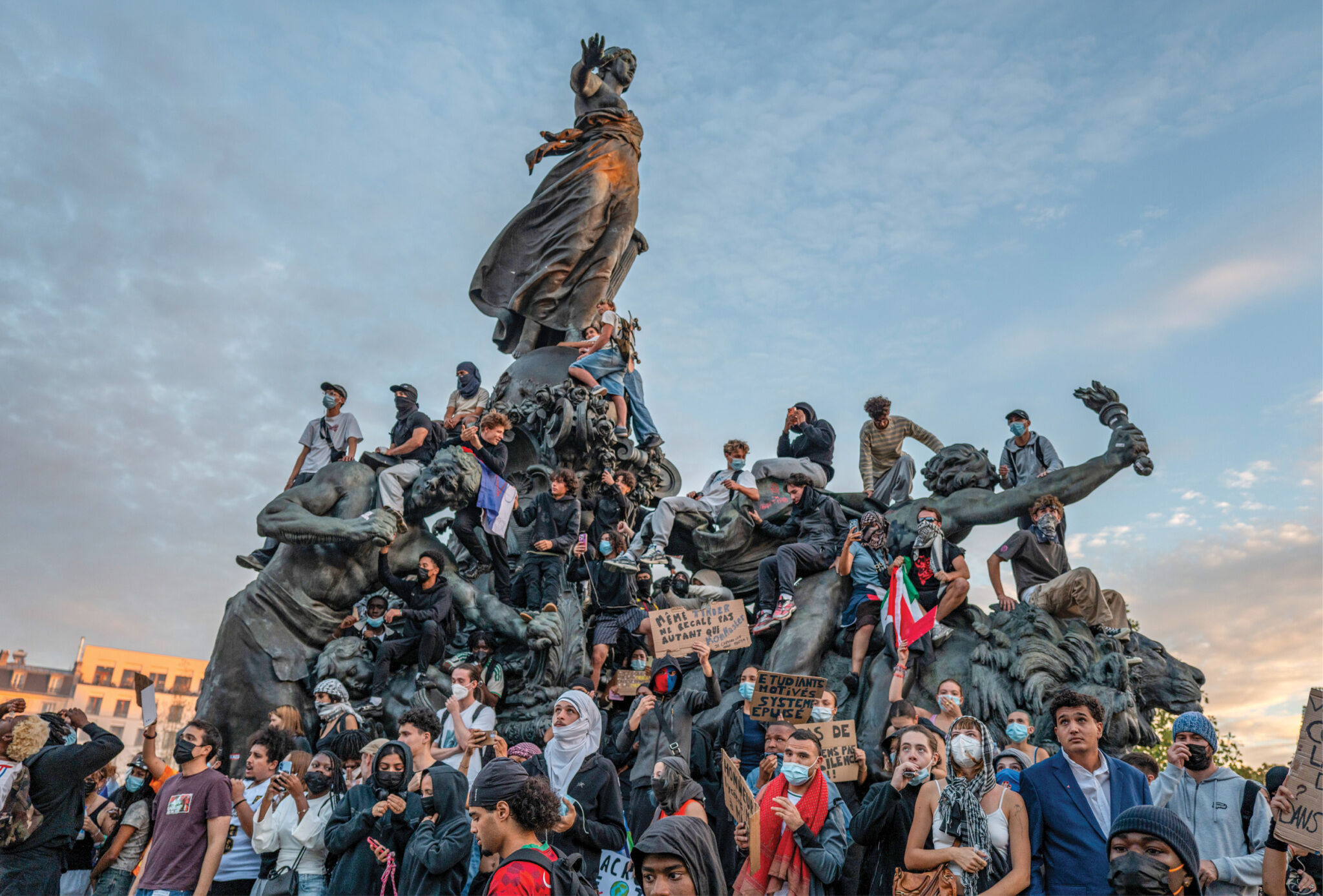
On October 17, all these crises came to a head in a single day of rioting. More than half a million people took to the streets across France. They looted shops, burned cars and attacked police and firemen. A thousand police officers were injured, at least 3,000 businesses were damaged or looted, and law enforcement arrested about 2,400 people. Insured losses could top $1 billion.
Protests are common in Paris. Destruction on this scale is not. The yellow vest movement, which filled headlines worldwide from 2018 to 2020, took 16 months to reach those numbers. But this autumn, France is suffering “a form of insurrection” and a “kind of urban guerrilla warfare,” said French Minister for Urban Affairs Vincent Jeanbrun. The Spectator asked, “Could This Be the End of the French Fifth Republic?”
The chaos in France inspired violent protests in Belgium and Italy. Protests also erupted in Spain, Portugal and Albania.
At the root of the riots lie crises Europe has failed to resolve, some of them for decades.
It brings to mind the words of European founding father Jean Monnet: “Europe will be forged in crises and will be the sum of the solutions adopted for those crises.”
These words will prove prophetic. More than anything else, Europe will become the result of its solution to the leadership crisis: dictatorship.
Stagnant Europe
By now, the 2008 euro crisis should be ancient history. It has been nearly two decades since the subprime mortgage bubble exploded in the United States and the euro currency almost collapsed. The eurozone pulled through—but something remains broken.
Before the 2008 crisis, the combined economy of European Union nations was 20 to 30 percent bigger than America’s (depending on how you dealt with exchange rates). Today, it’s about 30 percent smaller.
Since 2008, nominal gross domestic product in the U.S. has doubled. In other words, the dollar value of all goods and services produced in the U.S. today is twice what it was in 2008. A good deal of that is inflation, but not all. In the EU, nominal gdp has grown by only a fifth.
A core reason for this vast disparity is that European productivity has stagnated. From late 2019 to mid-2024, U.S. productivity per hour worked rose 6.7 percent. This is normal: Better education and better technology mean people can produce more per hour worked. But over the same period in the eurozone, productivity rose by only 0.9 percent—a meager 13 percent of America’s growth.
This has far-reaching implications. Government, society and lifestyle are built around the assumption that economies grow over time and that each generation will be wealthier than the last. When that growth stops, pensions become unaffordable. Though house prices have continued to rise, incomes haven’t, pricing an entire generation out of home ownership. As a result, many people are putting off marriage and children.
This is all the more striking because Eastern Europe grew dramatically richer over the same period. The stagnation is concentrated in the West.
The only factor preventing these economies from self-destructing is debt. Nations have borrowed heavily to keep pensions and benefits rising—often faster than inflation. When covid-19 hit, governments paid people to stay home, temporarily staving off economic disaster. To do so, they borrowed more money.
Eurointelligence grasps the scale of the crisis: “Europe’s unique economic and social model, as well as its democracy, is much more dependent on economic growth than people thought” (October 19).
With the growth having evaporated, the economy, the society and democracy itself are under threat.
Enter Putin
Now a new demand requires even more debt: rearmament. Russian President Vladimir Putin launched his full-scale invasion of Ukraine in 2022. Other European nations believe they could be Putin’s next target unless they spend enough to look intimidating.
President Donald Trump has made it clear that America has no interest in paying to defend Europe. Europeans will have to find the funds themselves.
For Germany, that’s no problem. As one of the least-indebted major economies, it is maxing out its credit card on defense. For everyone else, this is another budget headache they can’t deal with.
Millions of Migrants
Another crisis that has been managed rather than solved is the ongoing migration surge. Since 2014, somewhere between 5 million and 8 million migrants have entered Europe from the Middle East and North Africa. The flow of arrivals is lower today than at the height of the crisis, mostly because there hasn’t been another war on the scale of Syria’s. Also, European governments have bribed repressive regimes to stop migrants before they arrive in Europe. But they have done nothing about the millions of migrants already there.
Other “solutions” are more theater than reality. European governments might shift migrants around, change their types of accommodation, tinker with their government benefits, or put checks on their borders—but millions of migrants remain in Europe. Why?
Europe’s Democracy Crisis
For years, power in Europe has flowed away from citizens and elected governments into the hands of unelected bureaucrats: judges, regulators, members of committees in Brussels. There is now a complex hierarchy of national and international courts, with EU rules and treaties that go on for millions of pages.
As a result, major European countries can rarely make a significant decision without a series of courts weighing in. Taxpayer-funded regulatory bodies sue the government and drag it through national courts—then European courts.
This is another reason why Europe’s economy has been stagnant while America’s has grown. The U.S. economy has major, foundational problems—but at least it is led by a government that can react to changing technologies and circumstances. Europe’s can’t.
The effect has been most damaging on migration. Large numbers of Europeans want migrants out. The European Court of Human Rights makes deportations tortuously complex and often impossible, even for violent, dangerous criminals.
So the millions remain.
Political Paralysis
The backlash against these headaches has opened a new divide in European politics in addition to the fundamental left-right split. On one side are the mainstream parties of left and right, which disagree sharply on a number of issues but want to fight it out within the current system. On the other are upstarts from both the left and the right who want to smash the existing laws and norms. Their goals differ, but rightly or wrongly, all of them defy the mainstream order: They want to deport migrants, exit nato, print money, introduce 100 percent tax rates, cancel the EU, or ally with Russia.
This new fault line has rendered most of Europe almost ungovernable. No faction can gain a majority in any parliament. Europe is dominated by convoluted coalitions, minority governments and unpopular leaders.
- Germany: Chancellor Friedrich Merz hit the lowest approval rating ever recorded for a German chancellor in an October 1 poll by German public broadcaster ard, in which only 10 percent of respondents said they were satisfied with his leadership. He leads a coalition that pairs his conservative party with its mirror opposite, the Social Democratic Party. Meanwhile, the upstart Alternative für Deutschland is polling as the nation’s most popular party.
- France: President Emmanuel Macron has lost the support of his parliament, and his term in office ends next spring. France has cycled through five governments since 2024. More than two dozen people have declared themselves candidates to replace Macron, but only the far left and far right have real momentum.
- The Netherlands is governed by a three-way minority coalition of two center-right parties and one center-left party. Even when they agree on something, they lack the votes to get it through parliament.
- Spain: Prime Minister Pedro Sánchez has struggled for years to keep his left-wing minority coalition from collapsing. He finally ran out of steam on October 5, calling a snap election for November 29.
- Poland: The president and prime minister belong to opposite parties. They are locked in a power struggle, with the president vetoing the most important parts of what parliament passes.
- Belgium is perhaps the most absurd of all, governed by a five-party coalition that includes social democrats, center-right parties and Flemish separatists.
The French Are Revolting
All these factors and grievances have coalesced in Europe’s protest movements. French schoolchildren have attacked their own schools and teachers, cheered on by far-left presidential candidate Jean-Luc Mélenchon.
They have been joined by millions of Muslim migrants and children of migrants. Algerian and Palestinian flags fly alongside the hammer and sickle. “In the name of Allah, we can kill them all,” chanted one rioter. The New York Post wrote, “France’s Riots Are No Ordinary Protest—They’re an Intifada in the Heart of Europe.”
Among the non-migrant protesters, some want more money for schools. Others are protesting the cost of living. Meanwhile, year after year, the government keeps overspending. Everyone agrees it must reduce its borrowing, but there is no majority in parliament to do that.
So when President Macron addressed the nation after the October 17 protests, he announced … nothing. There was nothing he could do. There is no money left. France’s interest rates are approaching crisis levels as investors move their money out of French bonds and into much safer German ones. Macron is stuck, and so is France.
Confidence or Collapse
Europeans have two possible paths ahead of them. They can continue to follow conventional leaders who play by the rules, campaigning for election, promising change, and then simply doing what courts, bureaucrats and frightful financial mathematics dictate.
Or they can find a dictator.
A standard politician simply cannot free himself from the patterns of futility that have brought Europe to this point. It will take someone who is unafraid to break the rules.
When Europe faced disaster in the past, such a leader stepped forward. With the unrest in France, Napoleon is the example on the minds of many. In 1789, France’s massive debt, rising cost of living and discontent over inequality led to the French Revolution. Civil war, regular war, the Reign of Terror and a series of coups followed until Napoleon ended it with a “whiff of grapeshot.”
Adolf Hitler would have struggled to rise to power in a stable, prosperous Germany, but an economic crisis in a defeated and humiliated nation made his simple message—blame the Jews—popular.
Italy was on the winning side of World War i, felt shortchanged by the peace, and still fell into economic turmoil. The result: the rise of Benito Mussolini. In fact, the chaos of the interwar period brought dictators to power in Spain, Portugal, Hungary, Poland, Austria, Greece, Turkey, Yugoslavia, Romania, Latvia, Lithuania and Estonia. Few of these strongmen could have come to power if the Continent hadn’t been in chaos.
For a more modern example, look at Russia. The fall of the Soviet Union, hyperinflation, civil war and inequality spurred Boris Yeltsin—once a conventional freedom fighter—to give up, get drunk, and hand the reins to Vladimir Putin.
There are plenty of other examples, however, when collapse has simply led to even worse collapse, but no strongman stepped forward. This is where the Bible, with its bold claim of accurately predicting the future (Isaiah 46:10), is essential.
For years, the Philadelphia Trumpet has published cover articles predicting that a strong leader will soon appear and dominate Europe. Europe’s need for such a strongman is clearer than ever.
“The stark reality is, without such a man in charge, Europe will never become the superpower it wants to be!” wrote Trumpet publisher Gerald Flurry. “As much as they talk about building a unified military, the EU as currently constituted cannot rise to the intensifying challenges of a post-American world!” (Trumpet, November-December 2021).
Europe needs its strongman. And the strongman takes power not from a stable, free society but from people in turmoil. Mr. Flurry continued: “Europeans are facing great crises, including economic instability, terrorism and illegal immigration, rising threats from Asia. In times of crisis, people are less concerned about democratic norms. They need strong leadership. That has to come from Germany, which dominates and even domineers Europe today. It is the powerhouse.”
Many Americans are writing the obituary of European civilization. Conditions will grow even bleaker before the strongman appears and turns things around. Many Bible prophecies describe the superpower that is about to emerge on the Continent.
God gave Daniel a series of prophecies that He said would not be understood until “the time of the end.” He describes in detail the empires that would follow Daniel’s time, as well as events that would take place shortly before the Messiah’s return. Daniel 8 and 11 describe a strongman actually invading the Holy Land to try to stamp out true religion. Jesus Christ Himself said this passage is more than ancient history: It also describes a future event His followers should watch for (Matthew 24:15).
Revelation 17 depicts this same leader in different terms: 10 kings will give their power and strength to his empire (verses 12-13). Europe is already rising as a new form of multinational empire. An accurate understanding of the prophecy in Daniel 2 reveals that it will soon shrink to 10 nations or groups of nations—led by one strongman.
This leader must appear soon, or Europe will be lost. To learn more about what the Bible says about his rise, read our Trends article “Why the Trumpet Watches the Rise of a German Strongman.”


