

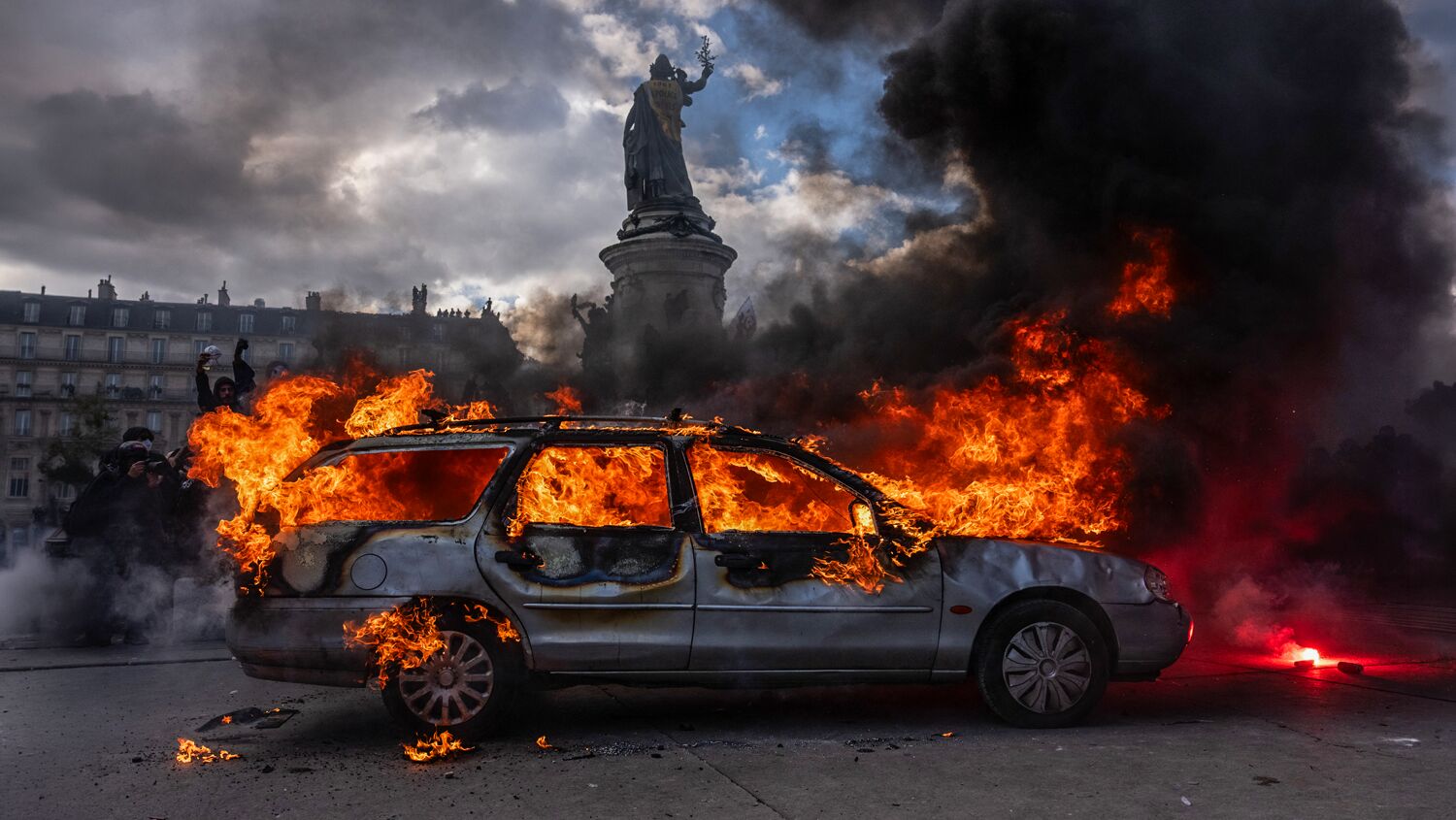
France Is in Flames. So What?
Protesting has been called France’s national sport. So it can be easy to ignore the past weekend’s unrest in Paris and other major cities. But this is much bigger than France’s standard weekend.
- Police made 2,300 arrests.
- Almost 1,000 security personnel were injured.
- Around 1,500 businesses were looted or vandalized.
- In Limoges, over 200 miles from Paris, the 19th-century town hall burned down.
This is not a standard protest. It took the yellow vest protest movement, which grabbed headlines worldwide from 2018 to 2020, 16 months to hit those kinds of numbers.
Initially, authorities said it was a “miracle” no one died. Now we know two did: one had a seizure during the protests; another fell off the Arc de Triomphe. One Paris resident wrote in the Telegraph:
Friends who lived near the worst of the violence, near Place de La République, reported that the scene looked like a war zone, that they were afraid to go out, but they were choking in the living rooms and kitchens from the tear gas and smoke that penetrated their 19th-century buildings.
Protesters on Saturday included:
- Students demanding more funding in education
- The radical left
- Trade unions
- A revived “yellow vest movement” once again protesting high food prices and cost of living
That evening, far-left protesters and migrants began smashing and looting shops. Luxury stores like Louis Vuitton and Christian Dior were stormed.
France had the worst protests, but masked rioters looted shops in Milan, Italy. Police used tear gas against copycat student protests in Belgium.
Other European countries had entirely separate protest movements. Sky-high house prices were the main grievances in Spain and Portugal.
All of Europe is reaching a crisis point. A growing number of journalists and politicians can see it.
- “[T]he whole of Europe—not just France—has a cancer, of which violence and decay are merely the symptoms,” Tim Stanley wrote in Daily Telegraph.
- France is suffering “a form of insurrection” and a “kind of urban guerrilla warfare,” wrote French Minister for Urban Affairs Vincent Jeanbrun.
- “The big question hanging French politics right now is whether these protests will turn into a broader insurrection against the Fifth Republic and the establishment that sustains it,” wrote Eurointelligence.
The protests are just one symptom of one crisis. Eurointelligence wrote:
The executive is facing a poly-crisis: a political crisis, a fiscal crisis, an energy and cost-of-living crisis, and now a security crisis. Economic growth is eroding in France at a moment where it would need it the most. If this goes on, who wants to invest in France? The state finds itself under attack.
All of Europe is straining, hence the different protests for different reasons in different countries. What is the one common problem? Leadership.
Europe is ultimately facing a leadership crisis. The eurocrisis began in 2008. The migrant crisis kicked off in 2014–15. The supply chain crisis and the fall of European industry got started after covid-19. Russia’s full-scale invasion of Ukraine in 2022 began an energy crisis. This year’s war with Iran kicked it up a notch.
These crises have been managed but not solved. The cumulative effect is a Europe where economies stagnate, costs rise, and real income falls. Governments cannot give the benefits their citizens expect nor fund the military power they need.
They have borrowed huge amounts. They have shifted migrants around and pressured the press not to report on the latest outrages. They have used up energy reserves and are heading into winter with empty tanks.
Eurointelligence grasps the scale of the crisis: “Europe’s unique economic and social model, as well as its democracy, is much more dependent on economic growth than people thought.”
Just look at France. It has cycled through five governments since 2024. All see the economic crisis, but no one has been able to push any budget cuts through Parliament. Every year the problem gets worse.
And it gets harder for democracy to solve. The political movements benefiting from the riots are the far left and far right. The Communists support them and are benefiting from the growing anger. The far right calls for law and order and backing the police. Votes are spread across a broad range of parties, and there’s no majority behind any bold action.
French President Emmanuel Macron typifies the problem. Appearing on tv to address the nation in the wake of the crisis, he announced … nothing. There’s nothing he can do, no measure he can get through Parliament.
Eurointelligence wrote:
What we can say with certainty is that this state of affairs is not sustainable. As with all things that are unsustainable, they are either made sustainable, or they end. Some big disruptions lie ahead.
Europe as a whole has two paths ahead. Slow decline followed by sudden collapse is the default.
But so many times in history, when Europe faced collapse, a strongman stepped forward.
Europe’s current crop of leaders is unequal to the task. But democracy is becoming fragile. Someone could be willing to break it to confront the crises.
History alone gives reason to expect this outcome. But Bible prophecy confirms it.
For years we’ve published cover articles about the rise of a strong leader to dominate Europe. Europe’s need for such a strongman is clearer than ever.
“The stark reality is, without such a man in charge, Europe will never become the superpower it wants to be!” wrote Trumpet editor in chief Gerald Flurry in one article. “As much as they talk about building a unified military, the EU as currently constituted cannot rise to the intensifying challenges of a post-American world!”
He continued:
Europeans are facing great crises, including economic instability, terrorism and illegal immigration, rising threats from Asia. In times of crisis, people are less concerned about democratic norms. They need strong leadership. That has to come from Germany, which dominates and even domineers Europe today. It is the powerhouse.
Revelation 17 is just one of many Bible prophecies that describe this coming superpower. It says 10 kings will give their strength and power to one empire (verses 12-13). Europe is already rising as a new form of multinational empire. It will soon shrink down to 10 nations led by one strongman.
This leader must appear soon, or Europe will be lost. To learn more about what the Bible says about his rise, read our Trends article “Why the Trumpet Watches the Rise of a German Strongman.”


