

Germany to Become a Satellite Superpower?
Satellites will be key to dominating the next global war. They can see and analyze nearly everything on Earth instantly, including military movements. They can provide secure communications and detect incoming strikes.
The fate of a nation depends on its satellite program.
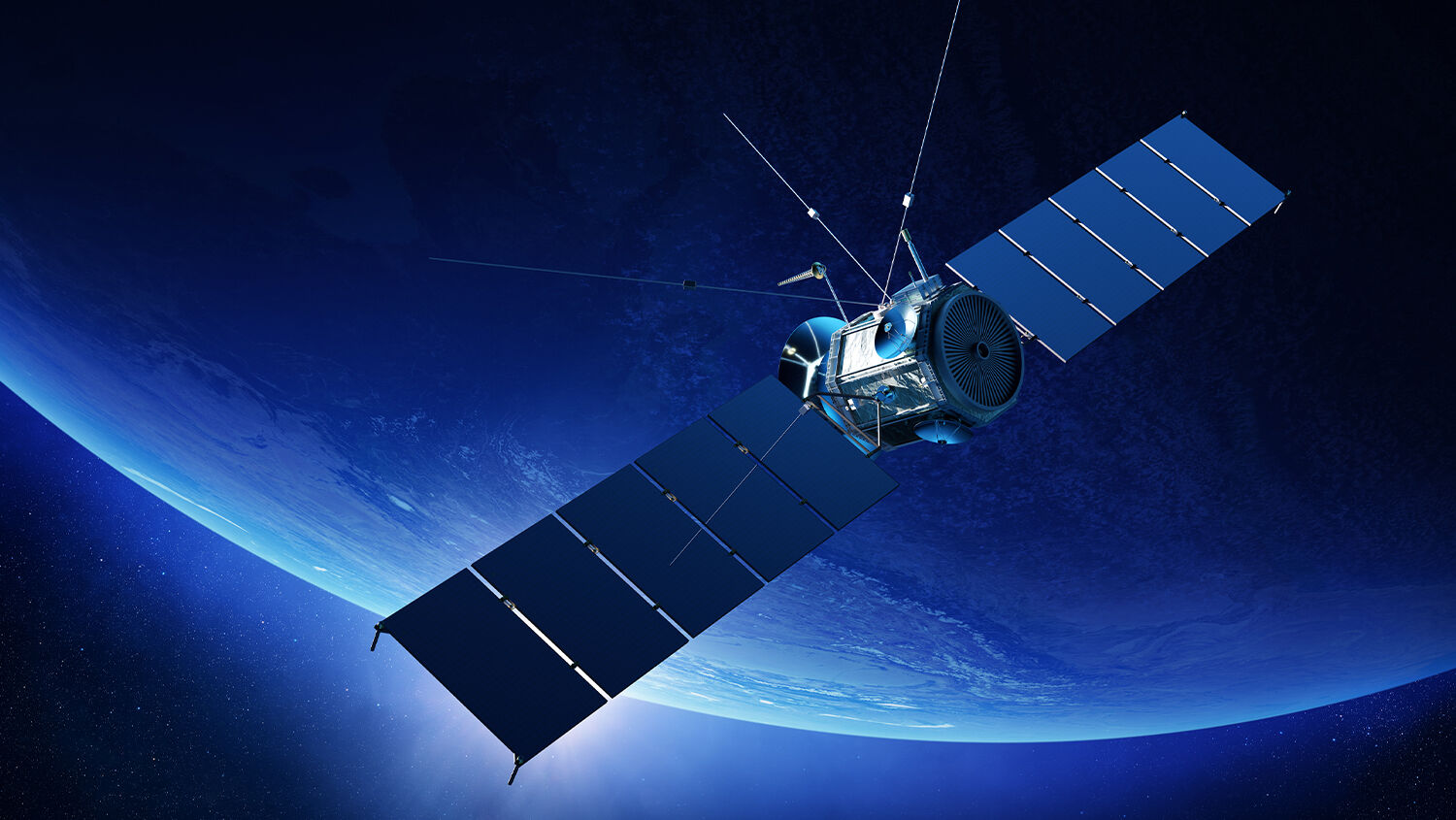
The German Army has secret plans to launch between 1,000 and 1,200 spy satellites into space, Handelsblatt reported last month. These satellites will be used for “the situational awareness of troops, tanks or other objects,” according to Ulrich Walter, a former professor of aerospace technology at the Technical University of Munich.
Only Starlink would possess more satellites.
Other secret documents viewed by German media last month reveal that Germany wants to launch four military satellites as soon as next year. The nation already has eight reconnaissance satellites; what makes the new ones special is at least half would be equipped with antisatellite capabilities.
The $115 million project is termed “Shield and Sword,” representing the capabilities of the four satellites. The two shield satellites can spy on enemy satellites; the two sword satellites can disrupt enemy satellites’ functions. They could be tested as soon as 2027 and are expected to be “combat ready in space” in 2029, according to Süeddeutsche.
As Germany tries to bolster its satellite capabilities, it is also developing the ability to strike down enemy satellites. This is a warning that Germany’s push for space has an imperialistic, offensive edge.
“Spock 2” (Space System for Persistent Operational Tracking 2) is another planned satellite network intended to, according to Heise, “deliver images of a battlefield from space.”
These comprise just part of the $40 billion budgeted to militarize space over the next four years. Although that’s minor compared to the nearly $60 billion America is set to spend on military space projects this year, new technology doesn’t need to be expensive to be effective.
Germany Is Becoming a Satellite Center
Those projects are largely still in the planning phase, but Germany is amassing the means to bring them to fruition.
Rocket Lab, one of America’s biggest space start-ups, valued at $50 billion, announced on August 10 that it had set up a German subsidiary. It already has foreign subsidiaries in New Zealand, Australia and Canada. It is in New Zealand because that’s where it was originally founded, and it offers a good launch site. It’s in Canada partly because it bought a Canadian company. It’s in Australia to profit from expected military spending.
Rocket Lab opened this subsidiary in Germany because of the effort and money being spent on satellites. The August 10 press release said the purpose of the German branch is to support “potential future scaling of Rocket Lab satellite and component manufacturing in Germany to provide sovereign space capabilities to Europe.”
The same press release noted that “the next decade [is] poised for an unprecedented boom in European demand that will see thousands of satellites deployed to commercial, defense and national security needs.”
Planet Labs, another major American space start-up, backed by Google, also has a subsidiary in Germany and is opening its first international factory near Berlin for satellite construction and research.
At the 60,000-square-foot factory, they plan to build Pelican satellites, which offer high-resolution imagery and real-time, artificial intelligence-empowered analysis based on that imagery.
Planet Labs is at the forefront of intertwining AI and satellites. ceo Will Marshall told Karl-Theodor zu Guttenberg in an interview last month that AI and space are “getting married right now.”
This means Germany is getting access to those cutting-edge, AI-powered satellites.
There are also German space start-ups, such as Isar Aerospace, that are working closely with traditional German defense companies like Rheinmetall to transform Germany into a major military satellite operator.
Where Will This Lead?
This push for satellite sovereignty is not new. It’s not just because the United States appears unpredictable under the Trump administration. Germany has been working toward satellite sovereignty for decades, often under the cloak of the European Union’s Galileo satellite program and iris2.
Germany wants to become a dominant power again, and power in space is crucial to achieve that goal.
Its efforts are accelerating because the apparent U.S. volatility has given the perfect excuse and because launching satellites has become much cheaper and much more important in warfare.
In that same interview with Guttenberg, Marshall stated, “[N]ow, with launch costs coming down and number of satellite costs coming down orders of magnitude for the same capability, you’re seeing an explosion of capabilities.”
If Germany can become a major player in the satellite realm, it can pivot from reliance on America and use that prowess to potentially disable much of America’s defenses while empowering its military.
Germany’s satellite race is not just about independence from America; it’s about destroying America.
For decades, the Trumpet has pointed to America’s reliance on technology like satellites as a weakness. This is based on a prophecy in Ezekiel 7:14: “They have blown the trumpet, even to make all ready; but none goeth to the battle ….”
Germany has used its military prowess and technological advancements to threaten Western civilization twice in the last century. According to Bible prophecy, history will repeat itself. To understand how this will affect you, read our Trends article “Why the Trumpet Watches Europe’s Push Toward a Unified Military.”


