

America’s ‘Affordability Crisis’
Graduate from high school, get a job, meet a girl, buy a house, start a family. White picket fence. Baby boy, baby girl. For generations, that was the American dream.
For a couple of generations, it became: Graduate from high school, go to college, find a job, meet a girl, rent an apartment, start a family.
Now it has become high school, college, temp job, move back in with parents, live in basement—the American nightmare.
Today, a home, family and good-paying job is barely even a dream for millions of Americans. If you are graduating college this year, you are carrying more student loan debt, facing a tougher job market, and staring at a much more expensive housing market than your father and grandfather ever confronted. Virtually everything is more expensive. And people’s ability to pay has not gone up to compensate. It is having profound impacts on our economy and nation.
Here is the lurid vision facing homebuyers: 75 percent of homes are unaffordable to typical Americans. Personal finance expert Dave Ramsey summarizes this as “The Most Unrealistic Real Estate Market in 100 Years.”
With so many fighting over so few, how much longer before that last 25 percent of affordable houses is gone too?
According to Bankrate, the median-priced house in the United States costs $435,000, which is affordable only to those making $113,000 or more per year. The Federal Reserve Bank of Atlanta says you actually need to earn closer to $121,400.
Most people don’t make anywhere near that much. The median U.S. household—with both spouses working—only earns about $83,000 a year.
According to cbs, that makes the typical U.S. home more unaffordable to the average American than at any point in history.
The dream has evaporated. Those who do take a flying leap and sign a mortgage risk a financial nightmare.
As recently as 2010, people were able to sleep peacefully at night, with 75 percent of homes affordable for the typical buyer. As recently as 2020, almost 54 percent of homes were affordable.
Then came covid-19, the government response, money printing, hedge funds buying single-family homes to rent out, and the average home price skyrocketed 54 percent.
How much have wages gone up during that time? Somewhere between zero and 0.4 percent, according to the Bureau of Labor Statistics.
See the problem?
What if you are just starting out? LendingTree says that fewer than 4 in 10 first-time homebuyers can afford a typical starter home (defined as houses priced around $200,000).
A starter home for $200,000? This isn’t your father’s housing market.
But this isn’t your father’s market for stocks, precious metals, oil, fertilizer and a host of other things that impact your bills.
Since 2020, the Dow Jones Industrial Index is up 87 percent. The Nasdaq is up 173 percent. West Texas Intermediate oil is up 116 percent. Gold is up 171 percent. Lumber is up 40 percent. Potash is up more than 40 percent. Corn is up 23 percent. Sugar is up 52 percent. Pick your commodity. Try to find one that is down in price from half a decade ago. I dare you.
And if you want to eat out? According to MarketPlace, a large fries at McDonald’s is up 73 percent. A Jack in the Box Spicy Chicken medium combo? Up 53 percent. A Chipotle medium veggie burrito bowl? Up 45 percent.
Health-care costs are also up almost 25 percent.
Yes, these values are measured from the 2020 covid-19 pandemic when the prices of many things were low.
Yet even before the pandemic ended, the prices of all these commodities started rising and continued to do so—right along with house prices—even though wages had stagnated.
Why?
Consider the housing market. There are two big reasons house prices have gone up so much since 2020, even though wages have not.
The first is immigration. From 2020 to 2024, immigration, both legal and illegal, surged to record numbers. The immigrant population grew by more than 11 million people since 2020, according to the left-leaning Pew Research Center. In 2023 alone, the number of immigrants grew by 2.4 million. In one year, that increased America’s total immigrant population by about 5 percent. As of 2024, more than 50.2 million immigrants lived in the U.S. As a percent of America’s population, that is the highest level since 1890 when America was giving away free land to homesteaders.
To put this number in context, there were only 8 to 9 million homes built in the U.S. between 2020 and 2026, according to the U.S. Census Bureau. So 2 to 3 million more people immigrated to America than homes that were built during this time.
The second reason house prices have gone up so dramatically is more subtle. And sinister.
In 2020, in the middle of the covid-19 hysteria, the Federal Reserve turned on the money printers. It expanded the total money supply (as measured by M2) by a whopping 27 percent. During that 12-month period, $1 out of every $5 of all the easily spendable money in existence since the founding of the nation was created and put into circulation. This had an enormous impact on inflation.
Economist Milton Friedman repeatedly said that inflation is always and everywhere a monetary phenomenon. When the money supply grows faster than the economic output, prices for everything rise.
We are dealing with the result today. Constantly introducing huge quantities of dollars into existence makes all dollars worth less. That means you need to spend more of them to buy the same amount of goods—or to buy the same house. That is why everything from mortgages to gasoline to coffee costs more than it did six years ago. It is why it now costs the Treasury 13.8 cents to manufacture a nickel.
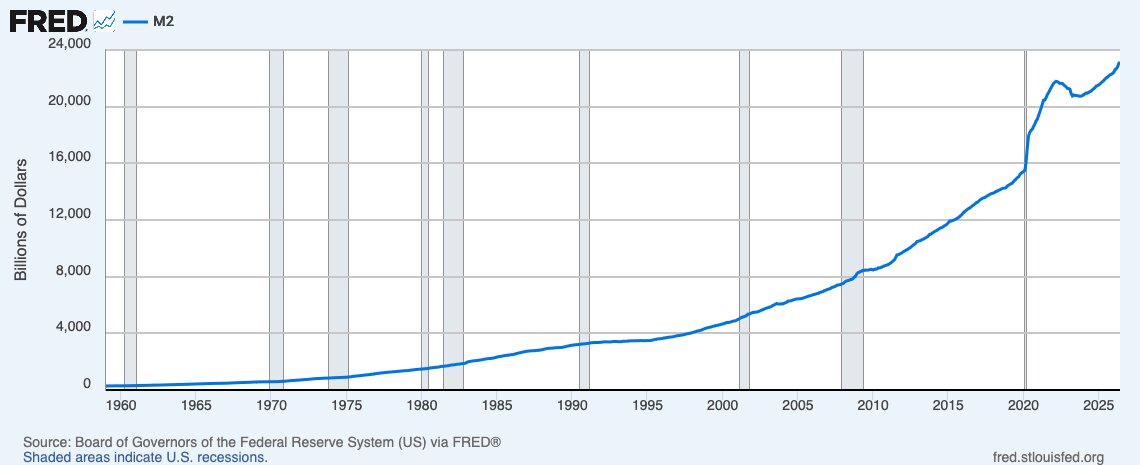
And rising prices might continue because the Federal Reserve is printing money again—at a rate similar to the height of the covid crisis.
If this continues, prepare for your money to be worth much less in the future.
“[E]veryone wants to call it an ‘affordability crisis,’ when really, it’s inflation,” says Kentucky Senator Rand Paul. “And the reason is simple: Washington keeps printing money to cover a $2 trillion deficit it refuses to close. We’re devaluing the dollar every single day to pay for spending we never dared to cut.”
If inflating the money supply causes prices to rise, why did wages stay flat?
Simple supply and demand.
Surging immigration (both legal and illegal) increased the supply of workers. Meanwhile, many states and cities reduced the demand for workers by increasing the minimum wage, incentivizing employers to embrace automation and cut jobs.
Unrestrained immigration coupled with poor policy ruined any chance workers had to see their real wages rise with inflation. Toss in onerous and politically motivated environmental regulation that handicapped manufacturing and resource production, and the average American has had their standard of living eviscerated.
The unaffordability crisis is now also causing problems beyond the white picket fences on Main Street.
Wall Street is starting to feel the stress too. Consider United Wholesale Mortgage. On Thursday, its shares fell by almost 50 percent. It was the largest drop in its history. For the first time in the lender’s 40-year history, it suspended its dividend and reported a loss of $452 million.
What is the company’s problem? People are not buying houses—because they can’t afford them.
The frozen housing market affects a lot of businesses.
For years now, national home builders like D.R. Horton, Lennar Corporation and Pulte Group have been using their credit ratings to help buyers purchase the homes they build. This effectively made it cheaper to purchase a new home than an existing one.
But this comes at the expense of those companies’ balance sheets.
Banks, mortgage lenders, school districts, real estate companies, lumber producers, drywall manufacturers, gypsum miners and many related industries all rely on a healthy housing market.
Husbands, wives and children need a healthy housing market. Little League baseball teams, soccer moms in suvs and teenagers with lawnmowers need healthy housing markets.
Stable housing markets stabilize neighborhoods, allowing people to build long-term relationships. Stable neighborhoods produce communities with higher levels of civic pride, safer streets and lower crime. Stable housing markets contribute to increases in generational wealth and financial security, and better educational outcomes for children.
But the market is unstable.
“Let me add some perspective on this,” says investment manager Martin Pelletier. “In order to go back to 2019 affordability levels, U.S. housing prices need to fall 40 percent or salaries rise 60 percent.”
Which will it be?
If house prices fall, America could soon be facing a different kind of housing problem. One more like 2008.
As credit analyst Rick Rule famously says, “The cure for high prices is high prices.”
Normally, high prices reduce demand and cause sellers to lower prices to make the sale. But according to housing analyst Melody Wright, so far sellers have resisted lowering prices. “Rage delisting has become a trend, where rather than bring down their price, sellers are just taking their real estate off the market, but they can’t do that forever.”
Wright told the Thoughtful Money Podcast that a wave of sellers is going to hit the market. There are huge numbers of frustrated sellers, she says, and eventually they will cave and sell at prices the market sets. “I do believe this is going to likely be worse than what we went through [in 2008 and 2009] because of our demographics and because the institutional investors … kind of bailed us out last time by buying up those homes to do long-term rentals.”
House prices will fall so much that Wright says it will lead to a foreclosure crisis. She envisions a situation where state attorneys general will need to institute foreclosure moratoriums like they did during the Great Financial Crisis. As the foreclosed homes pile up, Wright says the Federal government will face pressure to step in and even purchase homes to try and stabilize the market. She points to programs already active in places like Rochester, New York, where private-public partnerships are buying up whole blocks of distressed and blighted properties.
“[J]ust know, there will be a regulatory cycle, there will be a regulatory response,” says Wright. “I spent many of my years trying to save the financial system … but nothing has changed.”
From American dream to American nightmare, America’s boom-and-bust economy is becoming a curse on the nation. For some, the white picket fence has meant family, community, stability and financial freedom. For others, it has meant frustration, foreclosure, financial pain and suffering. For some, it is nothing more than a faded dream.
The author of Psalm 127:1 wrote: “Except the Lord build the house, they labour in vain that build it: except the Lord keep the city, the watchman waketh but in vain.”
America’s affordability crisis is a sign God is not blessing America. When 65 percent of households cannot afford a median-priced home, that is a national curse. When it takes both dad and mom working to afford an apartment to live in, that is a curse. And national curses are correction from a loving Father who wants to get our attention—so that we change our ways and be blessed.


