
Can Science Deliver Immortality?
From ancient alchemists trying to discover the elixir of life to the fantastical legends of conquistadors searching for the fountain of youth, the pursuit of immortality has consumed mankind’s ambitions for millenniums.
Today, many are consulting a different kind of “magic”: science.
Interest in longevity is soaring. Biotech firms like Altos Labs, backed by Jeff Bezos, and Calico, funded by Google, have poured billions of dollars into “cellular reprogramming,” attempts to reset aging cells back to a younger state. Scientists are running clinical trials on repurposed drugs like rapamycin and metformin, hoping decades-old medications might double as anti-aging treatments. Wearables and at-home blood tests now promise to calculate your “biological age” down to the year.
Analysts expect the longevity industry to top $30 billion globally this year alone, and the promises keep getting bolder: not just slower aging, but reversed aging—and some few dream, an end to aging altogether.
Could such scientific work actually yield immortal physical life?
The Pioneers
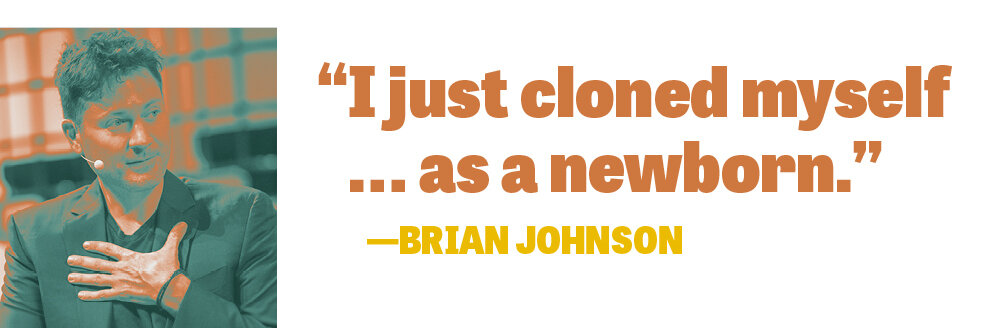
Bryan Johnson is the millionaire famous for experimenting on himself to reverse aging—strict diets, daily exercise, blood plasma transfused from his teenage son. Most recently, he announced July 21 on social media: “I just cloned myself … as a newborn.” He claims “this baby-Bryan lives in a petri dish for now” and can be used to someday harvest its cells, blood and organs for his own rejuvenation. (Contrary to his own hype, the “clone” is more accurately described as culturing some of his own cells and experimenting on them to reverse cellular aging.)
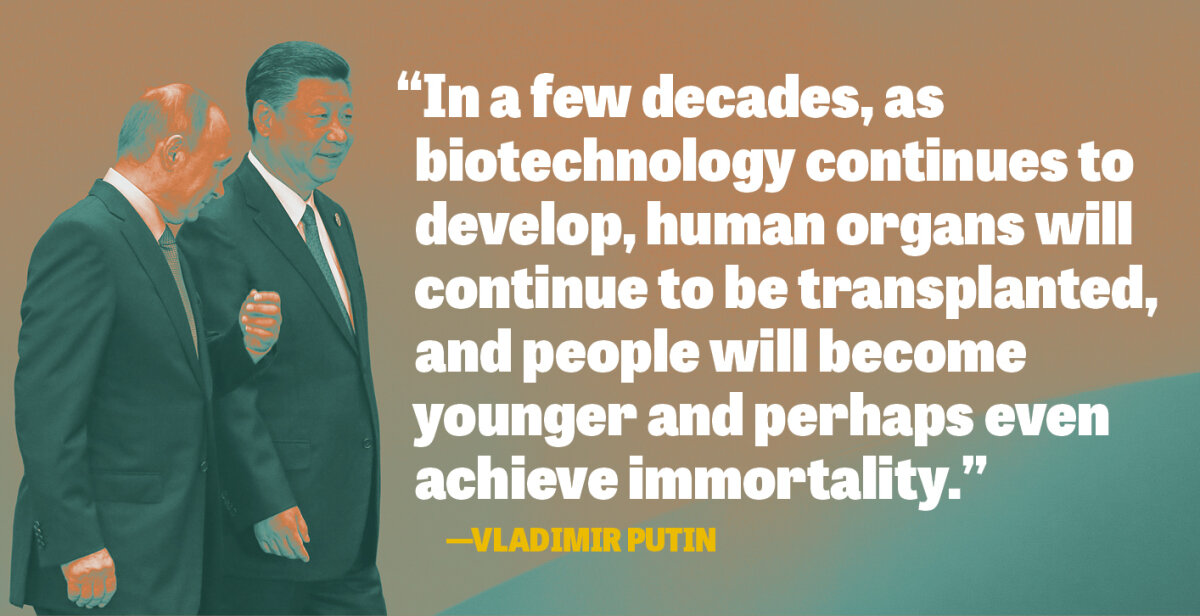
While visiting China last year, Russian President Vladimir Putin was caught on a hot mic telling General Secretary Xi Jinping, “In a few decades, as biotechnology continues to develop, human organs will continue to be transplanted, and people will become younger and perhaps even achieve immortality.” It wasn’t an offhand comment. Putin is very serious about discovering a cure for death. Russia has poured roughly $26 billion into a state program aimed at defeating aging by the end of the decade. A May 28 Wall Street Journal report claims the government is investing heavily in gene therapy meant to slow cellular aging, and is 3D-printing living tissue and growing human-compatible organs inside genetically modified mini-pigs. Researchers claim to have already printed human cartilage and a mouse thyroid gland and are aiming for organ replacement by 2030.
One controversial figure in the anti-aging movement is Italian surgeon Sergio Canavero. In 2017, he claimed he would perform the world’s first attempt at a human head transplant, attaching a healthy head to a body that would reanimate. Valery Spiridonov, a Russian paraplegic, volunteered for the project but later backed out. Thus far, it appears Canavero has yet to find another volunteer to have his or her head lopped off.
Scientist Ray Kurzweil, a pioneer in technologies like machine speech recognition, has been advocating for advancements based more on machine enhancement. One idea is to upload human consciousnesses into computers. Israeli historian and bestselling author Yuval Noah Harari predicts that current technological trajectory will eventually enable such a scenario. Harari is no fringe scientist: He has sold 50 million copies of his books in 65 languages.
Scientific investigations into longevity and immortality are attracting a lot of attention and money. Yet the “eternal life” some of these figures are promising doesn’t sound so desirable. Harvesting organs from pigs or from your own clone? Sewing your head onto a cadaver? Uploading your mind to the cloud?
Even if you had the money and scientists had the ability, is this a future worth hoping for?
Is Science Missing Something?
Nobody wants to die, but most of us are too cavalier about caring for the bodies God gave us. Inhabiting perishable bodies, living in an ephemeral world, we pretend life is permanent.
Then, rude reality intrudes. Our bodies age and fail. Our families suffer loss. Our friends die. And still we are loath to face it. Even in intensive or hospice care, where the end of life hangs in the air, the words die, dying and death are almost never uttered.
Christ came “that they might have life, and that they might have it more abundantly” (John 10:10). We should obey God’s health laws by disciplining ourselves to eat nutritiously, exercise, sleep well, avoid injury and obey other cause-and-effect principles that produce good health. The more moderate elements of the longevity industry are promoting these kinds of practices, and rightly so. They encourage us to make choices that prioritize long-term benefits over unhealthy, short-term pleasures. There is definite merit to that.
What far too many of us do instead is live how we please and then, after getting walloped by the consequences, hunt for quick fixes. And science, more and more, is promising to provide those.
Doctors are applying the utmost of their intellectual and creative powers to pursue the fundamentally benevolent goal of giving individuals a valuable, albeit fleeting gift: more years of precious life. More years to deepen relationships, to create memories, to share wisdom, to dare exploits, to fulfill dreams.
At the same time, most recognize that it is impossible to defy human mortality perpetually. We have no power to truly heal ourselves. And in many cases, our medical treatments, trading one set of symptoms for another, actually harm patients, diminish quality of life, and in tragic irony, hasten death. Thus they, along with patients and their families, confront agonizing choices about how much therapy to administer, treading uncertain ground, guided by probabilities and feelings.
Modern medical advances have clearly given years—of varying degrees of quality—to many people. At the same time, these advances have enabled us to put off the fundamental questions that our mortality raises. With death looming, we become preoccupied with essentially material concerns: options, trade-offs, treatments, schedules, odds. For so many, the last days of life are spent not in peace, but in struggle. Ultimately, that “rage against the dying of the light,” as poet Dylan Thomas put it, always ends in defeat.
There is something remarkable, even noble, in this near-universal quality among people and all living things: We want to preserve the spark of life we possess. God intended man to live an abundant life (John 10:10) and He wishes that man take great care of his health (3 John 2). But trying to defy death altogether takes one into a whole new realm of circumstances. And when that becomes a religion itself, we lose the plot.
You Can’t Outrun Biology
In July, Bryan Johnson revealed that he has been diagnosed with autoimmune gastritis, saying, “my stomach is eating itself.” The condition is rare and incurable. Johnson admitted, “[S]tandard medical care concedes defeat, stating that nothing can be done except managing the condition.”
This man has invested a fortune in not dying, about $2 million a year. He is ruthless with his scientifically optimized nutrition, including 54 pills he takes each morning. A helmet-like device tracks his biomarkers; he gets routine bloodwork on his ferritin, iron and vitamin B12. Still, his own body was quietly destroying itself from the inside, and he doesn’t even know how long it has been happening.
Johnson posted: “Been thinking things over and wonder if I’ve taken this whole longevity thing too far.”
Now he’s on to something. Here is a man with more resources, information and motivation to defeat aging than virtually anyone alive, and his own stomach won’t cooperate.
The reality is, God built an expiration date into every physical body (Hebrews 9:27). No amount of money or expertise changes that. It can be delayed, sometimes, but never canceled.
While not as extreme as men like Johnson, Putin or Canavero, many of us go to great lengths to preserve our physical existence. When advanced age or serious health trials hit, the temptation increases to take more radical measures, even if it means a severely degraded standard of living in exchange for a few more months on the respirator, for example. Our lives can be reduced to focusing on just one more session of treatment, just one more surgery.
Modern science promises a kind of immortality. It suggests that our energies, thoughts and money are best put toward employing every means to extend physical existence as long as possible. This is fiction. If we are not careful, this fiction can preempt the important spiritual concerns that should dominate our thinking, even our decision-making, as we contemplate the inescapability of death.
Vladimir Putin claims to be an Orthodox Christian. He encourages church involvement in state affairs, takes part in religious rituals, and brands Russia as the Christian opposition to Western godlessness. But he started his career in the atheistic Soviet Union’s secret police, which suggests he is actually an atheist who is using religion as a tool to enforce his rule. He seems to have more faith in pig organs than in the God of the Bible or even his own priests.
Sadly, many people who call themselves Christian make roughly the same decisions, placing their trust in science rather than allowing questions surrounding mortality to drive them to contemplate their relationship with their Maker.
There is tremendous peace in recognizing and understanding the value of the spiritual over and above the physical. What, after all, is the real purpose of life? Using every possible means to stretch it for a few more years does nothing to answer that fundamental question.
A May 2025 Pew poll suggests 70 percent of Americans are certain or near certain about life after death. But just what that might be remains shrouded in mystery for many people. They simply have never closely examined the subject. Maybe they are afraid to.
Real Abundant Living
“If in this life only we have hope in Christ, we are of all men the most pitiable,” the Apostle Paul wrote relatively early in his ministry (1 Corinthians 15:19; New King James Version). At the end of his life, he wrote: “For I am now ready to be offered, and the time of my departure is at hand. I have fought a good fight, I have finished my course, I have kept the faith: Henceforth there is laid up for me a crown of righteousness, which the Lord, the righteous judge, shall give me at that day: and not to me only, but unto all them also that love his appearing” (2 Timothy 4:6-8).
Paul longed to live, just as we all do. But what he alluded to was not an empty hope of extending his physical life—but the true hope revealed by God in the Bible. It includes understanding God’s wonderful purpose for creating man mortal and subjecting us to the trials of the flesh—an experience that He even put the other eternal God Being through (e.g. Hebrews 2:9).
Jesus Christ promised to give living water that “shall be in him a well of water springing up into everlasting life” (John 4:14). He was speaking of the Holy Spirit, the power of God, which He makes available to human beings upon repentance and baptism (Acts 2:38).
That Spirit is called “that holy Spirit of promise, [w]hich is the earnest of our inheritance …” (Ephesians 1:13-14)—that of eternal life. That is God’s guarantee in Scripture.
The gift of a joyous afterlife is a central teaching of Christianity. This theme is prominent from the Bible’s beginning, when Adam’s disobedience led God to cut man off from the tree of life (Genesis 3:22-24), to its end where it speaks of the tree of life being made available to all people (Revelation 22:1-2).
Eternal life is the prerogative and glorious gift of our Creator!
God never intended for men to live forever physically because it would not be good for men to live forever physically. The late theologian Herbert W. Armstrong wrote in Mystery of the Ages: “At that very foundation of Satan’s world it was also decreed (Hebrews 9:27) that God had appointed that all humans should die once, and after that, by resurrection from the dead, would come the judgment. Meanwhile mankind as a whole would not as yet be brought to judgment—neither condemned nor saved. It was at that time decided that as in Adam all humans should die, so in Christ the same ‘all’ should be brought back to life by a resurrection to judgment (1 Corinthians 15:22).”
The Bible reveals that God’s purpose is to bring humanity into His Family! It’s an existence of such joy that the material world could never compare with it. Christ said, “It is the spirit that quickeneth [gives life]; the flesh profiteth nothing: the words that I speak unto you, they are spirit, and they are life” (John 6:63).
Mr. Armstrong wrote, “Philosophers think of human worth as of supreme value in itself alone. They speak of ‘human dignity.’ … Much to the contrary, the sole value of human life lies in the human spirit and the potential of being begotten of God, later to be born very God, a child in the God Family. …
“Therefore, man of himself is infinitesimally of less value than the self-professed wise of this world suppose. But, once begotten by the Supreme God through the very life and Spirit of the living God dwelling in him, a human being’s potential is of infinitely greater value than the world has understood” (ibid).
None of us can outrun our own biology. The true hope of Scripture is not about the “miracles” of medical intervention. It is the promise of resurrection. It is the promise that, “as in Adam all die, even so in Christ shall all be made alive”—and that ultimately, “[t]he last enemy that shall be destroyed is death” (1 Corinthians 15:22, 26). Human death means nothing to God except a temporary sleep (verses 51-55), because God can resurrect humans from the grave!
In whom do you put your trust for immortal life? Is it in a mad scientist who offers surgeries and chips in your brain? Or is it in God who created you to have eternal life together with Him?