
Think Like a Pilgrim, Plan Like a King
In late 1620, William White stepped off the Mayflower into the freezing water off Cape Cod. As my family tells the story, there were not enough boats to bring everyone ashore dry, so he waded in and carried his two sons: 5-year-old Resolved and baby Peregrine, born aboard the ship while it lay at anchor. The boys reached land warm. Their father caught the cold that killed him. He died on Feb. 21, 1621.
[BRIEF]
I am a 14th-generation descendant of William White. He never saw the country his sacrifice helped build. But that was never what he was looking at. His eyes were on his children and on theirs.
That vision is the subject of a book that has been on my mind. In yesterday’s episode of Trumpet World, I spoke with Austin Ruse, author of Not Just for Kings: Cultivating a 500-Year Vision for Your Family. His argument is simple and badly needed: Ordinary families can think in centuries, just as kings do.
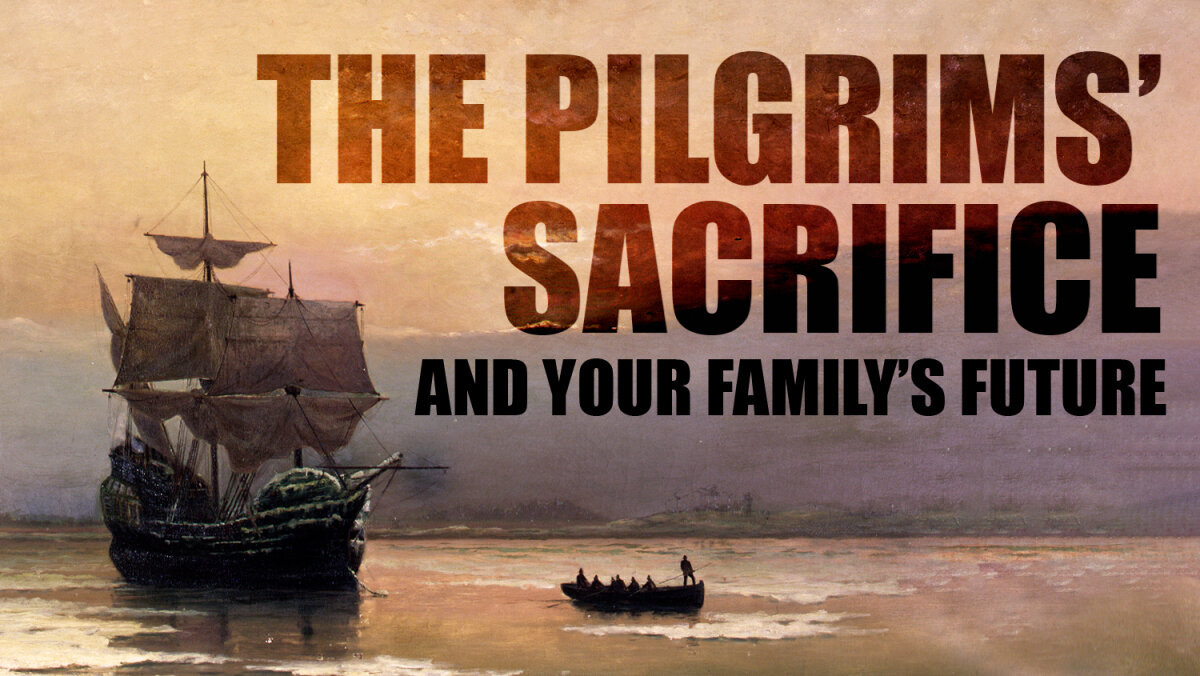
Our ancestors “were in fact not aristocracy,” Ruse told me. “They were regular folks, you know, who got on leaky boats and came over here—terribly brave and heroic people.” He meant it as high praise.
Think about what those regular folks did. The Pilgrims sailed from England on Sept. 6, 1620, knowing storms lay ahead, and spent 66 days at sea. My ancestor’s family had already left England for the Netherlands to worship freely. Family tradition says Resolved was named for the group’s decision to go to the New World. Half the company died that first winter. Yet the survivors built something that lasted.
They also wrote it down. After William died, his widow, Susanna, married Edward Winslow, whose own wife had died that March. Their wedding on May 12, 1621, was the first in Plymouth Colony.
Winslow raised my ancestor. He also kept the record. In December 1621, he wrote to a friend in England about the harvest celebration we now call the first Thanksgiving. His is the only eyewitness account that survives. He described Massasoit arriving “with some 90 men, whom for three days we entertained and feasted.” That spring, the Pilgrims and Massasoit made a peace that held for more than 50 years.
Then Winslow wrote a line I love: “And although it be not always so plentiful as it was at this time with us, yet by the goodness of God, we are so far from want that we often wish you partakers of our plenty.”
These people had buried half their friends. And their response was gratitude.
That is a family legacy worth passing down—and I know the story because Winslow picked up a pen and wrote it down.
That is the gift Ruse wants every family to give. The heart of his book is 10 secrets. The one that struck me most is saga. “That is knowing the family story and passing it along,” he said.
I’ve always enjoyed old Norse sagas like the Heimskringla, which traces the ancestors of the Scandinavian kings from the region of the Black Sea to Scandinavia. These sagas have strengthened my faith that the American and British peoples descend from the lost tribes of ancient Israel, so I am glad they were recorded. A saga is what turns a list of names into a family story worth honoring.
Many American families have lost their own saga. Many are good homes; they just don’t stress family history. People are often surprised that I know the names of my great-great-grandparents. Most of us remember our parents and grandparents, but two or three generations further back, the names are gone. If no one takes the time to build a sense of honor for the family’s history, it is simply forgotten.
Ruse’s own saga includes an ancestor named Aaron Ruse, who joined General Washington’s army at age 14 and was present at the British surrender at Yorktown. “I would not have known that story except for the work that other people have done,” Ruse said, “and it’s a story that I will pass along.”
You don’t need children of your own to do this. I don’t have children yet, but I spend a lot of time with my two nieces and my nephew. Ruse pointed out that I can keep the family story alive through them.
None of this is about making ourselves famous. “It’s unhealthy to live with a view to being remembered as a great person,” Ruse writes. “A 500-year family history isn’t about you; it’s about them.” It is about the ancestors who suffered for us, and the descendants who will want to know where they came from.
“Oh, how you wish that your ancestor Mr. White had written his story down,” Ruse said to me. I wish that too. I know about William White because his neighbors wrote things down. But I don’t know what went through William White’s mind before he signed the Mayflower Compact. He didn’t write it down.
Ruse mentioned Ecclesiastes during our talk: “The thing that hath been, it is that which shall be; and that which is done is that which shall be done: and there is no new thing under the sun” (Ecclesiastes 1:9). Thinking in centuries is not a new idea—it is an old one we can take back.
That is what Thanksgiving is for. “Thanksgiving is gratitude for those who went before us and suffered greatly and carried on and kept this thing going,” Ruse said, “of our country and of our families.”
The Pilgrims got their name from William Bradford.
Writing about the day they left Leiden, he said, “They knew they were pilgrims,” borrowing a word from Hebrews 11. That chapter describes Abraham and his family this way: “These all died in faith, not having received the promises, but having seen them afar off, and were persuaded of them, and embraced them, and confessed that they were strangers and pilgrims on the earth” (Hebrews 11:13).
William White died the same way: He never received what he crossed the ocean for, but he saw it afar off.
Abraham did more than look ahead—he taught the next generation. God said of him, “For I know him, that he will command his children and his household after him, and they shall keep the way of the Lord, to do justice and judgment; that the Lord may bring upon Abraham that which he hath spoken of him” (Genesis 18:19). God tied His promises to Abraham’s faithfulness in teaching his family.
Thousands of years later, Abraham’s saga is still being told. That is the kind of pilgrim worth imitating. Start your family’s saga today. Five hundred years from now, someone may look back and thank you.
Stocks Sink as AI Sell-off Resumes
Wall Street had a rough day yesterday as the Nasdaq index fell about 4 percent and the Dow Jones Industrial Average dropped more than 700 points. Investors sold AI stocks after high inflation data and new U.S. tariffs. The drop erased Monday’s rebound and raised doubts about the resilience of the ongoing AI boom.
- Investors are no longer just nervous about AI. They’re now worried about the broader economy.
- Alphabet, Amazon, Meta, Microsoft and Oracle have borrowed a combined $326 billion this year to build AI data centers, about triple what they borrowed last year. The interest rate hikes expected in December and January would make that debt more expensive to pay off.
Debt isn’t the only strain. AI is clearly a world-changing technology, but the massive demand for electricity to run data centers is already pushing power prices and straining grids. Building new data centers also faces constraints in land, materials, labor and permitting.
- Many businesses are still investing in AI without clear ways to measure financial returns, which makes these shortages especially risky.
The AI boom could mirror past bubbles like the dot-com bubble, the Bank for International Settlements (bis) warned in June, saying that a bust could lead to a recession. The dot-com bubble sent Internet stocks soaring until March 2000, when the Nasdaq lost 78 percent of its value.
- Many of the Internet companies that went public in the late 1990s were out of business or delisted by the end of 2002. The Internet did change the world, but the investing frenzy caused huge financial losses. That cleared the way for survivors like Amazon and Google to dominate.
Most technological revolutions create an early bubble that wise investors expect. But the bis is also warning of three other economic risks: inflation, fragile bond markets and soaring government debt. Any of them could make the bursting of an AI bubble especially painful.
- The U.S. national debt is about seven times bigger than it was during the dot-com bust.
Herbert W. Armstrong predicted that a financial crisis in America would likely push Europe to unite. Specifically, he warned in 1984 that a massive banking crisis in America “could suddenly result in triggering European nations to unite as a new world power larger than either the Soviet Union or the U.S.” The bis now warns that an AI bust could spread throughout the financial system.
Germany to Acquire Ukraine Battlefield Command System
Germany will become the first country to gain access to Ukraine’s delta battlefield command system, a letter of intent signed by the countries’ defense ministers in Berlin on Tuesday states. This development is about growing cooperation in defense production, data sharing and battlefield technology.
The delta agreement allows Germany to adapt and further develop the battle-tested technology for its military, while Ukraine retains its own combat data. Germany first tested the system during an exercise focused on modern warfare in October.
The two countries are a perfect match for further developing military technology. Ukrainian Defense Minister Yevhenii Khmara said:
Ukraine has technological solutions tested at the front. delta is a unique digital platform that combines planning, operations management and situational analysis. German technological expertise will help develop and scale the system’s capabilities.
Growing cooperation:
- In April, the two countries signed a defense data-sharing agreement that allows Germany access to selected Ukrainian battlefield data.
- In May, the two launched a joint initiative called Brave Germany, aimed at developing defense technologies and supporting innovative start-ups.
- In October, Germany announced the planned establishment of its first drone regiment based on lessons learned from its partnership with Ukraine.
Preparing for future wars: Politico reported on November 19:
After years of supplying Kyiv with weapons and military aid to fight Russia, Berlin is increasingly turning to Ukraine for the battlefield experience and technology it needs to modernize its own forces. That gives Ukraine a new role: not just as a recipient of Western military support, but as a defense partner helping shape how Germany prepares for future wars.
The Bible prophesies that Germany will fight future wars and, as Trumpet editor in chief Gerald Flurry explained in “Germany Is Arming for World War III,” shock the world. Germany’s military advances on the foundation of Ukrainian blood is a stark reminder that this nation has not given up its military ambitions.