
The Feminization of Everything
Imagine showing today’s America to your great-grandfather.
He would see law schools, medical schools and newsrooms run mostly by women. He would see millions of able-bodied men in the prime of life who have stopped looking for work, many of them living with their parents and spending their days in front of screens. He would see courts allowing violent criminals to walk free because their stories are sad. He would see marriage collapsing, birth rates at record lows, and millions of single adults saying that even if they find their perfect match, they want to stay single.
He would ask you one question: What has happened to the men?
It’s a good question. What we are witnessing is unprecedented in human history. It is exactly what an ancient prophecy in your Bible foretold—and that prophecy reveals both the cause and the solution.
The Great Feminization
Some observers have a name for this shift: “the Great Feminization.” The phrase was coined in 2019 by a blogger who writes as J. Stone. He argued that as women moved into the professions that shape culture—law, academia, journalism, publishing—they brought their distinctive priorities with them: empathy, emotional sensitivity, avoidance of conflict, protection of the vulnerable. Those priorities, he said, explain much of the social change of recent decades.
The trend is irrefutable. In 1979, women became a majority of undergraduate college students. Medical schools and the college-educated workforce became majority female in 2019. Women are now the majority in human resources, psychology, veterinary medicine and pharmacy. They dominate public-school teaching, nursing and social work. They make up 55 percent of the New York Times staff and nearly 80 percent of the publishing industry.
This is a unique historical experiment, Helen Andrews wrote last year in Compact: “Other civilizations have given women the vote, granted them property rights, or let them inherit the thrones of empires. No civilization in human history has ever experimented with letting women control so many vital institutions of our society …. Even where women do not hold the top spots, women set the tone …, such that a male ceo must operate within the limits set by his human resources vp” (Oct. 16, 2025). The effects on society are profound: These institutions are coming to prize the priorities women tend to hold—and are changing in dramatic and dangerous ways.
Not surprisingly, this thesis sparked swift, emotional backlash. Critics called it misogynistic, a way to blame women for all that is wrong with the modern world. They accused the author of crude stereotypes and of ignoring the harm done by institutions run by men. Some argued that feminization hasn’t gone far enough.
Yet much of the pushback acknowledged the fundamental premise: that men and women think differently, which means we do our jobs differently.
Men Thinking, Women Thinking
It has become politically incorrect to say men and women are different. Ironically, many of the people who get upset at the suggestion that men tend to think this way, women that way, are the same people who say the world would be better off if women were in charge.
The truth is, there are differences—plenty. Start with biology, which extends well beyond the reproductive domain: The average woman is almost 5 inches shorter and more than 30 pounds lighter than the average man, with roughly 40 fewer pounds of muscle. Men have larger frames and are physically stronger and more aggressive. They have larger voice boxes, which give them deeper, more commanding voices.
Obvious factors like these are matched by mental, emotional and temperamental distinctions. “The human brain is a sex-typed organ,” says neurobiologist Larry Cahill of the University of California–Irvine. “To some appreciable degree, these brain differences have to translate to behavioral differences.” As Herbert W. Armstrong wrote in The Missing Dimension in Sex, “The female sex hormones cause a woman’s body and mind to be feminine. The male sex hormones cause a man’s body and mind to be masculine.”
Yes, they do. Many surveys show that women generally prioritize care and protection from harm more than men do. They tend to more strongly support gun control and social welfare spending, and are less keen about military force and the death penalty. They are more willing to trade individual freedom for safety or inclusion. They prefer cooperative social relations, and on personality tests, they score higher on agreeableness. Men, on average, are more comfortable with conflict, competition and impersonal rules applied regardless of outcome.
These are general tendencies, of course; individuals vary, just as they do in height and strength. But the patterns are real.
As we will see, these patterns do affect our institutions when women are in charge. But the question the Great Feminization thesis doesn’t address is why men and women differ in these ways. The answer points us back to the first book in the Bible.
Created Male and Female
Genesis 1:26-27 describe God creating human beings: “And God said, Let us make man in our image, after our likeness …. So God created man in his own image, in the image of God created he him; male and female created he them.” This is extraordinary: God is neither male nor female, yet He made two categories of humans, both in His image. This was no fluke; it required careful deliberation with strategic purpose. God distributed His qualities and attributes between the sexes so that each reflects part of His nature, and together they reflect more of Him than either does alone. Men tend to manifest certain aspects of God’s character, such as strength, ambition and decisiveness. Women tend to manifest other godly traits, like nurturing, sensitivity to others and attention to detail (sidebar, page 11).
Each of these tendencies is a strength—and each needs its counterpart. When the two come together, they complement and balance each other. Separate them, let one set operate without the other, and things go wrong. Rules applied without compassion can become harsh, even cruel; compassion without firm rules can excuse almost anything. A group that avoids all conflict never confronts its real problems; a group that thrives on conflict tears itself apart.
The woman brings different priorities and goals into her work than the man. And when women dominate an institution, they feminize it—and society with it. The Great Feminization thesis is that many of these changes are inadvertently destabilizing pillars of society.
“The problem is not that women are less talented than men or even that female modes of interaction are inferior in any objective sense,” Andrews explained. “The problem is that female modes of interaction are not well suited to accomplishing the goals of many major institutions.” An academia run by consensus, she argued, “will be oriented toward goals other than open debate and the unfettered pursuit of truth.” Journalism needs “prickly individualists who don’t mind alienating people.” A business that loses its “swashbuckling spirit” and becomes “a feminized, inward-focused bureaucracy” will stagnate.
Critics of the thesis, like Texas A&M professor Valerie Hudson, object that societies run by men have often been far worse—think of the gulag, Mao’s re-
education camps or North Korea. She is right. But that does not refute the Great Feminization; it confirms the principle behind it. Masculine traits unchecked by feminine ones produce recklessness, cruelty and domination. Feminine traits unchecked by masculine ones produce smothering overprotection, sentiment in place of justice, and avoidance of necessary confrontation. Our world suffers from both sets of problems—but America and other English-speaking nations are particularly plagued by the latter.
The Pinking of Courtrooms
The effects of female-oriented thinking are reshaping significant swaths of society. One arena where feminization poses real danger is the law.
Consider the trial of Lindsay Clancy this summer. In 2023, the Massachusetts nurse, struggling with postpartum depression, committed a demonic act: She used exercise bands to strangle her three children, ages 5, 3 and 8 months. She admitted to the killings, and a psychologist testified to premeditation. Yet after seven days of deliberation, the jury deadlocked—only because one juror, a man, refused to release her from criminal responsibility. Clancy’s attorney asked the state’s highest court to remove him for bias against people with “debilitating mental illness.” Outside the courthouse, hundreds of women held signs reading “Team Lindsay” and “She needed help.” Online, mothers wrote, “I could have been Lindsay,” or, “I am Lindsay Clancy”; they posted TikTok videos of themselves holding their babies under the caption “Same, Lindsay.” In one poll of 45,190 people, 48 percent said they would not find her guilty of murder.
What is going on here? How did so many people come to consider a juror who holds to the law as the problem? How did deciding a murder trial shift from whether the accused committed the crime to whether we feel for her? When did society shift from the rule of law to the rule of feelings?
The Great Feminization explains it.
“All of us depend on a functioning legal system, and, to be blunt, the rule of law will not survive the legal profession becoming majority female,” Andrews wrote. “The rule of law is not just about writing rules down. It means following them even when they yield an outcome that tugs at your heartstrings or runs contrary to your gut sense of which party is more sympathetic” (emphasis added).
The first woman attended law school in 1869. The first female was appointed to the Supreme Court in 1981. American law schools became majority female in 2016, and law firm associates followed in 2023. As women take over the legal field, we can expect judges to increasingly bend the rules for groups they sympathize with and enforce them strictly on everyone else.
College campuses have been offering a preview of this trend. Under federal pressure, many universities set up sexual-misconduct tribunals that lowered the standard of proof and restricted the accused’s ability to cross-examine his accuser. Due process gave way to the desire to protect those seen as vulnerable.
This tendency means massive changes within courtrooms, Andrews wrote. “Oddly enough, both sides of the political spectrum agree on what those changes will be. The only disagreement is over whether they will be a good thing or a bad thing” (ibid). Legal journalist Dahlia Lithwick, for one, welcomes it. Her 2022 book Lady Justice opens with a 2016 Supreme Court argument over a Texas abortion law, in which the court’s three female justices ignored the time limits and talked over their male colleagues. Lithwick celebrates the scene as “an explosion of bottled-up judicial girl power.” She praises women for their disregard of the law’s formalities, which she says were designed to protect the privileges of propertied white men.
Watch the headlines, and you routinely find therapy and rehabilitation replacing punishment, even for violent crimes. In Stillwater, Oklahoma, a female judge approved a plea deal giving probation and counseling instead of a prison sentence to a 17-year-old who pleaded no contest to 11 felonies, including rape and strangulation of two teenage girls. Teenage rapists in New Jersey and Washington state were given community supervision. An Illinois judge reduced a sexual-abuse sentence because of the defendant’s exposure to “systemic racism.” Hawaii now requires judges to weigh young offenders’ past trauma. California’s Racial Justice Act is turning felonies into misdemeanors.
When sentiment and virtue-signaling supplant bedrock principles of justice, that reflects feminized legal thinking.
The same trend is affecting other English-speaking nations. In England, judges gave teenage boys convicted of raping girls as young as 14 token fines or rehabilitation orders, to avoid “criminalizing these children unnecessarily.” In Canada, the Supreme Court—majority female since 2023—upheld a reduced sentence for a man who beat his partner on a sidewalk, faulting the trial judge for not deferring enough to an indigenous “sentencing circle” that recommended no further jail time. Four of the court’s five women joined the 5-4 majority; three of its four men dissented.
The fact that women are making such rulings might seem contradictory, because surveys show that women care more than men about safety. But their idea of safety is preventing harm, not punishing it, and their sympathy tends to follow whoever appears most vulnerable. Studies show female judges sentence sex offenders more harshly when the victim is a woman or a child. But when the offender has a more moving story—young, traumatized, oppressed, mentally ill, a struggling mother—the sympathy shifts to the offender. Justice then depends not on what was done but on whose story is more compelling.
That is the feminization of the law: sentiment taking the place of justice. And it’s not limited to female judges. Once these values dominate an institution, the men within it absorb them too. Several of the judges in these cases were men.
The courtroom is only one place this transformation shows up. The same priorities are reshaping the wider culture.
Feelings Over Everything
Look at the shifts of recent decades: speech codes and “hate speech” rules, cancel culture, an ever expanding definition of “harm” and “trauma,” human resources-driven workplace culture, the elevation of diversity and inclusion over merit, overprotective parenting and schooling, and public policy driven by emotional stories instead of sober analysis. The idea that “if I feel it, it’s truth” has become society’s operating principle.
Andrews sees a common thread. “Everything you think of as wokeness involves prioritizing the feminine over the masculine: empathy over rationality, safety over risk, cohesion over competition,” she wrote.
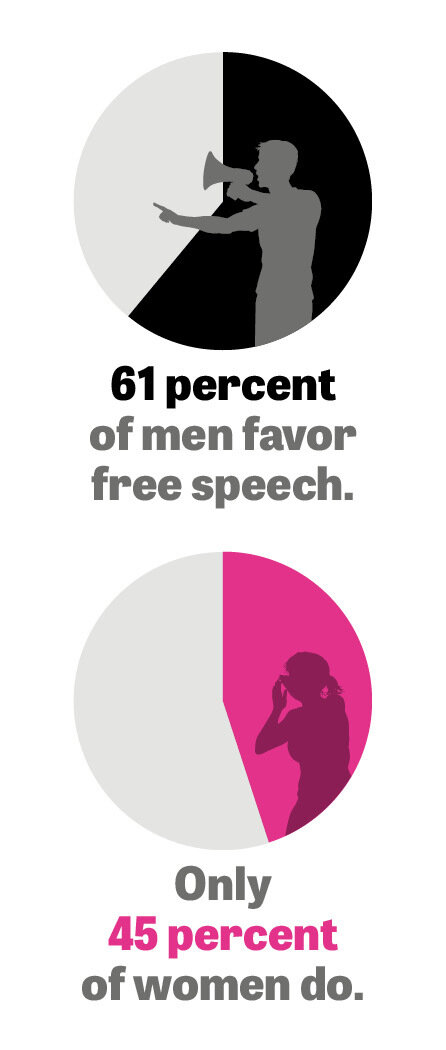
Consider free speech. Open debate requires tolerating words that offend. Yet in one survey of college students, men preferred protecting free speech over an inclusive society 61 to 39, while women favored inclusion over free speech 64 to 35. A 2024 national survey found that 61 percent of men agreed people should be allowed to say whatever they want, compared with 45 percent of women.
This helps explain cancel culture. It is what happens when the number of women in an organization reaches a critical mass: Opponents are not openly argued with but ostracized and pushed out. “Female group dynamics favor consensus and cooperation,” Andrews wrote. “Men order each other around, but women can only suggest and persuade. Any criticism or negative sentiment, if it absolutely must be expressed, needs to be buried in layers of compliments. The outcome of a discussion is less important than the fact that a discussion was held and everyone participated in it.”
Think about covid-19. Most people faced little danger from the virus, yet governments insisted on keeping everyone “safe” at extreme cost: Everybody must mask up; we can’t be too cautious; we must prioritize health and safety above all else—even if we have to shut our economies down. There were simply too few men standing up and insisting on exercising balance, sense and courage.
“If wokeness really is the result of the Great Feminization, then the eruption of insanity in 2020 was just a small taste of what the future holds,” Andrews wrote. “Imagine what will happen as the remaining men age out of these society-shaping professions and the younger, more feminized generations take full control.”
The Cost at Home
The damage reaches far beyond institutions. From grade school onward, boys now trail girls in nearly every academic measurement. In 1970, 20 percent of young men had a bachelor’s degree, compared with 12 percent of young women. By 2020, the numbers had flipped: 41 percent of young women, 32 percent of young men.
That education gap is profoundly impacting the formation of families. Women tend to look for a husband with at least as much education and earning power as they have, and there are fewer and fewer such men to go around. This is one reason that marriage is collapsing. In 1980, just 6 percent of 40-year-old Americans had never been married. By 2021, it was 25 percent—a record—and 28 percent among men (sidebar, page 12).
And within marriages, roles have reversed. A half-century ago, the husband was the primary breadwinner in roughly 85 percent of American marriages. Today it is 55 percent, and 16 percent of marriages have a breadwinner wife—more than triple the share in the early 1970s. The shift is accelerating: Women accounted for 98 percent of the jobs added to the United States economy in August, and earlier this year they overtook men in total payroll employment. The result is effectively a reversal of a male-female dynamic that has existed for virtually all of human history.
This has been no accident. For decades, the traditional pattern—men as providers, women as homemakers—has been under attack for being unfair to women and even to men, and spoken of almost as if it were the only thing standing in the way of successful families, fulfilled parents and self-actualized children. Feminism and political correctness have dictated that women pursue their own careers outside the home—and that men not stand in their way.
Women have proved themselves spectacularly capable as workers, entrepreneurs and earners. But now that the traditional roles have been abandoned, are we better off?
One unforeseen consequence has become obvious: Men have gotten the clear message that they are not needed. Rather than working to keep up, many have simply given up. More than 7 million American men ages 25 to 54—prime working years—are neither working nor looking for work. Few of these men are in school; they spend, on average, 2,000 hours a year in front of screens. Richard Reeves of the Brookings Institution, who studies the struggles of boys and men, describes a pattern of passivity and drift among young men—a sense that many are simply checking out.
A man needs to be needed, and marriages suffer when he isn’t. Harvard sociologist Alexandra Killewald studied more than 6,300 married couples over a span of 46 years. When a husband was not employed full time, the couple was about a third more likely to divorce in any given year. A study by economists at the University of Chicago found that when a wife earns more than her husband, the couple reports less satisfaction with the marriage and is likelier to divorce.
The costs show up everywhere. Men without work, wives or purpose are lonelier, less healthy and more prone to “deaths of despair”—from drugs, alcohol and suicide; men die by suicide at roughly four times the rate of women. About 1 in 4 American children now grow up without a father in the home. This is the bitter irony of the Great Feminization: A movement that promised to liberate women has left many of them unable to find a man worth marrying, their children growing up without fathers, and their brothers and sons drifting without purpose. Women are succeeding financially and professionally—but families are fragmenting, and the nation is morally and spiritually disintegrating.
When we reject God’s design, everyone loses.
Women Rule
Believe it or not, this calamity was prophesied in your Bible thousands of years ago. The prophecy in Isaiah 3 is primarily about the end time, in which we now live. It specifically focuses on “Jerusalem” and “Judah,” biblical names for the modern descendants of ancient Israel, including America and Britain. And it describes exactly what we see in society all around us.
“For, behold, the Lord, the Lord of hosts, doth take away from Jerusalem and from Judah the stay and the staff … The mighty man, and the man of war, the judge, and the prophet, and the prudent, and the ancient, The captain of fifty, and the honourable man, and the counsellor …” (verses 1-3). God removes strong male leadership—including, notice, the judge.
The result is a more effeminate age, as verse 12 explicitly states: “As for my people, children are their oppressors, and women rule over them.” That is God’s view: Women rule.
Some will argue that men still hold the most seats in Congress and most ceo positions. But women increasingly set the tone even where men hold the top posts. Effeminate thinking has taken over our politics, our business, our education—our whole society. Everything is feminized.
Notice: This prophecy shows that the curse begins with men. God removes the mighty man, the judge, the counselor—and because the men retreat, women rule. This is a curse from God because of our people’s sins against Him.
God also says, “Woe unto them that call evil good, and good evil; that put darkness for light, and light for darkness; that put bitter for sweet, and sweet for bitter!” (Isaiah 5:20). This inversion of reality well describes our world. By throwing out God’s design, we have cast ourselves adrift in a disorienting ocean of amorality.
The Bible defines sin as the transgression of God’s law (1 John 3:4). The devil has entrapped men today in a range of terrible sins. A man who succumbs to them grows weak, more inward-
focused and self-absorbed; his ability to lead suffers. In a word, he becomes less of a man. When a nation’s men retreat on a broad scale, God removes His blessings, and strong male leadership disappears.
The tendencies toward feminization have been there throughout human history. At the very beginning, when Eve gave Adam the forbidden fruit, “he did eat” (Genesis 3:6). God’s judgment on him began, “Because thou hast hearkened unto the voice of thy wife, and hast eaten of the tree, of which I commanded thee, saying, Thou shalt not eat of it: cursed is the ground …” (verse 17). Adam’s sin was not that he listened to his wife; it was that he followed her against God’s command. Something in a man’s nature wants to please women. When that impulse overrides God’s law, it brings disaster. Think of Samson and Delilah, Solomon and his many wives, Ahab and Jezebel. The inescapable reality is that because of human nature, mankind will always have problems. However, whenever men abdicate and women rule, you end up with a distinct set of troubles.
These are playing out on a grand scale in modern society. Thus we see with greater and greater clarity just how dangerous it is to discard God’s order, His government, His revealed truth—and what a terrible curse it is, as described in Isaiah 3, when women rule.
Two Different Roles
The design we saw earlier—male and female, deliberately different and complementary—is only the beginning. The Bible also shows how that design is meant to work in practice, including the different roles God gave men and women.
This is what modern society balks at most of all. Before dismissing it, though, consider whose idea it is. God says through the Prophet Isaiah: “For my thoughts are not your thoughts, neither are your ways my ways, saith the Lord. For as the heavens are higher than the earth, so are my ways higher than your ways, and my thoughts than your thoughts” (Isaiah 55:8-9). Surely we should have deep regard for instruction from the God who created us male and female.
Notice what came before God made woman. First He made Adam (Genesis 2:7). Then He gave him a job: He put him in the garden “to dress it and to keep it” (verse 15). Only then did He say, “It is not good that the man should be alone; I will make him an help meet for him” (verse 18). A man needs a mission, and he needs a woman to help him fulfill it. She is “meet” for him, perfectly suited to him, supplying what he lacks.
The truth is, men and women are incomplete without each other (verses 21-24). You need the right kinds of male-female interactions to become a whole and balanced person.
God built interdependence into the sexes (1 Corinthians 11:11-12). He made us to function as a team, with our individual qualities and tendencies complementing one another. But that balance requires order. “[T]he head of every man is Christ; and the head of the woman is the man; and the head of Christ is God” (verse 3). It is true that men in charge have created the world’s problems. But the solution is not for women to rule—it is for men to rule as God intended, in subjection to Christ!
Godly male leadership is not tyrannical. Husbands are to love their wives “even as Christ also loved the church, and gave himself for it” (Ephesians 5:25). They are to “dwell with them according to knowledge, giving honour unto the wife … as being heirs together of the grace of life …” (1 Peter 3:7). Spiritually, men and women are equal and are qualifying for the same eternal reward. A godly husband listens, learns how his wife thinks, seeks her counsel, and takes advantage of her wisdom. God told Abraham, “[I]n all that Sarah hath said unto thee, hearken unto her voice …” (Genesis 21:12). Yes, a man needs a woman—but God gave him the responsibility to lead.
Complementary and Interdependent
God also gave each a different sphere. Men have tended to be inventive and productive in the wider world, applying their strength to provide for others (1 Timothy 5:8). Women are inventive and creative within the family, where their work directly shapes the next generation (e.g. Titus 2:4-5; 1 Timothy 5:14).
Proverbs 31 shows how beautifully this works. “The heart of her husband doth safely trust in her,” and, “She will do him good and not evil all the days of her life” (verses 11-12). The exemplary woman works willingly with her hands, buys quality food for her household, and rises before dawn to care for her family (verses 13-15). Her husband, meanwhile, “is known in the gates, when he sitteth among the elders of the land” (verse 23). The man is in the field working to provide for his family and at the gates creating the environment where his wife can reach her full potential. His wife is an active, dynamic force within the home—keeping it, teaching her children, and supporting her husband. There is no competition between them, no strife. Each fulfills a different role, and they need each other.
“Every wise woman buildeth her house [her household, or family]: but the foolish plucketh it down with her hands” (Proverbs 14:1). A woman makes a house a home in a way a man cannot. Yet where are the wise women in society today? Women today are building many things—careers, businesses, institutions—but fewer and fewer are building families.
Married couples now head fewer than half of American households, down from nearly 80 percent in 1949. Birth rates have hit record lows: In April, the Centers for Disease Control and Prevention reported that America’s total fertility rate fell to 1.57 children per woman in 2025, far below the 2.1 needed to replace the population. Commentators tend to blame economics. But as Matt Bose argued in Chronicles, blaming impersonal economic forces lets women off the hook for choices they often make consciously and even proudly, while treating the needs of children as a minor concern. Families are suffering in every way. If women aren’t building families, who is? Nobody.
Strong families are the building blocks of a stable and upright society. The feminization of society draws women out of the home and into institutions that men should be running, and the results have been devastating.
But the elusive solution is hiding in plain sight if your Bible is open. It is about embracing how we were created. Get God’s perspective and submit to His design, and subject yourself to His rule. Men: Embrace the role your masculine mind and body were designed for. Women: Embrace the role your feminine mind and body were designed for. Discover that, live that, and you will be embarking on a life of growth, challenge, fulfillment, confidence and happiness, built on knowing what it really means to be a woman, and what it really means to be a man.