
The Middle East Is Going Nuclear
A quarter of a century has passed since the morning planes crashed into the iconic Twin Towers in Manhattan, the Pentagon and a Pennsylvania field. Soon American troops were deployed to Afghanistan, Iraq, Somalia and beyond. The United States has been at war ever since. The legacies of America’s presidents continue to die and revive based on what happens in the faraway Middle East.
And yet, the world has changed. 2026 is not 2001. America’s days of zero compromise with radical Islam are over. In fact, United States President Donald Trump is helping two Arab states to begin developing nuclear weapons. One of these nations helped the September 11 terrorists launch their attacks. The other is governed by a group derived from al Qaeda.
The first is Saudi Arabia. Though it is ruled by a stable monarchy with strong ties to the West, U.S. investigations have confirmed some levels of the Saudi bureaucracy assisted al Qaeda 9/11 terrorists in killing 2,997 people. How high up this complicity went remains an open question. Meanwhile, the country remains a strict Islamic society that has inspired jihad worldwide.
The second is Syria, which is literally ruled by a leader from an al Qaeda affiliate. Ahmed al-Sharaa led the group Hayat Tahrir al-Sham until 2024, then integrated his terrorist fighters into Syria’s new official government and military. During his two years as president, his government has persecuted religious minorities and sheltered Palestinian Islamic Jihad and other Sunni terrorist groups.
Saudi Arabia and Syria are among the last countries the West should grant a path to nuclear weapons. Yet President Trump is not only allowing these developments, he is sponsoring them.
Catalyst
The U.S. and Saudi Arabia announced a nuclear cooperation deal on July 25, with the U.S. agreeing to help the Saudis establish a civilian nuclear program. The deal is currently under review by the U.S. Congress.
Saudi Arabia claims it wants nuclear energy for peaceful purposes only, despite already being an energy superpower. The deal excludes the nation from snap inspections by the International Atomic Energy Agency (iaea) (something other nuclear-threshold states like Iran had to agree to). Saudi Arabia wants U.S. help on civilian nuclear reactors so it will be able to convert to a nuclear weapons program if it desires. In fact, its leader has admitted as much.
The text of the agreement has not yet been made public, but reports say it could allow Saudi Arabia to enrich uranium to 20 percent. This is a major step toward weaponization. Nuclear analyst Scott Roecker told the Wall Street Journal, “[A]t that level of enrichment, you are most of your way toward producing weapons-grade material in terms of the work that needs to be done.” By comparison, the 2015 Joint Comprehensive Plan of Action limited Iran to 3.67 percent enrichment.
Syria reached a similar agreement with the United States. The previous regime under President Bashar Assad operated a covert nuclear weapons program that Israel bombed in 2007. Assad salvaged large quantities of unenriched uranium and stored it in several locations, including a secretive facility called “Site 99.” After Assad fell in 2024, there were concerns that bad actors, including incoming leader Ahmed al-Sharaa, could obtain the material. Israel bombed Site 99’s entrance to prevent this. In recent months, Israel has found it necessary to threaten further bombing of the site if it detects Sharaa’s government attempting to access the uranium. To defuse tensions between Israel and Syria, President Trump negotiated a “diplomatic agreement” stipulating that Site 99 nuclear material would be removed by the iaea. A U.S. official told Axios, “We think everybody is happy with the result.”
On August 18, iaea Director General Rafael Grossi said that the agency found “a few tons of nuclear material that could be put to bad use.” Standing next to Grossi was Syrian Foreign Minister Asaad al-Shaibani, who said the nuclear stockpiles “do not pose a risk” to international security and “will remain in Syrian national custody and subject to the agency’s safeguards system.” Shaibani said Syria has a “sovereign and legal right” to enrich uranium “for civilian and peaceful purposes.”
Israel is witnessing the exact scenario it was trying to avoid: Syria’s government consolidating its control over the nuclear material and gaining diplomatic legitimacy for it.
In a September 2 report, the iaea clarified what it meant by “a few tons of nuclear material”: about 80 U.S. tons. If Syria enriched this material, most of it would end up as waste. But Iran has just over a quarter of a ton of highly enriched uranium, and that is enough to make 10 nuclear warheads. If Syria acquired the knowhow, it could hypothetically replicate similar levels.
Like Saudi Arabia, Syria lacks the technology and industrial capacity to rapidly develop a uranium stockpile into functional nuclear weapons. Both countries are estimated to be several years away from potentially becoming nuclear powers. But they are taking big steps in that direction. And in Syria’s case, this nuclear material came from a weapons program.
Fallout
Nuclear weapons are the deadliest weapons ever developed. As North Korea demonstrates, a country that defies other nations to build these warheads risks becoming an international pariah. Why would countries like Saudi Arabia and Syria give even the appearance of desiring them and run the associated risks?
Crown Prince Mohammed bin Salman, the de facto leader of Saudi Arabia, gave his answer in 2023. In a Fox News interview, Bret Baier asked what Saudi Arabia would do if Iran acquired a nuclear weapon. His response: “If they get one, we have to get one.”
The U.S. started the Iran war to destroy Iran’s nuclear weapons capacity. Yet while much of Iran’s enrichment infrastructure is heavily damaged, most of its enriched uranium remains intact and, apparently, salvageable.
The iaea estimates that Iran has enough enriched uranium to make as many as 10 nuclear weapons. About half that material was stored in a tunnel complex at a site in Isfahan. The U.S. and Israel bombed Natanz, Fordow and other Iranian nuclear sites in June 2025. These strikes destroyed entrances, but the tunnels and the uranium stockpiles are believed to have survived. Israeli Prime Minister Benjamin Netanyahu reportedly provided evidence to the U.S. in July indicating that Iran could be accelerating development of a nuclear weapon.
These circumstances, plus Iran’s bombing of Saudi Arabia in retaliation for U.S. strikes, boost Saudi Arabia’s impetus for developing its own deterrent.
Syria, meanwhile, remains in a standoff with Israel, which has had nuclear weapons for decades. Israel distrusts Sharaa’s Islamist regime; it has been occupying parts of Syria near Damascus since 2024 and carrying out periodic strikes. Sharaa may see a nuclear program, or even the mere threat of starting one, as leverage against Israel.
Two other states in the region already possess nuclear weapons and are tacitly threatening to use them.
Proliferation
Saudi Arabia signed a mutual defense agreement with Pakistan and Turkey on August 7, augmenting a similar deal it made in 2025 with Pakistan. This effectively joins these three nations in a nato-like alliance.
Both Pakistan and Turkey possess nuclear weapons. Pakistan has about 170 nuclear warheads and is believed to be expanding its stockpile. Turkey hosts about 20 U.S.-made nuclear bombs that a nato agreement grants Turkey joint control over.
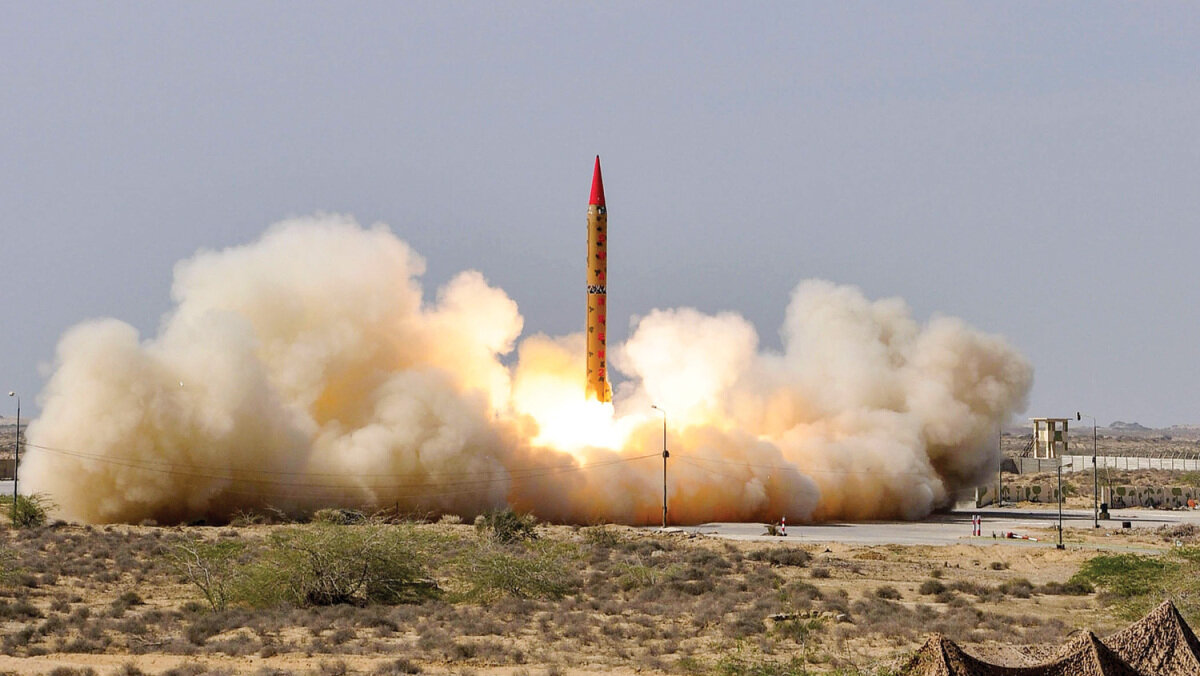
Per the previous agreement, Pakistan reportedly sent 8,000 troops, jet and drone squadrons and an air defense system to Saudi Arabia when it was bombed by Iran. Nuclear-armed Pakistan was seriously contemplating going to war with Iran.
Pakistan lies to Iran’s east, and Turkey to its west. Saudi Arabia lies directly across the Persian Gulf. Any war between Iran and these countries is unlikely to remain a limited conflict. Whether through its own domestic capabilities or its nuclear alliances, Saudi Arabia is essentially telling Iran: When we said we’ll get one if you get one, we meant it.
Mutually Assured Destruction
On Sept. 11, 2001, America realized that Middle Eastern volatility was no longer contained in a faraway region. America launched the “war on terror” to stop radical Islam from threatening the peace of the world.
Twenty-five years later, it is clear this mission has failed. In fact, the threat from the Middle East has grown dramatically worse. Now, five Muslim states are either trying to gain nuclear weapons or threatening to use the ones they have. In Syria, this is happening under the authority of an outgrowth of the very terrorist group that launched the 9/11 attacks.
The discussion of nuclear proliferation in the most unstable part of the world increases the probability of mushroom clouds appearing—in the Middle East and far beyond.
How can we solve this problem? America has been trying to snuff it out since 2001 and has failed. Last year, it resorted to launching B-2s from Missouri and directly striking Iran for the first time, attacking its nuclear program outright. Beginning February 28, it tried to put Iran in its place by striking it day after day and week after week and sending in the largest buildup of American forces in the Middle East since the Iraq War. Yet Iran remains undefeated, and the region remains explosive.
If the world’s largest, most advanced military cannot solve this serious problem, what hope does any other nation have?
Daniel 11 prophesies this dilemma. Verses 40-45 describe end-time unrest in the Middle East instigated by Iran. As Trumpet editor in chief Gerald Flurry’s free booklet The King of the South explains, despite the best efforts of diplomats and other policymakers, this relatively local crisis will mushroom into a worldwide cataclysm as described in Daniel 12:1: “And at that time … there shall be a time of trouble, such as never was since there was a nation even to that same time ….”
Jesus Christ gave a related prophecy in Matthew 24:21-22: “For then shall be great tribulation, such as was not since the beginning of the world to this time, no, nor ever shall be. And except those days should be shortened, there should no flesh be saved ….” The Moffatt translation renders verse 22 as “… not a soul would be saved alive ….”
Mankind has never been in a position to destroy itself until the invention of weapons of mass destruction. These prophecies are about nuclear war—starting in the Middle East!
In 2017, Mr. Flurry published a booklet focusing on Jesus Christ’s prophecy in Matthew 24: Nuclear Armageddon Is ‘At the Door.’ At the time, he focused on two nuclear threats gripping the world’s attention: Iran’s enrichment of uranium and North Korea’s testing of nuclear-capable missiles. Those countries’ leaders “changed the nuclear equation in this world,” he writes. “They relish the idea of a nuclear war! This is not a fantasy! This is the real world! Will that problem cause mankind to finally realize that the nuclear madness is out of control? No ….”
As he explains, the real nuclear chaos that will break out soon is caused by none of these countries but rather by a united European superpower. Yet Mr. Flurry still associates the nuclear work of these smaller countries as part of the lead-up to the prophesied worldwide cataclysm. North Korea’s nuclear program alone “is just one example of what the fifth seal [of Revelation 5-6], or the Great Tribulation, is all about,” he writes. “… Many nations have weapons of mass destruction—including nuclear bombs. The Prophet Daniel called this ‘the time of the end’—or as Moffatt translates it, ‘the crisis at the close’—the crisis of all crises! This is all tied to the Great Tribulation ….”
Mr. Flurry was inspired to write his booklet based on events in North Korea and Iran. Today, it’s not just these countries threatening to “change the nuclear equation in this world.” Saudi Arabia, Syria, Pakistan, Turkey and others are all capable of sparking this “crisis of all crises.”
Nuclear proliferation has now become so commonplace that it barely makes headlines anymore.
This is the world we live in. Even if you don’t believe Bible prophecy, current circumstances should drive you to serious reflection.
How to Be Protected
Though man’s governments are failing to solve the nuclear problem, Bible prophecy provides a sure solution.
Daniel 12:1 concludes, “[A]nd at that time thy people shall be delivered ….” Matthew 24:22 concludes, “[B]ut for the elect’s sake those days shall be shortened.” Throughout the rest of Matthew 24, Jesus elaborated on what this means: Man’s plunge into cosmocide will be stopped by nothing less than Christ’s Second Coming (verses 29-31).
Nuclear Armageddon Is ‘At the Door’ continues: “It is childish folly to think anybody but Christ could stop this nuclear madness. … So all this nuclear insanity is also a part of the sign of the Second Coming and the sign of the end of the age when Christ will save humanity from totally exterminating itself!”
Christ promises to return and save mankind, but before that, the cataclysmic prophecies of the Great Tribulation will be fulfilled. God doesn’t promise to protect mankind or even Christians in general. Christ prophesied that only His “elect” will be protected. Most people are confused about who the “elect” are. Request your free copy of Can You Prove Which Church Is God’s? for more information.
If you are not part of God’s work today, you will not be protected from the Great Tribulation!
“How many traditional Christians heed His warning?” Mr. Flurry writes. “How many Christian leaders do you hear even discuss Matthew 24? It is the most important prophetic message Christ gave when He was on this Earth! They talk about the person of Christ continually—but not His message. One third of your Bible is prophecy. Yet traditional Christians virtually ignore it all!” (ibid).
You cannot afford to ignore the message of Matthew 24. The Bible warns that the final world war is coming soon. By the time it starts, it will be too late to make a choice. You need to act now, while there is still time.