
U.S. Debt Crisis Enters Uncharted Territory
Rising interest payments on America’s national debt are pushing the nation into uncharted territory. U.S. Treasury bond yields edged higher on Tuesday, extending a sell-off of those bonds and threatening to raise borrowing costs for the government and millions of Americans.
This is bad news for the world’s biggest debtor.
- The Congressional Budget Office estimates the U.S. government is on track to pay $1.039 trillion in interest in fiscal year 2026, which ends September 30.
- With federal revenues projected at $5.58 trillion over the same period, the interest-to-revenue ratio would hit a record of 18.6 percent.
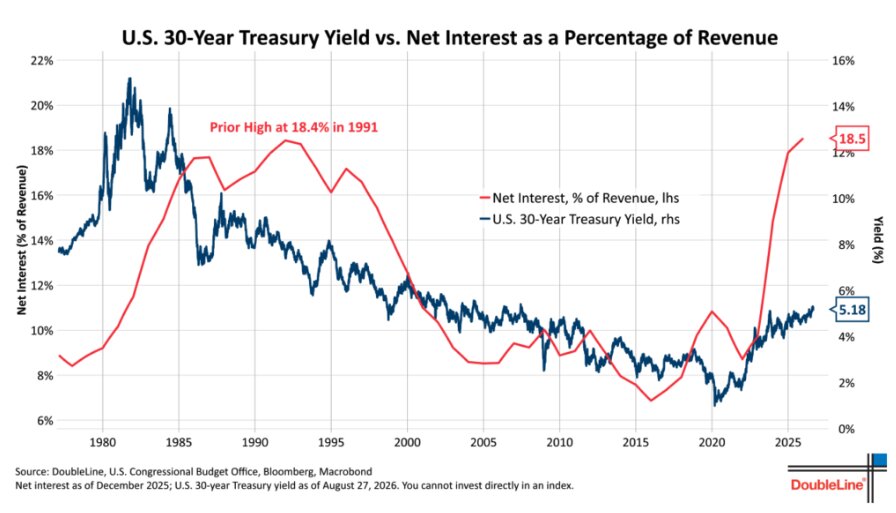
Federal net interest expenses reached 18.5 percent of revenue last year, surpassing the previous record of 18.4 percent set in 1991. Yet America’s current situation is more dire than it was 35 years ago.
- In 1991, 30-year yields around 8.1 percent pushed total interest payments to their prior peak. Today, with the 30-year yield near 5.3 percent, interest is already consuming nearly a fifth of tax revenue.
- If the 30-year yield remains near 5.2 percent, the interest-to-revenue ratio could reach 30 percent by 2036. If it returned to 8.1 percent, that ratio could approach 50 percent by 2036. Either path would crowd out other priorities and leave far less room in the budget to run the government without still-larger deficits.
- Many economists believe America has only 10 to 25 years to stabilize its national debt before it becomes mathematically impossible to handle. Yet if global investors collectively lose confidence in the government’s willingness to pass fiscal reforms, a bond-market crisis could destroy the nation practically overnight.
Gerald Flurry warned last year that “A Financial Crisis Is Imminent,” writing:
Decades ago, the late Herbert W. Armstrong warned about a global financial crisis triggered by the United States. These recent events showed how this could happen at any time! America’s financial markets are on shaky ground. One wrong move and the whole financial system could collapse. In the 2008 banking crisis, the U.S. financial system was saved only by spending huge amounts of money we did not have. This only set us up for an even bigger crisis down the road.