
Does the Geologic Column Actually Exist?
“Herbert Armstrong, you are simply ignorant! One is uneducated and ignorant unless he believes in evolution. All educated people now believe it.”
These words stung. Exactly 100 years ago, in the fall of 1926, Herbert W. Armstrong’s business had collapsed, his wife was saying Christians should keep the Sabbath, and his wife’s sister-in-law, Hertha Dillon, was mocking his fundamental understanding of life, the world, and reality itself.
Hertha was a 19-year-old college freshman, obviously hungry for intellectual sophistication. Mr. Armstrong set aside her motive and her offensive words and accepted the challenge.
With what remained of his business requiring little of his time, he spent day after day, evening after evening, and night after night examining the work of the leading proponents of evolution: Charles Darwin, Ernst Haeckel, Herbert Spencer, Thomas Huxley, Karl Vogt and others. As he studied, real doubts about the existence of God entered his mind. Like most Americans in the early 1900s, he had always assumed God existed simply because he had been taught it from childhood. He had never actually proved it.
For months, he spent up to 12 hours a day in the Portland Public Library, immersing himself in anatomy, embryology, paleontology, radioactivity and related fields. He examined the facts of Darwin’s life—his continual sickness, his preconceived theory and the inductive process of reasoning he used in searching for arguments that would sustain that theory. He quickly determined that “proofs” like comparative anatomy were not actually proofs in themselves; they only made the theory seem more reasonable once evolution had been proved by other means. Since evolution teaches that all life descended from a common ancestor, the only way to truly prove it historically is through the fossil record.
“I came to see that there was only one possible proof of evolution as a fact,” he later wrote in his autobiography. “That was the assumption that, in the study of paleontology, the most simple fossils were always in the oldest strata, laid down first; while, as we progress into strata of later deposition, the fossils found in them become gradually more complex, tending toward advancing intelligence.”
This assumption is the foundation of the “geologic column”—the idea that arranges Earth’s rocks into a chronological sequence in which the simplest fossils always appear in the oldest strata—exactly the orderly progression evolution requires if common descent is to be demonstrated by the fossil record.
But how do you prove this column is real?
The Hypothesis
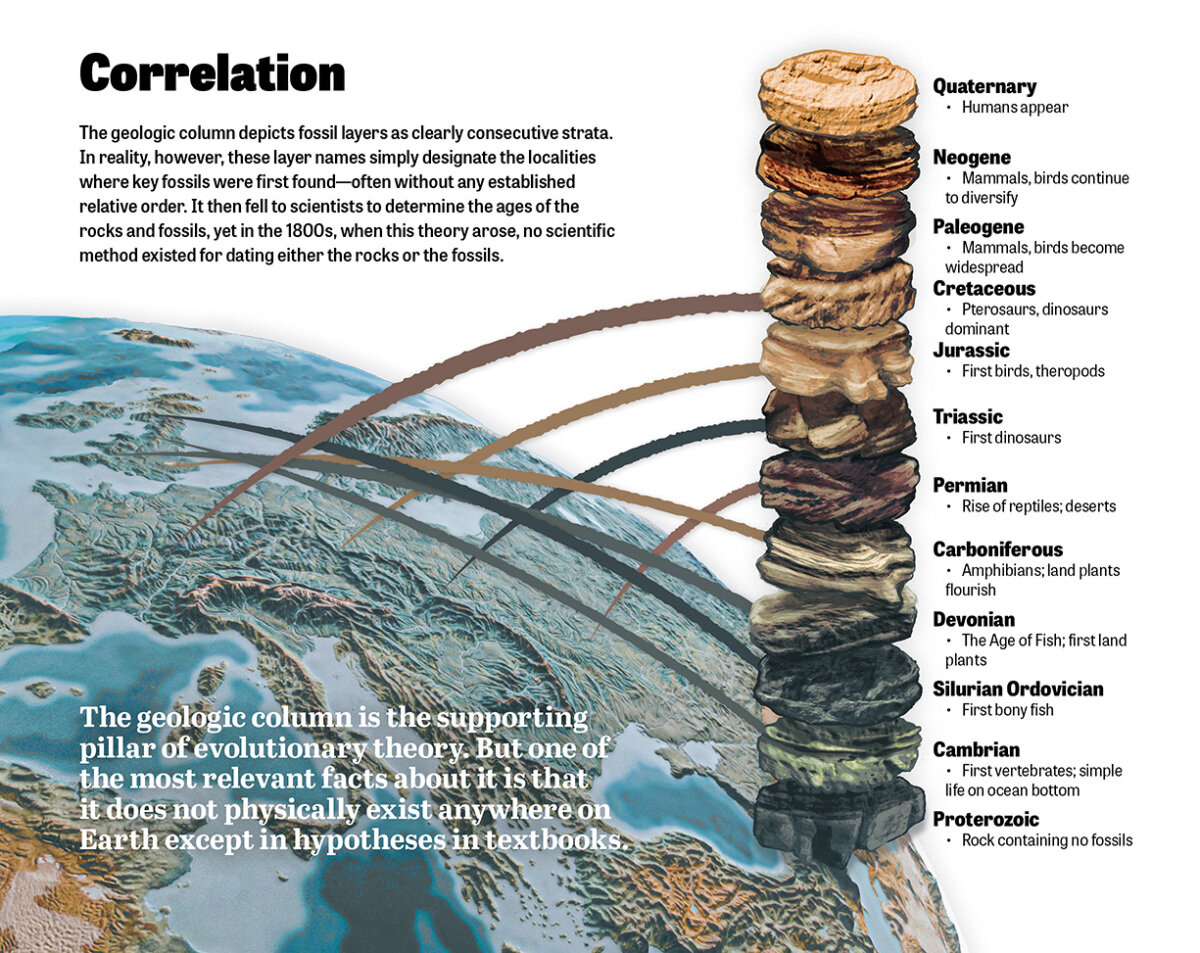
Most high school and college students have seen a representation of the geologic column: a depiction of about a dozen types of rock, one atop another. Textbooks vary, but most label them, from bottom to top, as Cambrian, Ordovician, Silurian, Devonian, Carboniferous, Permian, Triassic, Jurassic, Cretaceous, Paleogene, Neogene and Quaternary.
The bottom three on this list have been found to contain fossils of only simple marine invertebrates. The Devonian contains an abundance of fish fossils. Carboniferous rock contains many amphibian fossils. Reptiles are found in Permian rock and are much more common in Triassic rock. Jurassic and Cretaceous rock contain numerous fossilized dinosaurs. Paleogene and Neogene rock contain an abundance of mammals and birds. Quaternary rock is the only type to contain human fossils.
Scientists reason that these 12 rock types are best represented not as a grid, table or map but rather as a column, with Cambrian at the bottom. And, crucially, they introduce a time element: Cambrian rock is also the oldest.
Reasoning these rocks into a column and thereby into a timeline produces the notion that marine invertebrates are the oldest life-forms on Earth and that they eventually became the current life-forms.
But that’s getting ahead of our scientific examination. First, we should understand which locations in Earth’s crust contain these 12 layers atop one another in this order. Curiously, there are none.
There are local rock formations, like the Grand Canyon, that contain so-called Cambrian, Devonian, Carboniferous and Permian rock stacked in rough sequence. Yet even this sequence famously skips the Ordovician and Silurian layers entirely. This absence highlights the fact that the strata of the Grand Canyon represent a local ecological zone rather than a global timescale. The bottom of the Grand Canyon doesn’t represent a global “Cambrian Era.” Rather it represents what prehistoric Arizona was like.
The real fossil record is contained in a jumbled heap of rocks scattered across the globe. Paleontologists have no actual physical geologic column to study: They look for clues that one type of rock with certain fossils in one place should be represented as above or below another type of rock an ocean away.
The names of the rock types remind us of the fact that they have been found not atop one another but hundreds or thousands of miles apart. Cambrian rocks are located in Wales. Ordovician and Silurian rocks are named after Welsh tribes because they are also located in Wales. Devonian rocks are located in England. Carboniferous rocks are also found in England (named for their high coal content). Rocks near Perm, Russia, are Permian. Rocks from three areas of southern Germany are Triassic. Those in France’s Jura Mountains are Jurassic. Chalky rock near Paris is called Cretaceous. The Paleogene, Neogene and Quaternary strata are found in still other places, including the Paris Basin and parts of Italy.
In fact, none of these fossil-containing regions are located above or below each other. Geologists can’t climb down cliffsides—or even one cliffside—and point to 12 different periods atop one another. The most distinct major eras you can see in a single, continuous vertical sweep constitute about six layers. Yet, since plate tectonics continuously recycles the heavy ocean floor while pushing up mountain ranges and shifting the shapes of the continents, you cannot say with any confidence that Cambrian fossils are always the oldest. Someone had to decide which of these scattered rock piles was older than which other pile.
Following Mr. Armstrong’s example, there remains more for us to do: Sift through information, seek facts, ask questions, and insist on reality. The geologic column is the supporting pillar of evolutionary theory. But one of the most relevant facts about it is that it does not physically exist anywhere on Earth except in hypotheses in textbooks.
Just as telling, interpretations of the fossil record have shifted dramatically over time.
The ancient Greeks read fossils as the petrified remains of giants and monsters slain in wars between the gods and the Titans. Medieval Christians saw the same remains as evidence of Noah’s Flood. Early paleontologists like Georges Cuvier saw them as evidence that violent catastrophes including floods have occurred throughout Earth’s history and wiped out entire species. Not until the 1800s did anyone propose the idea that the rock layers containing the simplest fossils, scattered here and there across the globe, had to be the oldest.
A New Theory
The idea of a creation that came into being without a creator has been taught since the days of the Epicurean philosophers of ancient Greece. But this notion did not take deep root in the Western world for thousands of years—until Charles Darwin.
When 22-year-old Darwin boarded the hms Beagle in 1831, the captain handed him a book that would reshape his thinking: the first volume of Charles Lyell’s Principles of Geology.
Lyell, a Scottish geologist, openly aimed to “free the science from Moses.” He rejected explanations that linked major geological formations to the events recorded in Scripture—especially the global Flood—and insisted instead that they formed gradually over vast ages through ordinary processes.
His approach became known as uniformitarianism: the idea that the same slow, natural processes we observe today operated at roughly the same rates in the past, shaping the Earth over immense spans of time. Lyell never disproved the possibility that some ancient formations resulted from catastrophes, yet most modern geologists still interpret the fossil record primarily through a uniformitarian lens.
The law of superposition states that in any undisturbed sequence of rocks, the oldest layers sit at the bottom and the youngest at the top. Direct evidence of some disturbances does survive—igneous dikes and sills, for instance, show where molten rock intruded into existing layers—but confirming the extent, timing and cumulative effect of such disturbances across a global column is another matter. Some independent method of confirming relative age other than superposition was therefore needed.
Lyell recognized this limitation. He therefore adopted William Smith’s principle of “faunal succession.” Smith, a canal engineer, had noticed that each rock layer in a canal contained its own distinctive assemblage of fossils and that these fossil groups occurred in the same order from place to place. He proposed that fossil assemblages, not the rock itself, could be used to place isolated outcrops into a shared sequence—even when those outcrops were never physically connected. Smith’s observations, however, were limited to England and Wales, areas of the world that were underwater fairly recently in geological history. The idea that marine invertebrates are the oldest life-forms in the British Isles does not prove that they were the first life on Earth. Nevertheless, Lyell extended this regional pattern to a global scale, using it to support the claim that marine invertebrates always appear first in the global fossil record.
Working with the French shell collector Gérard-Paul Deshayes, Lyell classified geological strata according to how closely their fossil assemblages resembled modern species. Strata in which about 90 percent of the fossils belonged to still-living species he named the Pleistocene; those with around 50 percent, the Pliocene; those with about 20 percent, the Miocene; and those with only about 3 percent, the Eocene.
This became a key foundation for the modern geologic column. But Lyell’s approach had a major flaw. He assumed a rock containing many extinct species must be older than one containing mostly still-living species. That is not necessarily true. A rock full of unfamiliar fossils could still be young, and one full of familiar, living species could be ancient. This is evident in the case of the coelacanth, a deep-sea fish once thought to have gone extinct with the dinosaurs about 66 million years ago. It was found alive off South Africa in 1938. While scientists once assumed that a coelacanth fossil indicated a rock millions of years old, they now know roughly 400 coelacanths still swim in the deep waters off the Comoros Islands.
Darwin eagerly embraced the idea of faunal succession, as well as Lyell’s geologic column. In his book On the Origin of Species, he repeatedly cited the fossil record as strong evidence for biological evolution, claiming the geologic column showed a slow progression from simpler to more complex life and that “missing links” would eventually turn up. His argument later helped persuade Lyell to accept evolution.
Both men’s ideas, in short, sprang from the same uniformitarian theory.
If the same slow, natural processes we observe today operated at the same rate in the past, then it seems reasonable to assume that rocks with many unfamiliar species might be older than rocks with few. But if the world’s rock structures were instead shaped largely by ancient catastrophes, the fossil record is likely too jumbled to support the neat progression evolution requires. In other words, evolution is a theory largely devised by Darwin to explain faunal succession, which itself is an unproven hypothesis.
Circular Reasoning
During his intensive study at the Portland Public Library, Mr. Armstrong learned about the theory of faunal succession. Information on how scientists date rock strata proved much harder to come by.
“I began a search to learn how these scientists determined the age of strata,” he wrote in his autobiography. “I was months finding it. None of the texts I searched seemed to explain anything about it. … Were the oldest strata always on the bottom—the next oldest next to the bottom, the most recent on the top?”
He finally found a recognized text on geology by Thomas Chrowder Chamberlin, emeritus professor of geology at the University of Chicago, explaining that the most recent strata sometimes end up below the most ancient, owing to geologic processes like faulting, folding and overturning. This same text, A College Textbook of Geology, explained that geologists relied on “index fossils” to determine a stratum’s age, since stratigraphy alone couldn’t do the job.
The discovery flabbergasted Mr. Armstrong. “The age of strata was not determined by stages of depth,” he wrote. “The depth of strata varied in different parts of the world. How, then, was the age of strata determined? Why, I finally discovered in this very reputable authority, their age was determined by the fossils found in them. Since the geologists ‘knew’ their evolutionary theory was true, and since they had estimated how many millions of years ago a certain fossil specimen might have lived, that age determined the age of the strata!
“In other words, they assumed the age of the strata by the supposition that their theory of evolution was true. And they ‘proved’ their theory was true by the supposition of the progressive ages of the strata in which fossil remains had been found! This was arguing in a circle!”
Mr. Armstrong wrote a short paper on the topic and showed it to the head librarian of the science department of a very large library. She agreed he’d gotten “right to the crux of a problem” and had “robbed” her of any proof that evolution was actually true. Yet she said she’d still “go on believing in evolution,” because she’d done graduate work at Columbia, the University of Chicago, and other top-level institutions. She was too steeped in the theory to give it up.
Hertha, his wife’s sister-in-law, wasn’t. Once she learned that geologists were organizing rock strata on the assumption that the simplest life forms were always the oldest—and that biologists were building their theory on that assumption—she had to concede evolution was unproven. The men who cobbled the geologic column together were not, it turned out, unbiased observers. They started with a premise and built a theory to fit it.
Radiometric Dating
Long after the geologic column was largely established in the late 19th century, British geologist Arthur Holmes proposed, in 1913, that radiometric decay rates could assign absolute dates to its layers. Certain elements—parent isotopes—decay into simpler elements, called daughter isotopes, at constant rates. Measure the ratio of one to the other in a rock, Holmes argued, and you could date it. This would finally test whether the rocks in the supposed geologic column were actually stacked in the right order.
Mr. Armstrong studied radiometric dating extensively during his time at the library and once visited the darkroom of an X-ray laboratory to watch the emanations of tiny particles thrown off by radium. The slow decay of uranium into lead convinced him that the universe and Earth had a definite beginning, and were likely at least millions of years old—far older than traditional young-Earth views.
He was likely unaware of Holmes’s 1913 work tying radiometric dates to the geologic column, since Professor Chamberlin’s 1909 textbook did not mention it. Evolutionists today claim Mr. Armstrong’s circular-reasoning critique is outdated for exactly this reason: Radiometric dating, they say, has since proved the geologic column’s time order to be scientific fact.
Radioactive decay calculations rest on three significant assumptions. Since no geologist was present when most rocks formed, the first is that scientists know the initial ratio of parent-to-daughter isotope present when the rock formed —an assumption that plays out differently across elements, from carbon-14 to potassium-argon to uranium-lead. The second is that the decay rate has stayed constant the whole time. The third is that nothing contaminated the rock with outside parent or daughter isotopes afterward. Get any one of these wrong, and the calculated date is wrong too.
One way to test them is to date rocks whose age is already known. Geologists tried exactly that in 1996, running potassium-argon dating on a lava sample from the Mount St. Helens crater, known to have formed and cooled in 1986. The 10-year-old rock came back with so much daughter isotope (argon-40) that its calculated age ranged from hundreds of thousands of years to over a million years. Scientists explained the discrepancy by arguing there was so little argon-40 present that it couldn’t be measured accurately. Probably true—but that admission itself means the method can’t tell a 10-year-old rock from a million-year-old one.
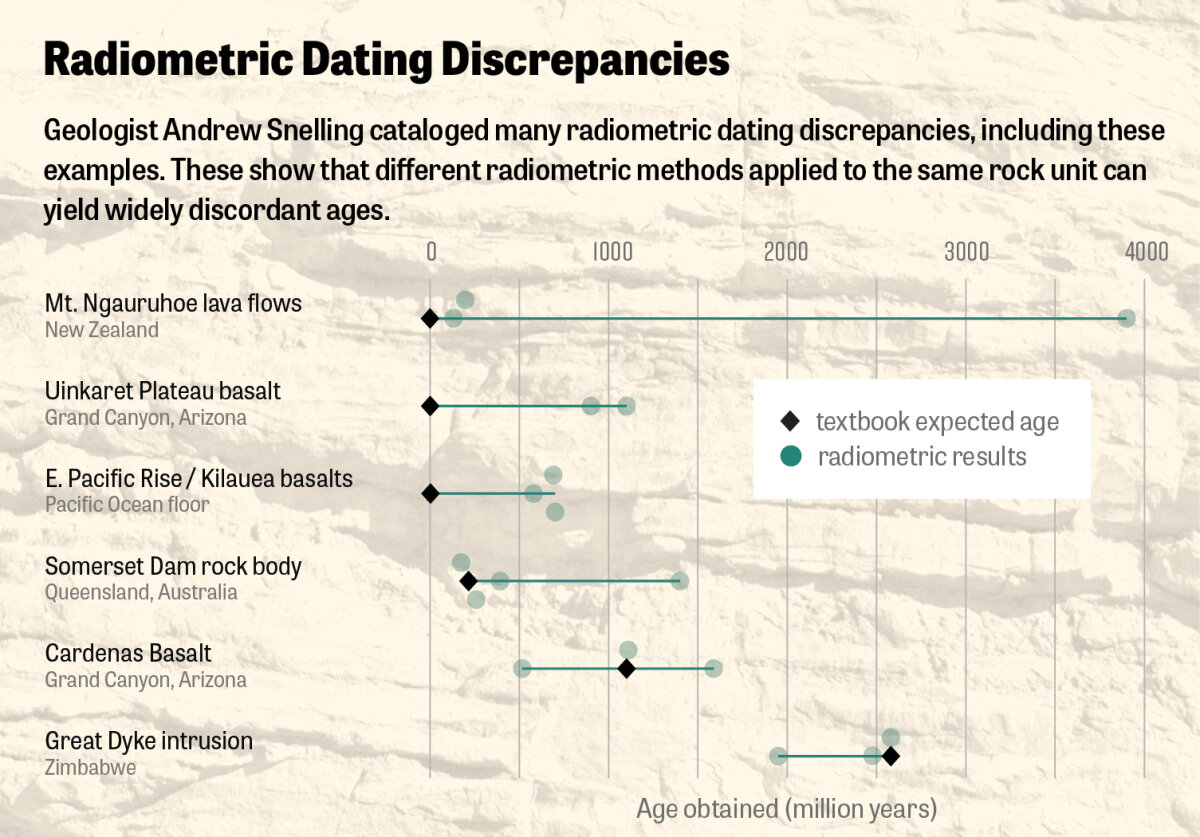
Something similar happened with potassium-argon dating on lava flows at Mount Ngauruhoe, New Zealand, known to be less than 50 years old: Calculated ages again ranged from hundreds of thousands to several million years, again blamed on excess argon. That’s an enormous margin of error. The oldest known human fossils, according to geologists, are about 2.8 million years old. The technique used to date them carries a multimillion-year margin of error.
Academic Fraud
Geologist J. E. O’Rourke is best known for his 1976 paper “Pragmatism Versus Materialism in Stratigraphy” and his 1978 historical analysis “A Comparison of James Hutton’s Principles of Knowledge and Theory of the Earth.” Both highlighted the circular reasoning built into using fossils to date rocks and rocks to date fossils. O’Rourke conceded the point directly: “The rocks do date the fossils, but the fossils date the rocks more accurately. Stratigraphy cannot avoid this kind of reasoning if it insists on using only temporal concepts, because circularity is inherent in the derivation of time scales.” Rather than reject the geologic timeline as unreliable, he argued the circularity was a pragmatic necessity—philosophically flawed, but a system that ultimately worked for mapping the Earth.
O’Rourke was talking mainly about fossil and stratigraphic dating, but the same pattern shows up with radiometric dates. In “Radiometric Geochronology Reappraised,” geologist John Woodmorappe surveyed hundreds of technical papers and cataloged well over 300 cases where a radiometric date conflicted with the age already expected from the fossil record—dates that were then set aside as anomalies rather than treated as evidence against the method itself.
In other words, because scientists assume the “Law of Faunal Succession” is true, they reason that radiometric dates that contradict the “Law of Faunal Succession” must be erroneous. In most of these cases, they say that the third assumption of radiometric dating has been violated and that the rock has been contaminated with outside parent or daughter isotope after it was formed. In some cases, they may be right, but excluding radiometric dates that contradict the “Law of Faunal Succession” means that radiometric dating is no longer an independent check on the circular reasoning Mr. Armstrong highlighted.
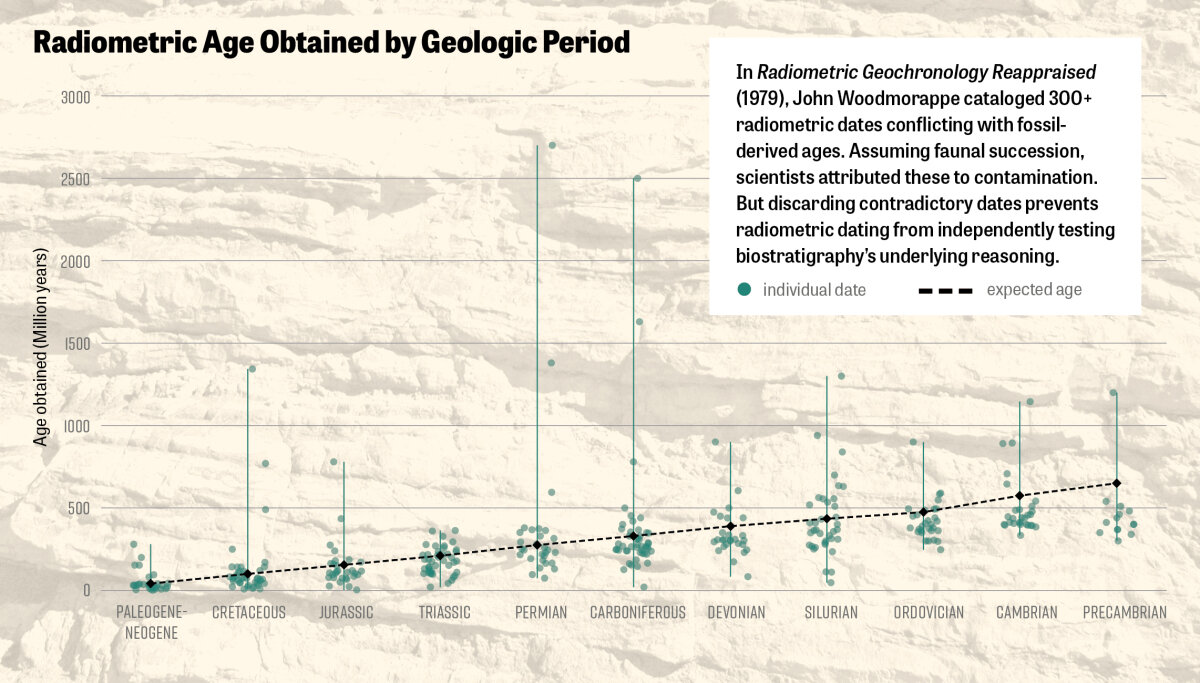
Interestingly, an eight-year research program done by the Institute for Creation Research and the Creation Research Society found that if you leave the so-called contaminated samples in the radiometric analysis, you get 15 percent error bars on all radiometric dates. Such a large margin of error is enough to discredit the “Law of Faunal Succession” by making it impossible to distinguish between geologic eras. This means that what evolutionists call subsequent geological eras may in reality be concurrent ecological zones of the prehistoric world.
A separate case makes the same point vividly. Richard Leakey’s team recovered a human-like skull in Kenya in 1972 near a layer of volcanic ash known as the kbs Tuff. Potassium-argon dating first put the tuff’s age at about 2.6 million years—squarely in the Neogene Period, far older than expected for the skull and tools found with it, even by evolutionary reckoning. After a decade of debate, new samples went to different labs, and this time the date came back around 1.9 million years. It fitted the expected time frame better, so scientists accepted it. What they should have admitted instead is that potassium-argon dating couldn’t reliably tell relatively young rock from rock supposedly millions of years old.
Findings like this show that radiometric dating isn’t really an independent check on the circular reasoning evolutionists use to date rock strata—it’s subject to the same after-the-fact adjustment. Scientists routinely reject dates that don’t fit their theory.
The problem shows up even more starkly with isotopic discordance: cases where different radiometric methods yield conflicting ages for the same rock. Andrew Snelling, a young-Earth creationist geologist, cataloged many such cases in his paper “Isochron Discordances and the Role of Inheritance and Mixing of Radioisotopes in the Mantle and Crust.”
One example: A rock formation in Queensland, Australia, conventionally dated between 216 and 225 million years old, was tested using potassium-argon, samarium-neodymium, and rubidium-strontium methods. The results: 174 million years, about 259 million years, and 393 million years, respectively. A single Late Triassic-Early Jurassic formation, in other words, comes out Jurassic by one method, Permian by another, and Devonian by a third.
That’s scientists unable to tell Devonian fossils from Jurassic ones—two layers supposedly separated by 160 million years. The idea that the “Age of Fishes” preceded the “Age of Amphibians” and the “Age of Reptiles” remains, at bottom, an unproven hypothesis.
A group of 19th-century geologists set out to “free the science from Moses.” They hypothesized that fish evolved before reptiles, then built a geologic column on that assumption. But the radiometric techniques meant to corroborate it sometimes disagree by more than a billion years—on a fossil-bearing column that’s supposed to span only about 540 million years in total. Using radiometric dating to distinguish between fossil strata, at that point, is like timing a 100-meter dash with a calendar.
Old Earth
Having concluded that the Earth had a beginning, that it was millions of years old, and that the geologic column rested on circular reasoning, Mr. Armstrong turned to an in-depth study of the Bible. He told his sister-in-law it was important never to study just one side of a two-sided question.
Some 60 years later, he summarized his life’s work in Mystery of the Ages—a book laying out a truth unrecognized by academia, religion or science alike: The Bible does not say that the Earth is 6,000 years old. Genesis 1:1 says, “In the beginning God created the heaven and the earth,” but the very next verse says, “And the earth was without form, and void; and darkness was upon the face of the deep. …”
God did not create the planet formless. Something must have gone catastrophically wrong—destroying all life on the planet and forcing God to renew the face of the Earth. Scriptures including Isaiah 14:12-15, Ezekiel 28:15-19, 2 Peter 2:4, and Jude 6 point to an angelic rebellion as the cause. As Mr. Armstrong explained, the creation described in Genesis 1:2-31 “could have been millions or trillions of years after the actual creation of the Earth described in verse 1.”
Radiometric dating and the fossil record do show that our present world sits atop the ruins of a far older one, one that existed for millions of years before any human walked the Earth. What they don’t show is that the fossil record can be sorted into a branching “tree of life,” proving every species descended from one common ancestor over billions of years. That diagram is a human construction—the fossil record arranged to make it look like life evolved from simple to complex.
So the modern claim that radiometric dating checks the circular reasoning 19th-century evolutionists relied on doesn’t hold up under its own weight. At best, it sorts the fossil record into only the vaguest outline. Rocks containing human fossils do, as a general rule, contain less daughter isotope than rocks containing dinosaur fossils, suggesting the two never coexisted. But between measurement errors and isochron discordances, scientists still can’t reliably tell a 10-year-old rock from a million-year-old one, or Devonian strata from Jurassic.
The geological literature is full of examples of dates being rejected because they do not fit the expected age. Modern technology hasn’t broken the circle. Evolutionists are still reasoning inside it.
Mr. Armstrong put it this way: “Error generally comes from assuming a false premise, taken carelessly for granted without proof, and building on that premise.” Darwin’s false premise—the one everything else was built on—was the “assumption that, in the study of paleontology, the most simple fossils were always in the oldest strata, laid down first.”
Prove that premise false, and the entire structure built on it comes down with it.