
Resisting Barbarism
For centuries, the Barbary pirates terrorized much of the world. Operating from what is now Algeria, Libya, Tunisia and Morocco, these Islamic corsairs were active in great force by the 1400s and remained a brutal menace for hundreds of years. Any ship navigating the Mediterranean or the North African Atlantic coast sailed under constant threat.
Victims were killed or, more often, enslaved. The scale was staggering. Holy War and Human Bondage author Robert Davis shows that between 1530 and 1780, Barbary pirates enslaved as many as 1.25 million people, mostly Christian Europeans. Some captives were forced to work for and kill for the pirates. Most were sold in slave markets in Algiers or Tripoli to become laborers or concubines. Captives from wealthier families were sometimes ransomed. Most died in bondage.
This was a dark and pernicious evil that needed to be confronted.
Barbary Barbarism
The danger was not limited to those out at sea. Barbary corsairs also carried out razzias—raids on coastal towns, mainly in France, Italy, Portugal and Spain, and sometimes as far as Britain, Ireland and even Iceland. Backed by North African Islamic governments and the mighty Ottoman Empire, this was not furtive, sporadic crime perpetrated by ragged, skittish misfits but rather a vast, sustained enterprise.
The scourge not only afflicted Europe but powers trading with the Europeans, including those in North America. Before the United States won its independence, American colonists enjoyed the protection of Great Britain’s Royal Navy. But that safeguard ended abruptly in 1776, leaving American vessels to fend for themselves against the numerous, well-established and well-armed Barbary pirates. And after all the tea the Americans spilled into Boston Harbor, the Brits even spilled some of their own, spreading word to the pirates that U.S. ships were no longer under protection.
To make matters worse, many Barbary pirates believed they were waging holy war against Christian Europe. Theirs was an Islamic naval jihad. This religious conviction intensified their zeal and ruthlessness. Their violence and enslavement were viewed not merely as justified but righteous.
“Now I have got you, you Christian dogs,” an Algerian slaver told American seaman John Foss and his crew upon capturing them in 1793. “You shall eat stones.”
After three years in captivity, Foss enumerated the punishments he and his fellow “Christian slaves” suffered at the hands of the Barbarys: “[I]mpalement upon an iron stick thrust up through his posterior, having one’s head chopped off, castration, being cast off the walls of the city upon an iron hook, and nailed to the gallows by one hand and opposite foot. Of course these were the worst of the punishments, and often floggings and random beatings were the everyday form of punishment.”
Some nations attempted to protect their citizens from this nightmare by paying tribute. But the Barbarys’ prices kept going up, and their promises were little more than wind and spray. Tribute reduced attacks and enslavements but never eliminated them.
The pirates terrorized the seas year after year, decade after decade, century after century. But as the calendar page turned to the 1800s, on the opposite end of the Atlantic, currents were shifting.
‘Chastise Their Insolence’
Struggling with economic fragility and political division, the newly launched United States was still finding its sea legs and trying to establish its position in the choppy waters of international relations. Its earliest administrations experimented with paying Barbary tribute. But with the tolls ever rising and the guarantees never truly guaranteed, the patience of many Americans had run aground.
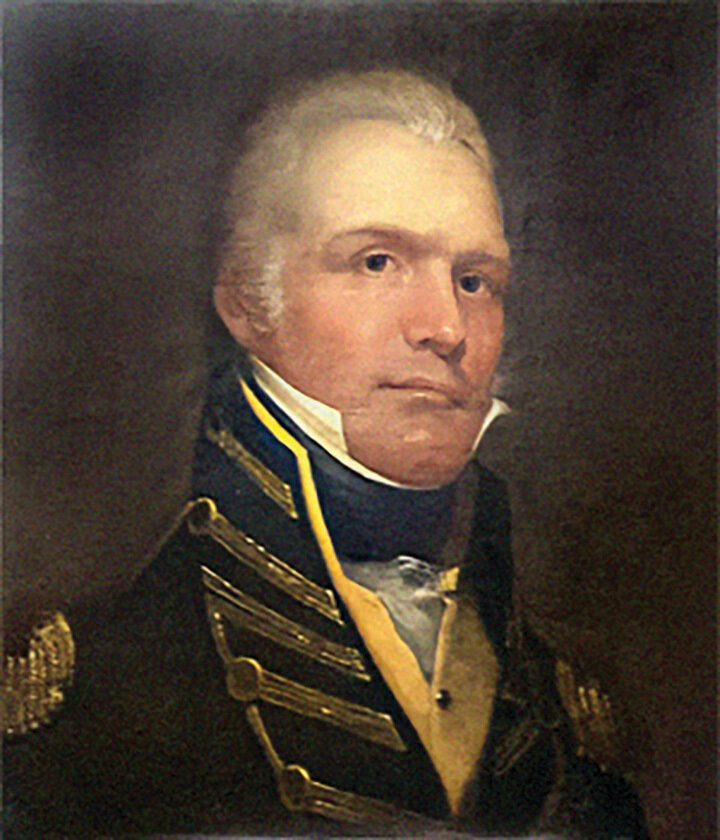
“The more you give the more the Turks will ask for,” U.S. Army officer William Eaton wrote. It was a reality he understood firsthand. From 1797 to 1801, he worked as consul general to Tunis, in modern Tunisia, with the goal of negotiating better terms for American commerce. As Barbary demands and barbarity increased, Eaton became one of the loudest critics of the tribute system. For the young United States of America, he warned, it was a course with no safe harbor.
Thomas Jefferson agreed with this view, labeling the payments a “humiliation.” When he became president in 1801, he resolved to meet Barbary terrorism not with treasure but with the cut of steel.
On May 13, 1801, Jefferson deployed a small squadron from the nation’s 25-year-old navy to the Mediterranean Sea. Their orders: “Chastise their insolence—by sinking, burning or destroying their ships and vessels wherever you shall find them.”
The Barbary pirates by this point had been operating for more than 300 years. They had nearly 100 battle-hardened crews, sailing expertly designed ships, calling on robustly fortified bases, and enjoying cover from the Islamist-ruled, Ottoman-aligned regencies.
The Americans had three frigates and a schooner, and no ground troops to support maritime operations. Though some battles were won, the outcomes were mixed. The frigate uss Philadelphia was lost in 1803, its crew captured.
The decisive victory that Jefferson and the rest of America sought remained a figment on the horizon.
But in 1804, Eaton returned to the Mediterranean, this time with the commission of a navy lieutenant. And he brought with him an audacious plan.
Restore a Ruler, Earn an Ally
Ruling over Tripoli and other parts of modern-day Libya was a man named Yusuf Karamanli. Yusuf had seized power in the early 1790s first by killing his oldest brother Hasan, in front of their mother no less, and then by exiling his second-oldest brother Hamet, who was next in line, to Egypt. Yusuf then established himself in Tripoli as a major perpetuator and powerbroker of the Barbary slave system.
In this dark sibling rivalry, Eaton saw an opportunity for America: If the U.S. could restore Hamet Karamanli to power, the Americans would have a major ally in the region and weaken or eradicate piracy at one of its strongest ports. The trouble was that a battle against Yusuf Karamanli’s fortified coastal cities could not be won from the sea alone. The Americans would also need boots on the ground.
If the plan failed, not only would the ships and crews of America’s fledgling navy be in jeopardy, but the land troops supporting Hamet would be stranded deep in hostile territory.
Eaton requested that a contingent of 100 marines join him to “place the success beyond the caprice of incident.” Jefferson authorized the mission, but Eaton was given just seven marines. With this modest detachment, he entered Egypt and met Hamet in Alexandria. Hamet required little persuasion to rally behind the plan, and he helped Eaton recruit Greek and Arab mercenaries.
They determined that the city of Derna on Libya’s coast would be the place to first confront Yusuf’s forces and to install Hamet. The plot was coming together. But seizing Derna was only half the battle. Reaching the city on foot would be just as treacherous.
A Miracle March
On March 6, 1805, Eaton, Hamet and the seven marines began walking westward from Alexandria. With them were nearly 400 Arab and 67 Greek mercenaries, as well as 190 camels bearing supplies. Their destination was 500 miles of cruel desert away. And the trek happened to coincide with Khamsin season, when a scorching Saharan wind whips sand northward across the desert, relentlessly battering anyone unsheltered.
In these conditions, the motley crew managed fewer than 20 miles each day.
Not even a fortnight into the journey, supplies were dwindling and rations had to be reduced. Eaton wrote in his journal: “We have marched a distance of 200 miles through an inhospitable waste of world without seeing the habitation of an animated being, or the tracks of man, o’er burning sands and rocky mountains. … Our only provisions [are] a handful of rice and two biscuits a day.”
They slaughtered every camel they could spare without losing the means to carry the weaponry they would depend on in Derna and other supplies. Still, the hunger of so many men burning through endless calories raged on.
Locating water proved to be a constant battle. One marine described a long-belated drink from a putrid puddle as “more delicious than the most precious cordial.” Several days later, the group found a cistern contaminated by the rotting corpses of two apparently murdered men. “We were obliged nevertheless to use the water,” Eaton wrote. At another point, they went 47 hours without a drop.
The weary, sand-pelted, desiccated column trudged on, toward the opportunity to face gunshot, cannon fire, slashings, capture, torture and death.
On one occasion, hunger and thirst and concerns about their pay compelled a number of the Arab mercenaries to raid the group’s supply wagon. The marines, backed by the Greeks, narrowly beat them back. In the aftermath, many Arabs left the group to return to Egypt.
Eaton faced two more attempted mutinies, and Hamet himself even packed up his tent at one point, demoralized and vowing to return to Alexandria. Eaton persuaded him to press ahead.
In late April, after almost seven weeks of crushing slog, the group reached the port city of Bomba. Their bodies were gaunt, stomachs empty and strength nearly gone. According to National Museum of the Marine Corps curator Kater Miller, completing the march “was a miracle itself.”
At this location a few dozen miles east of Derna, the men spotted three faint shapes floating on the horizon: The American warships Hornet, Argus and Nautilus sailing their way toward shore with food and water.
“Language is too poor,” Eaton wrote, “to paint the joy and exaltation.”
The American sailors provided Eaton’s men food, water, pay for the mercenaries, hope and a promise spoken like fair wind: They would join in the battle ahead and provide offshore bombardment.
‘To the Shores of Tripoli’
Much refreshed, Eaton’s group left Bomba on April 23 to walk the final miles to Derna. Two days later, they were upon the city. Several sheikhs came out to the American camp to swear their loyalty and that of two thirds of the city population to Hamet Karamanli. Yet they also brought grim news: The city’s governor, Mustafa Bey, was staunchly aligned with Yusuf Karamanli. Mustafa commanded 800 soldiers and formidable artillery and would soon be reinforced by a force from Yusuf that was fast advancing from Tripoli.
Eaton sent a message to Mustafa. “I want no territory. With me is advancing the legitimate sovereign of your country. Give us a passage through your city; and supplies of which we shall need you shall receive fair compensation. Let no differences of religion induce us to shed the blood of harmless men who think little and know nothing.”
Mustafa was unimpressed. His reply wasted no words: “My head or yours.”
At this reply, many of Eaton and Hamet Karamanli’s remaining mercenaries took action. “The Arabs mutinized,” Eaton wrote, and “took up a retrograde march.”
But Hamet and his entourage along with the Greeks remained. And at dawn on April 27, what was left of the group awoke to the reassuring sight of the three U.S. warships afloat off of Derna, prepared for combat. At the same time, Eaton received word that Yusuf’s reinforcements were just over two days away. The time to strike was now.
After delivering two field pieces to Eaton’s forces “with much difficulty,” the crews piloted the warships near the Derna shoreline. Favorable winds allowed them to anchor remarkably close. At the same time, the Americans and Greeks—perhaps as few as 80 men—took up forward positions, readying for one of the first joint-force strikes in U.S. military history.
“Assaulting a fortified coastal city, with a handful of marines, bolstered by a mercenary army against numerically superior defenders was a tremendous gamble,” Miller wrote.
But however long the odds, Eaton’s crew would see their mission through—or die in the attempt.
Against the Odds
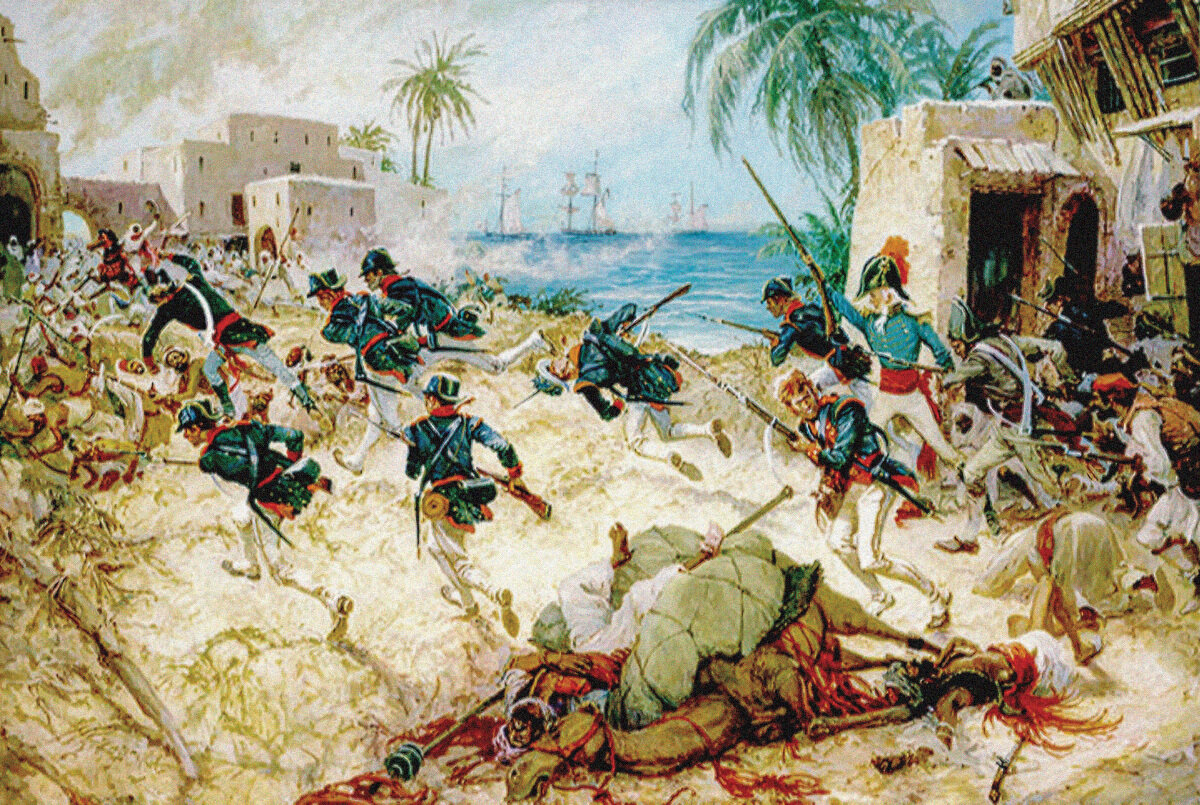
Around 1:30 in the afternoon, Mustafa’s forces opened fire on the anchored U.S. ships, and the Americans thundered back, bombarding the town with cannon fire. Eaton and 1st Lt. Presley O’Bannon led the marines and Greeks, delivering coordinated fire on Mustafa’s men from positions along the town’s perimeter.
Within 45 minutes, the U.S. cannons had silenced Mustafa’s city batteries. His artillerymen abandoned their positions to turn their attention and rifles toward the marines. With heavy musket fire pinning them down, and with the field pieces moving too slowly, Eaton gave a desperate order: Charge!
“We rushed forward against a host of savages,” he wrote, “more than 10 to our 1.”
Seconds into the charge, a Barbary bullet mangled his wrist. But he and the men he led charged on, and the defenders were left with a grim choice: Stand and fight, or flee for their lives.
The unyielding resolve of the advancing men broke their nerve. They chose flight.
The Americans captured the Barbary’s main battery overlooking the port as Mustafa Bey fled the city alongside what was left of his forces.
By 4 p.m., United States Marines held the city of Derna. O’Bannon tore down the Barbarys’ flag from the ramparts and, for the first time in history, raised an American flag over a conquered city on foreign soil.
The triumph was spectacular. But they had paid for it in blood. Marine Pvt. John Wilton was killed in the assault, and Pvt. Edward Stewart was mortally wounded. Along with Eaton, Corporals David Thomas and Bernard O’Brian were wounded, as were nine Greeks.
But the Battle of Derna was an improbable and awesome victory against wicked terrorism. And it is famously celebrated to this day in the Marines’ Hymn, a verse of which says: “From the Halls of Montezuma to the shores of Tripoli, we fight our country’s battles in the air, on land and sea.”
Jefferson’s decision to fight the pirates rather than paying them also signaled that America was ready to stand up to foreign threats, strengthening national pride and establishing the nation as an emerging naval power.
The Barbary pirates and their brutal slavery would not be fully defeated until years later. But the victory forced Yusuf Karamanli to sue for peace and free many of his American captives, and it put a decisive end to the U.S.’s annual tribute payments. Analysts agree that this battle marked a turning point for the overall Barbary operation, dealing it a history-altering blow that set it on a course that would end in wreckage.
It was a pivotal success, not merely because of tactics or strategy, but because a few men of integrity refused to compromise with evil. Their steadfastness carried the day. It delivered victory where lesser courage would have certainly failed. As Psalm 119:1-3 declare, “Joyful are people of integrity …. They do not compromise with evil, and they walk only in his paths” (New Living Translation).
In the refusal of Jefferson, Eaton and his men to yield to wickedness, their honor became their weapon, and their conviction, a force more decisive than any cannon could be.