
The Unthinkable Will Happen
Over 100 million Americans were introduced to the grim prospect of nuclear war on Nov. 20, 1983. Nearly 39 million households sat in front of their televisions to watch The Day After, a film depicting nuclear conflict between the United States and the Soviet Union.
The unsettling film left Americans sobered and terrified. Its graphic depictions of instant incineration, nuclear fallout, radiation sickness and humanity’s desperate and chaotic response to nuclear crisis sparked national dialogue. Americans stopped to consider how mutually assured destruction could affect their lives, homes and families. Dinner table discussions centered on what must be done to prevent such a crisis.
Cold War-era Americans viewed nuclear conflict with the Soviets as a real and imminent possibility. Many homes had fallout shelters in their backyards. Children practiced nuclear drills as well as fire drills in school. But The Day After and other films brought the nuclear threat right into living rooms. It showed Americans a horrifying picture of what this kind of war would look like for them individually.
In the four decades since, Hollywood has created dozens of films and tv shows about nuclear war. Dystopian television and movie plots project what the world could look like in the days after an attack. Such films have become so prevalent that a New York Times article in January was headlined “Nuclear Anxiety, That Staple of 1980s Cinema, Is Back.” Americans flock to the movie theater to watch Oppenheimer and A House of Dynamite. They stream the Chernobyl series and dystopian drama Silo from their living rooms. Nuclear war is today’s entertainment.
But instead of frightening Americans into considering what must be done to prevent worldwide nuclear cataclysm, nukes have turned into a plot point. Postapocalyptic films may bring a temporary shudder, but public concern and calls for denuclearization are muted.
In 1983, the United States was shocked into deeply considering the horrors of nuclear war. In 2026, nuclear war is a far more urgent threat than ever—yet Americans yawn.
Herbert W. Armstrong wrote in the Plain Truth, “The television movie on nuclear war, The Day After, has shaken a world from its complacent, indifferent slumber. Too many people were getting used to violence and war and threats of war” (March 1984; emphasis added throughout).
How much more used to this threat are we today? How much more is the world lulled into a “complacent, indifferent slumber”? If the YouTube comments for the trailers of recent nuclear war movies are any indication, a lot of people consider the nuclear threat an overused trope or even a joke.
If we recognized the true and imminent reality of nuclear war, we would take the threat more seriously instead of viewing it as an unpleasant and impossible fiction.
Increasing Threats
The nuclear arms race is an infinitely more present threat today than it was four decades ago. A new nuclear arms race is underway, and no country wants to be left behind.
There are more than 12,000 nuclear weapons on Earth today, spread across nine different nations. Russia and the U.S. possess between 85 and 90 percent of the world’s nuclear weapons. China’s nuclear arsenal is growing steadily. Other powers are working to expand or create their own nuclear armories.
The New start treaty expired on February 5, ending the last nuclear arms control agreement between Russia and the U.S. This was one reason the Bulletin of the Atomic Scientists moved the Doomsday Clock forward to 85 seconds to midnight. The U.S. allowed it to expire partially because the treaty didn’t limit China’s nukes. But calls for new nuclear arms control agreements are being drowned out by the intensifying pursuit of these deadly weapons.
Europe wants to build a nuclear arsenal independent of the United States. Germany has relied on nuclear sharing with the U.S. for decades, but now it is quietly scoping the options for getting its own nuclear bombs. Saudi Arabia is also testing the waters, allying with nuclear nations in the hope that it may one day get its own nuke. Russia is testing its nuclear-capable Oreshnik hypersonic missile in the Ukraine War with nonnuclear payloads. Iran will not give up its pursuit of nuclear weapons despite efforts by Israel and the United States to thwart it.
Ironically, while all this activity is intensifying, President Donald Trump is boasting about solving wars and making deals for world peace. This is a delusion. The world is not on the cusp of peace—it is preparing for war on an unimaginably destructive scale.
‘No Flesh Saved’
In 1983, most Americans turned off their tvs after watching The Day After. Had they kept watching, they would have heard a panel of experts discuss the key questions of the film: What can be done to prevent nuclear war? Is there still time?
These questions are even more relevant today. Nuclear Armageddon is at our door.
Matthew 24:21-22 describe the unthinkable: “For then shall be great tribulation, such as was not since the beginning of the world to this time, no, nor ever shall be. And except those days should be shortened, there should no flesh be saved: but for the elect’s sake those days shall be shortened.”
These verses describe a time when it is possible to blast all human life out of existence. Only since the advent of weapons of mass destruction has this been a possibility. Without supernatural intervention, nuclear warfare will exterminate mankind!
The thousands of nuclear weapons at man’s disposal will be used. My father, Trumpet editor in chief Gerald Flurry, wrote in our February 2014 issue: “The Second World War ended with the development and use of the nuclear bomb. A world war where many nations—some of which sponsor terrorism—start out with nuclear weapons is an unparalleled nightmare! We can’t even imagine how bad it will be!”
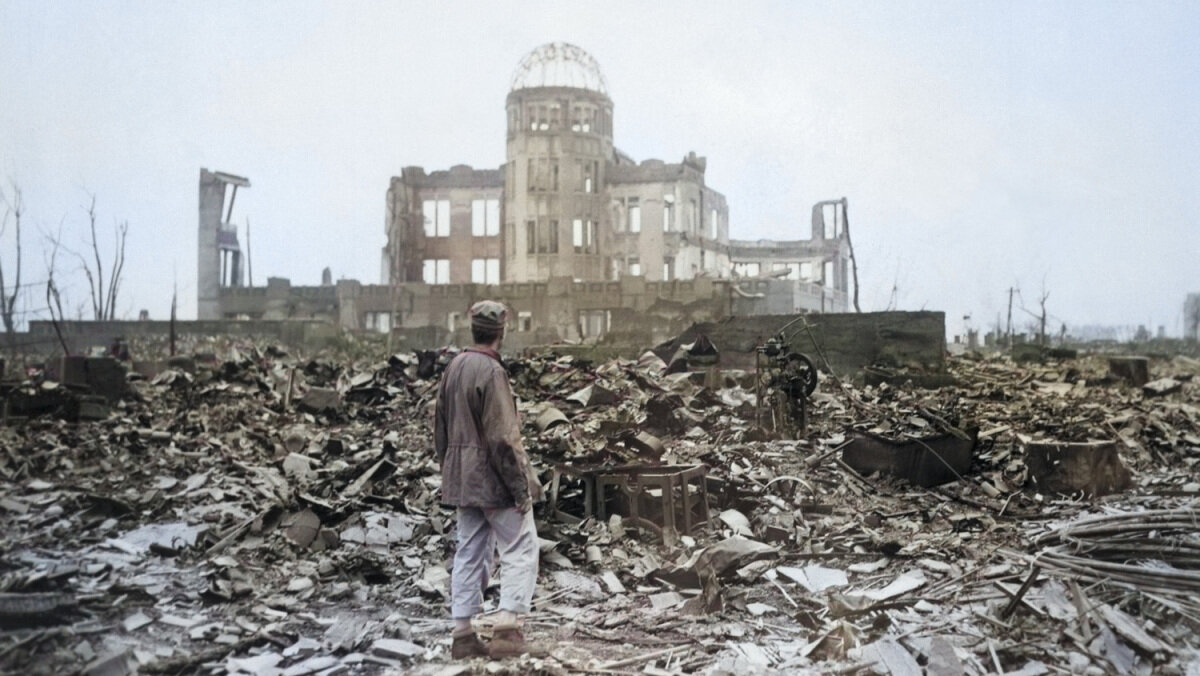
If Western democracies barely survived the war that introduced us to the atomic age, what will happen when the next conflagration begins with nuclear weapons? The magnitude of destruction in this third round will be unlike anything ever seen!
My father continued, “These problems are almost too horrifying to even contemplate. That is why most people ignore the potential for nuclear war. But we won’t be able to ignore it for much longer. Biblical prophecy makes that plain.”
Humanity now has the power to exterminate all human life. That is the ultimate achievement of man!
The Day After ended with this disclaimer: “The catastrophic events you have just witnessed are, in all likelihood, less severe than the destruction that would actually occur in the event of a full nuclear strike against the United States. It is hoped that the images of this film will inspire the nations of this Earth, their peoples and leaders, to find the means to avert the fateful day.”
But is there any way to “avert the fateful day”? As mankind races toward destruction, is there any hope?
‘It Must Be of the Spirit’

Gen. Douglas MacArthur warned America in 1945: “Men since the beginning of time have sought peace. … Military alliances, balances of powers, leagues of nations, all in turn failed, leaving the only path to be by way of the crucible of war. The utter destructiveness of war now blots out this alternative. We have had our last chance. If we do not devise some greater and more equitable system, Armageddon will be at our door. The problem basically is theological and involves a spiritual recrudescence and improvement of human character that will synchronize with our almost matchless advance in science, art, literature and all material and cultural developments of the past 2,000 years. It must be of the spirit if we are to save the flesh.”
General MacArthur was right. Addressing our spiritual problems is the only way to save humanity from extinction. Unless we repent, terrifying punishment is coming on our nations because of our national and individual sins.
The Bible pronounces woe on today’s political and religious leaders who are “at ease in Zion, and to those who feel secure on the mountain of Samaria” (Amos 6:1; Revised Standard Version). Our leaders are not vigilant! They are “at ease”—lulled into a false sense of security. We think we are too advanced, too sophisticated to use these awe-inspiring weapons. But history and prophecy show that nuclear war is certain. It will require divine intervention to prevent man from obliterating human life!
Jesus Christ will return to save humanity from itself, ushering in a new world of true peace. This is the hope that must light our way through the coming crisis.
The Day After made the public aware of the horror of nuclear Armageddon. Bible prophecy makes it clear that the nuclear Armageddon America once feared is now at our door. Are you emotionally and spiritually prepared for this staggering turn in world events?
1 Peter 4:7 says, “But the end of all things is at hand: be ye therefore sober, and watch unto prayer.” “The fact that Christ’s return is so near should change our behavior,” my father writes in The Epistles of Peter—A Living Hope.
It may be too late for our nations, but individuals can still turn to God in repentance. Revelation 12 and Matthew 24 reveal that God will protect His faithful people from the coming nuclear destruction. Only God can lead us out of the coming crisis. The future is hopeless without Him.
As the 10-nation European superstate begins to form, international trade blocs take shape against the United States, and madmen seek to increase their nuclear arsenals, we must face reality. Time is short. Nuclear war is coming.
The unthinkable will happen. How will you respond?
Jesus Christ Himself foretold of nuclear war as a sign of the end of the age—and of the greatest event in history. Learn about it in Gerald Flurry’s free booklet Nuclear Armageddon Is ‘At the Door.’