
“Help is on the way.”
Millions of people had been ground into poverty, suffering under a failing economy. Hundreds of thousands finally couldn’t take it anymore and started bold, brave street protests. Bold and brave, because these people were Iranians, and the regime they were protesting is a violent, radical tyranny that they knew could ruin—or end—their lives.
That is exactly what it began to do. But they had hope: “Help is on the way.”
United States President Donald Trump addressed the Iranian protests on January 2, warning the regime that if it met the protesters with violence, as it had done with previous unrest, U.S. forces were “locked and loaded and ready to go.”
A number had already been murdered, but less than a week after Trump’s warning, agents of Iranian Supreme Leader Ayatollah Ali Khamenei committed the worst massacre in living memory: On January 8-9, they killed tens of thousands of Iranians.
President Trump posted a response on January 13. It should haunt him as it haunts the Iranians who trusted his words: “Help is on the way.”
Help never came.
Why? Multiple explanations flooded the news cycles: insufficient military assets in place; the generals dissuaded the president; Arab governments deterred him; Israel, bafflingly, discouraged him from acting; the tough talk was actually intended to pressure the Iranians into negotiating another nuclear deal.
Whatever the case, Trump publicly promised to save protesters from the violence of the Iranian regime, had the power to dispatch U.S. forces—but didn’t.
Hadis, a 36-year-old resident of Tehran, protested because she believed Trump’s promise. “Our eyes were fixed on the sky,” she told the Washington Post, “like something will happen. He’ll hit now. We came out [to protest] with fear, but we had hope that Trump will strike now, will kill these guys.”
Siavash, a 38-year-old father, also responded to the president’s call and joined the protests on January 8. “Siavash hoped until the very end that Trump’s help would arrive,” his cousin told the Guardian. “We told him: ‘Don’t go, it’s dangerous.’ But he gave a firm answer: ‘Trump said he supports us, I’m going.’”
Now he’s dead.
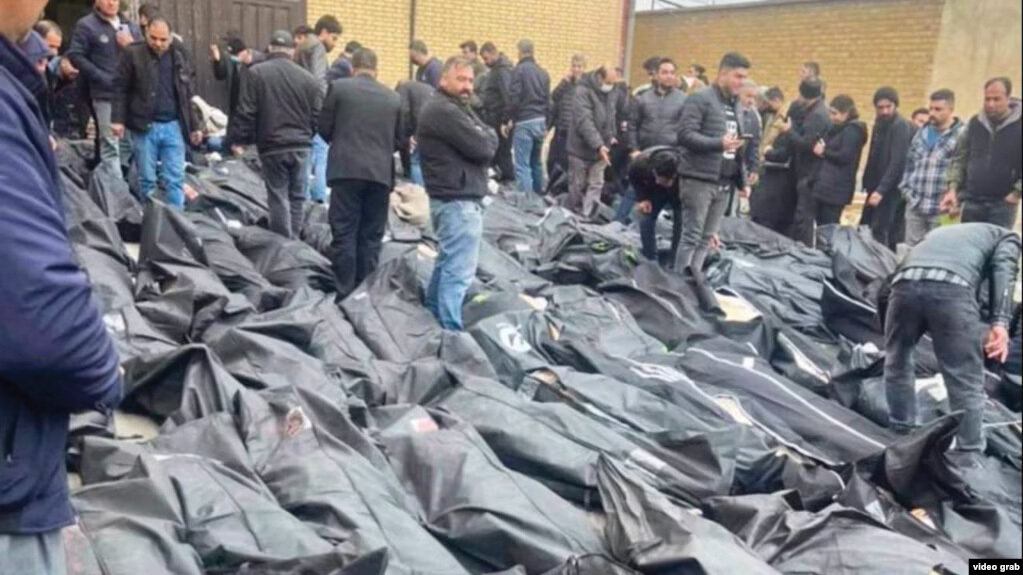
Ahead of the January 8-9 massacres, Iran’s authorities used their control of Internet utilities to block service nationwide. Even those who tried to use satellite Internet technologies like Starlink to get the truth out were reportedly jammed with military-grade technologies. So the true numbers of those murdered by the Iranian government may never be known. But two Iranian Health Ministry officials told Time magazine there could be as many as 30,000. Dissident group Iran International reviewed information including documents from the Islamic Revolutionary Guard Corps (irgc), and estimates the death toll surpassed 36,500.
Leaked video footage shows rooms stacked with dead bodies. Eyewitness accounts obtained by the Sunday Times say gunmen from the irgc and other government agencies fired into crowds with Kalashnikovs from motorbikes and with machine guns mounted on pickup trucks. They indicate government forces hunted down wounded protesters in hospitals for execution. Images show corpses with medical tubes and other equipment still attached.
The Legacy of a Peacemaker
At his 2025 inauguration, President Trump said his “proudest legacy will be that of a peacemaker and unifier.”
Another president who wanted to bring peace to the Middle East was George H. W. Bush. He ordered America’s military to evict Saddam Hussein’s Iraqi forces from Kuwait. He also encouraged Iraq’s Kurds to rebel against their socialist dictator. Many answered his call. Hussein responded by gassing them with chemical weapons, murdering thousands, and causing millions to flee as refugees.
At the time, Trumpet editor in chief Gerald Flurry called America’s failure to respond to Hussein’s attacks on the Kurds “the greatest betrayal in U.S. history!” He stated this from a moral position not a political one: “How can these poor wretched people understand ‘geopolitical explanations’ or ‘balance of power’ solutions as they hunger, get sick and die?” (Trumpet, May 1991).
How President Trump failed the Iranian people is analogous to how President Bush failed the Kurds.
Aanahita, a 45-year-old Iranian woman living in Turkey, told the Washington Post: “I kept thinking about how helpless we are that we have to pray for another country to attack us for our salvation and freedom. But today, more than anything, anger is surging through me. I feel like Trump has backtracked again and traded the lives of Iran’s youth.”
“Most Americans seem to accept our betrayal of the Kurds and Shiites,” Mr. Flurry’s article continued. “That is an attitude that needs to be changed because America, England and modern Israel are all going to suffer that same fate unless we repent of our many sins.”
Daniel 11:40 prophesies the rise of “the king of the south” in “the time of the end.” Since the 1990s, Mr. Flurry has identified this bloc as radical Islam led by Iran. The aggressive regime leading this Middle Eastern power bloc will provoke a worldwide “time of trouble, such as never was since there was a nation even to that same time …” (Daniel 12:1).
When Mr. Flurry said Iran would lead the king of the south, the nation was unknown to most people. It was the region’s newest and least stable regime with the third-largest economy and sixth- or seventh-strongest military. Fast-forward to today, and that same regime has gained massive strength in the region and beyond through its sponsorship of terrorism and its pursuit of nuclear weapons. It wants to wipe the Jewish state off the map. It has violently put down repeated protests and engaged in a seemingly interminable foreign-policy “push” (Daniel 11:40) against its neighbors, Europe and even the American superpower.
Iran’s citizens, desperate for freedom, rejected this regime and begged America for help, and America promised to help. America had the power to do something. It promised.
The blood of tens of thousands is on its hands. And Bible prophecy warns that the killing—in the Middle East and far beyond—is only getting started.
Iran’s massacre should wake America up to the state of the world, the nature of the Iranian regime, and the crying need for righteous use of words, promises, threats and military power.
The future of Iran’s terrorist regime—and the role of righteousness and sin in global conflict—is explained in Gerald Flurry’s free booklet The King of the South.