
What Is the Future of Venezuela?
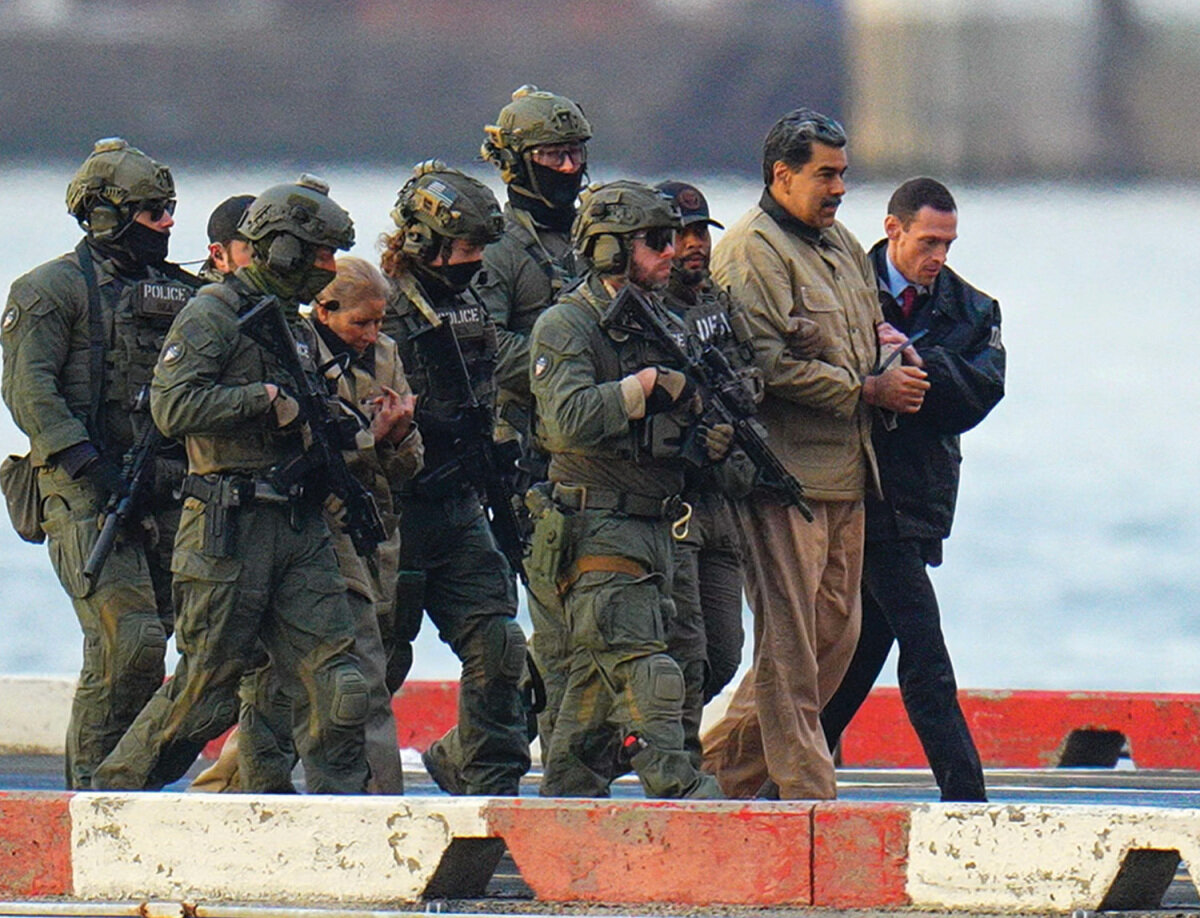
On January 3, the geopolitics of the Western Hemisphere transformed literally overnight. In an estimated 140 minutes, United States forces neutralized Venezuela’s air defenses and communications, entered its airspace, dropped special operations troops into a fortified complex within a fortified air base, located and captured dictator Nicolás Maduro and his wife before they could lock themselves in a safe room, and flew them to the uss Iwo Jima, then to Guantanamo Bay Naval Base, then to New York, where he was charged with drug trafficking and terrorism crimes. No Americans died in the operation.
This has to be one of the gutsiest moves by a modern U.S. president.
But Maduro’s socialist regime, despite its narco-terrorism, extrajudicial killings and other crimes, is still in place. His vice president, Delcy Rodríguez, is now in charge. At the time of writing, little has changed on the ground for the people of Venezuela. But for U.S. overseas influence and geopolitics, the raid and its effects are monumental. This could be a major turning point in America’s security situation.
Could be.
America is at a crossroad. Whether this becomes a blessing or a curse depends on what President Donald Trump does next.
Crimes of the Regime
Since 1999, when socialist revolutionary Hugo Chávez become Venezuela’s president, the nation has been under an authoritarian socialist dictatorship. The government nationalized major industries; worked closely with Cuba, Russia and China; and rigged elections.
In 2013, Chávez died and Maduro took over. Since then, Venezuela has become a case study for everything that could go wrong with a country. Hyperinflation has gutted the economy, leaving millions unemployed and pressuring millions to flee the country as refugees. Between 2010 and 2023, the number of Venezuelans immigrating to the U.S. grew by 318 percent. Teachers, doctors and others of formerly respectable employment readjusted to becoming smugglers, prostitutes and drug dealers. Maduro’s regime locked up hundreds of political prisoners, and has been accused of extrajudicial killings.
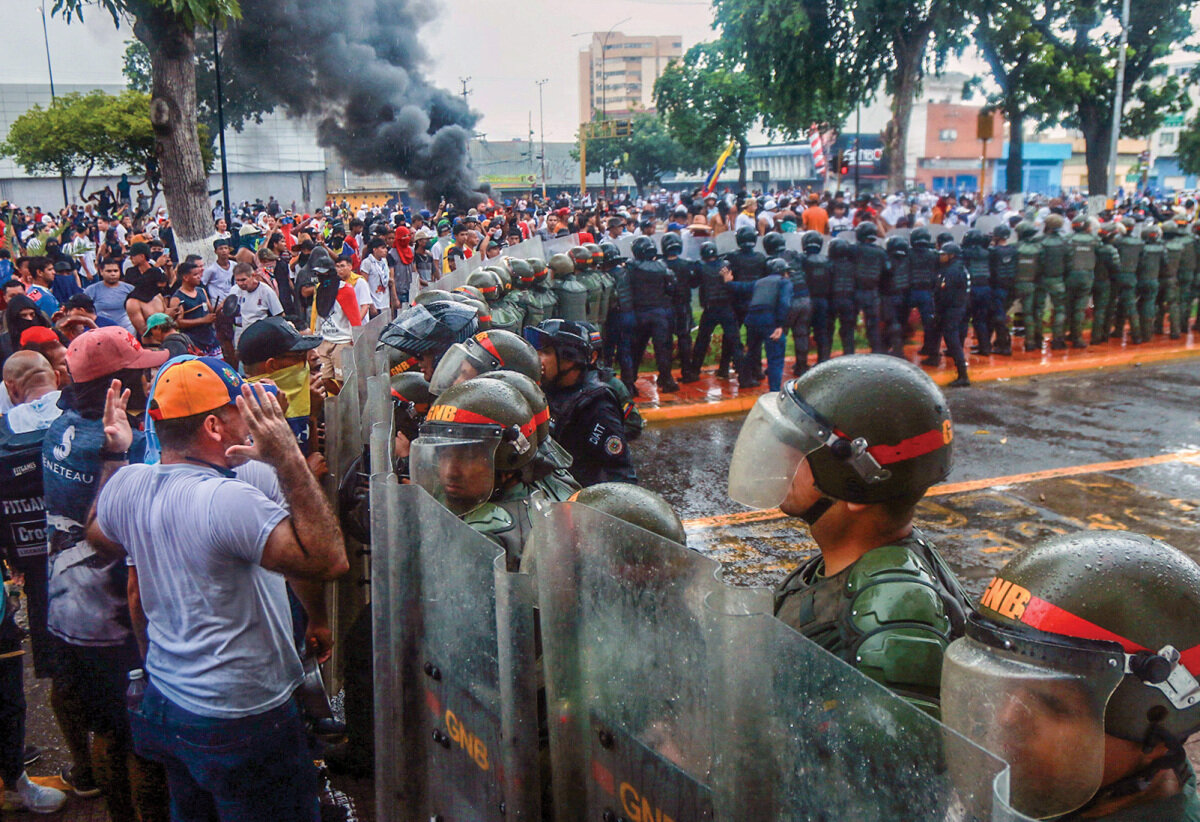
Venezuela’s failure as a state has opened the doors to gangs perpetrating thefts, extortions, robberies, prostitution, kidnapping and murder. One human rights group estimates the cartels’ trade in illegal drugs in Venezuela generated over $8.2 billion in 2024, mostly in cocaine and mostly bound for the United States. The most notorious Venezuelan cartel is Tren de Aragua, but Mexico’s Sinaloa Cartel and affiliates of Colombian farc guerillas are also involved. Then there is the so-called Cartel de los Soles. The “Cartel of the Suns” is a generic name for a loosely connected cabal of corrupt government and military officials (the sun emblem is the insignia of Venezuela generals). They protect drug traffickers and take a cut of their profits.
All this has not endeared Maduro’s Venezuela to the U.S. or to the West at large. So Maduro turned to U.S. enemies for support. For decades, these adversaries have proved all too eager to help relieve Venezuela’s debt, provide billions for its military and security apparatus, and prop up its dictatorship in return for cheap Venezuelan oil and new vectors of attack against American power in the Western Hemisphere.
Cuba also was a major sponsor of Maduro’s regime. Cuba needed Venezuelan oil to function, and Venezuela needed Cuba’s expertise in intelligence and repression. Maduro also hired Cuban bodyguards. The two nations were so intertwined that some analysts call the two nations “Cubazuela.”
Friends Like These
Another U.S. enemy to partner with Venezuela is Iran. Both countries are frozen out of the world financial system. They could not trade normally with each other because the world’s banking systems as run by the U.S. would automatically freeze their transactions. So they used secret shipments of oil as their “currency” to buy and sell other goods. Iran refines Venezuelan oil and sells it at a higher price. Venezuela’s oil industry infrastructure is quite decrepit, so even with their impressive oil reserves, getting extra from abroad—especially if it’s already refined—helps put gas in the cars at home.
Reports cited by Israel’s Calcalist Tech indicate that the value of Venezuelan-Iranian trade is in the billions. Venezuela was a major market for Iranian attack boats, anti-ship missiles and other military technology, including advanced Mohajer and Shahed drones.
But far more consequential was how Iran used Venezuela through its Lebanese terrorist proxy, Hezbollah. It provided territory for training centers, including Margarita Island in the Caribbean Sea, where Hezbollah controlled its own compound for document forgery and paramilitary training. One analyst called it “Hezbollah’s most critical operational base in the Western Hemisphere,” but it’s not the only one. Anecdotal reports suggest Hezbollah had similar camps on the Venezuelan mainland.
Hezbollah’s largest influence in Venezuela is its participation in the drug trade. In 2016, the U.S. Drug Enforcement Agency estimated Hezbollah gained as much as $400 million a year just from selling cocaine from Latin America. One Hezbollah-run program investigated by the dea under Operation Cassandra uncovered a drug-dealing and money-laundering program worth $200 million a month. In 2018, the U.S. Justice Department named Hezbollah one of the top five transnational criminal organizations, alongside El Salvador’s MS13 and three Mexican cartels.
Maduro’s removal jeopardizes all of this, and the swiftness with which the U.S. accomplished it showed Russian, Chinese and Cuban security assurances to be ineffectual.
Will America Benefit?
America stands to benefit from possibly evicting its enemies from its backyard, and in other ways.
Venezuela has the largest proven oil reserves in the world, estimated at more than 300 billion barrels. American companies like ExxonMobil were developing these reserves, when Chávez seized them, without compensation.
“We built the Venezuelan oil industry with American talent, drive and skill,” President Trump said. “And the socialist regime stole it from us during those previous administrations, and they stole it through force. This constituted one of the largest thefts of American property in the history of our country.” He said that with Maduro gone, America will run Venezuela for the time being, and “it’s going to make a lot of money.”
President Trump’s aims are not altruistic. But if he makes good on his promises, there will be enormous benefits not only for the U.S. but also for Venezuelans. People can get normal jobs instead of having to resort to crime to feed themselves. Law and order can be restored. Elections can be free and fair. Venezuelans can learn to live in a normal country again.
But will this one bold, successful move guarantee good results? The Caracas raid was an awesome instance of America demonstrating its power for good. But there are still many questions.
What Happens Next?
Will Maduro’s regime stand down? Will America have to send in ground troops? Who will be the next leaders of the country? How will Maduro’s allies in Russia and China respond? And what are the long-term implications of capturing a foreign head of government? President Trump correctly stated that Maduro was an illegitimate leader. But many enemy leaders can be viewed as illegitimate. Will more world leaders try to kidnap their opponents? How will this affect America’s reputation and power in the world?
We don’t know—and that’s the point.
The Trumpet examines world events through the lens of Bible prophecy, much of which is directed to the nations of Israel. As late theologian Herbert W. Armstrong proved in The United States and Britain in Prophecy, the U.S. is one of the nations that descended from ancient Israel. It became the world’s greatest superpower not because of American ingenuity but because of blessings from God, a fulfillment of His promise to our ancient forefather Abraham.
God also promised ancient Israel severe curses for disobeying His law (see Leviticus 26). Many of America’s problems are direct results not of policy failure or geopolitics but rather of forsaking God. Much of the Bible is devoted to accounts of God commanding His nation through His prophets to obey His laws—and warning of serious personal and geopolitical consequences for disobedience.
But 2 Kings 14 records a moment when God gave Israel a respite from curses, not because of Israel’s repentance but because of His mercy: “For the Lord saw the affliction of Israel, that it was very bitter: for there was not any shut up, nor any left, nor any helper for Israel. And the Lord said not that he would blot out the name of Israel from under heaven: but he saved them by the hand of Jeroboam the son of Joash” (verses 26-27).
“The Bible shows that, anciently, God raised up the kingdom of Israel to represent Him,” Trumpet editor in chief Gerald Flurry writes in America Under Attack. “Satan attacked that nation in every way he could. History shows that at one point in the ninth century b.c., an enemy almost completely destroyed it—but God intervened. How? He raised up a human king to temporarily save the nation.”
As America Under Attack elaborates, this history is also a prophecy. Mr. Flurry writes that the “bitter affliction” is the self-destructive policies of the recent radical Democratic administrations, and that the strong leader to save America temporarily is President Donald Trump. It was this understanding that led Mr. Flurry to assert for four years that Trump would return to the presidency, which was fulfilled in January 2025.
Anciently, God’s salvation was only temporary. Ancient Israel never repented of its sins, and so God finally allowed its adversaries to weaken and destroy the nation and enslave its people (2 Kings 17). This history too is prophetic.
An Opportunity to Repent
“Right now, there is a great focus on whether Donald Trump will return to office,” Mr. Flurry wrote in the 2023 edition of America Under Attack. “Prophecy shows that he will. The bigger issue is what will happen after Trump regains power. … President Trump’s return will ‘save America’ briefly. But he will have to hear God’s message and realize that God saved America through him—and that he and this nation must repent, believe and obey. If the American people do not repent and turn back to God during Trump’s second term, then God will allow America to become ‘desolate’ and ‘laid waste.’”
God has reduced some of the curses on America to give the nation an opportunity to repent. But Donald Trump has not accepted that he and this nation must repent, believe and obey. He is trying to save America permanently by his own self-confident efforts.
We don’t know yet how these events will play out, nor all the long-term ramifications of America’s actions, but God does. He offers the only secure future for America. God warns those who continue to disobey that “your strength shall be spent in vain” (Leviticus 26:20). America has great strength and President Trump has used it at times—but these victories can easily turn into defeats!
The Deciding Factor
The Bible warns that if America does not repent, God will use a union of 10 European nations, united and guided by the Catholic Church, to punish it, much as the Assyrian Empire and the Babylonian Empire punished America’s ancient forefathers. (Our free booklet Germany and the Holy Roman Empire explains this in detail.)
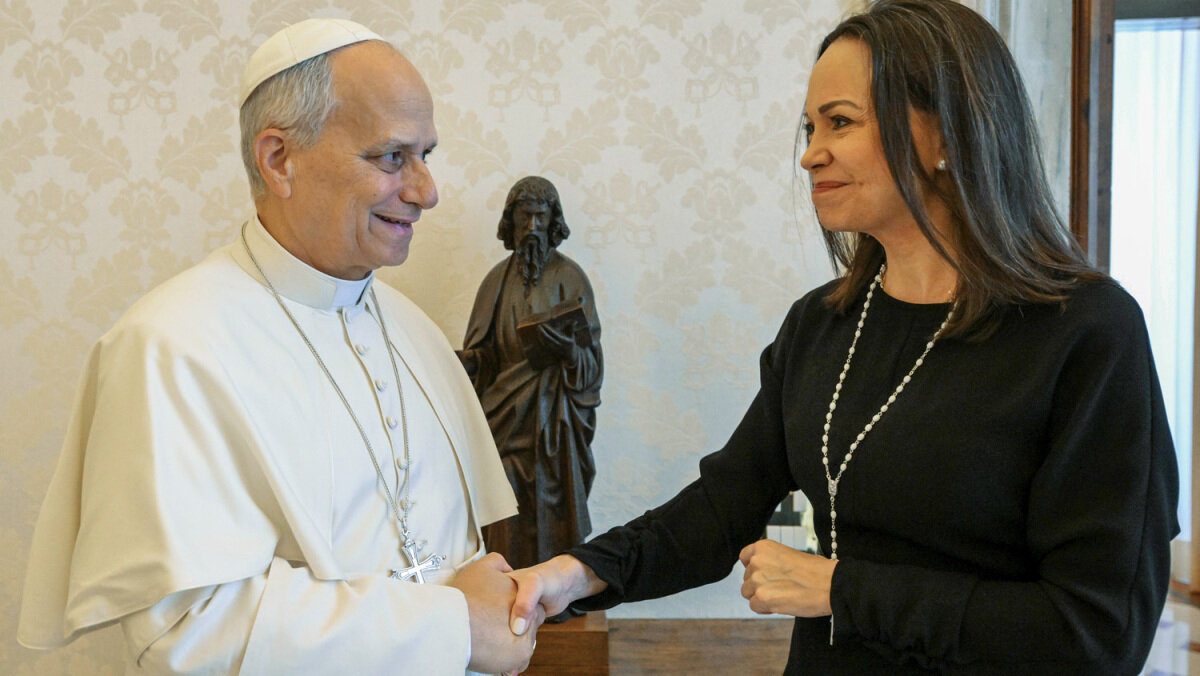
This prophecy has begun to take shape in Venezuela: Maduro was at odds with the Catholic Church. Cardinal Baltazar Porras, archbishop emeritus of Caracas, is one of his biggest critics. Maduro canceled Catholic events to prevent opposition to his regime from spreading. After Maduro’s ouster, Pope Leo xiv met with Venezuela’s exiled opposition leader, María Corina Machado.
In taking out Maduro, President Trump dealt a major blow to drug traffickers and enemies of the U.S. in Iran, Russia, China and elsewhere. But he may have also paved the way for Venezuela to align with Catholic-dominated Europe—a much more subtle and much more dangerous foe.
Regime change in Venezuela is an opportunity for tremendous blessings for America. At the same time, it could turn out to be a stepping-stone to America’s collapse. What determines this is not policy efficacy or geopolitical maneuvering. The deciding factor will be whether America and its leadership let these events lead them to repentance toward the God of the Bible.
America is experiencing a reprieve and a resurgence. But unless the nation uses that to humble itself, turn to God, repent and obey, the downhill slide will resume—and accelerate.
This lesson isn’t reserved only for governments and countries. God is leaving the door open for individuals to respond to His message, repent and turn to Him. The Prophet Jeremiah wrote that “it is not in man that walketh to direct his steps” (Jeremiah 10:23). Donald Trump may have restored pride in America’s power for the moment, but that’s not enough. Individually and nationally, we need God to direct our steps.