
Plowshares Into Swords
Rheinmetall, Germany’s largest armaments manufacturer, has surpassed automotive giant Volkswagen in market value. That inflection point, which occurred in March, was one signal among several that investors are losing confidence in the nation’s automotive industry—and gaining confidence in its weapons industry.
Germany and other European nations are building weapons factories rapidly. The sector is becoming ever more lucrative, and more industrial facilities are turning to the dark side of manufacturing.
“It says a lot about the world we live in when battery factory openings fail one after another,” Germany’s Handelsblatt wrote, “while ammunition factories are ceremoniously inaugurated” (August 28).
Europe is turning plowshares into swords on an industrial scale.
One After Another
“The German economy is currently experiencing a clash between industrial crisis and arms boom,” Germany’s Tagesschau reported. “Some companies that previously had little to do with the military see this as an opportunity …” (August 12).
“Once the pride of the nation, Germany’s car industry is reeling from an annus horribilis of poor sales, job losses and the threat of unprecedented factory closures,” the Telegraph wrote on June 22. “But defense firms have found a silver lining in the decline of the ‘auto’ trade: rehiring skilled workers to build equipment for a new German Army that may soon have to defend Europe from Russia. … Sources in the European defense industry, which will play a critical role in German rearmament, say they are eager to snap up engineers who have been let go by car companies so they can be put to work producing tanks and infantry fighting vehicles.”
Deutz AG is one example. It produces engines for tractors, combine harvesters, excavators, bulldozers, loaders and other agricultural and construction equipment. Only 2 percent of the 160-year-old company’s business has involved military equipment, but its leaders want to boost this to 5 to 10 percent in the coming years.
In February, Franco-German arms manufacturer knds acquired the Alstom train factory in Görlitz. Then German Chancellor Olaf Scholz actually attended the event, remarking: “Instead of train carriages, parts for the defense industry will be manufactured here from next year.” He called it “very good news that industrial jobs will be preserved.”
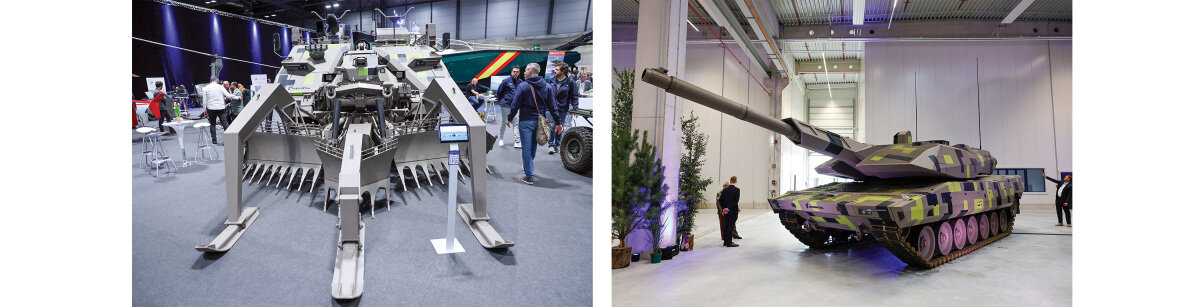
Germany is the world’s fourth-largest military spender, allocating about 2 percent of its gross domestic product on the military last year. By 2029, it plans to spend 3.5 percent ($177 billion) on core military costs.
“We would all prefer to live in a world where none of this would be necessary,” German Defense Minister Boris Pistorius said at the opening of a Rheinmetall ammunition factory on August 27. But Germany knows it is necessary. As you read this, Europe’s newest and largest artillery factory is ramping up to produce 350,000 155-millimeter shells per year by 2027.
Since Russia invaded Ukraine in 2022, Rheinmetall’s stock value has increased 20-fold. The $86 billion corporation, one of Germany’s largest, has been busy in recent weeks: It has explored further expansions, including a strategic partnership with Anduril Industries to produce military drones; planned to take over shipbuilder Naval Vessels Luerssen; explored a new missile partnership with Lockheed Martin; invested $1.2 billion in new Bulgarian factories; and received an order from Germany’s armed forces for about 1,400 military logistics vehicles.
Germany’s automotive sector is currently still about 10 times the size of its weapons industry. But as the trend continues, more and more workers find themselves producing deadly weaponry instead of civilian products.
“Volkswagen’s major shareholder Porsche SE is coming under increasing pressure,” Bild reported on August 13. “The holding company controlled by the Porsche and Piëch families is feeling the effects of the crisis in the automotive industry and is now looking for new business areas beyond traditional mobility. In the future, it plans to invest more heavily in the defense industry.”
The Telegraph wrote, “The dramatic shift in German defense policy, known as the ‘Zeitenwende’ or turning of the times, has created unprecedented opportunities for the German arms industry, which used to be a pariah in the country due to its Nazi past” (June 22).
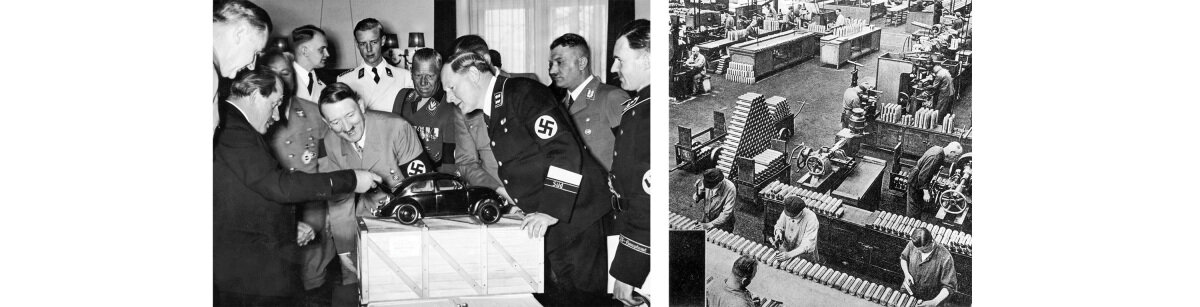
The Porsche and Piëch families are part of a group of wealthy families that David de Jong highlights in his book Nazi Billionaires: The Dark History of Germany’s Wealthiest Dynasties. The history of these companies and their present-day dealings are a sobering reminder of how quickly a peaceful Germany can convert into a high-tech, high-output war machine.
Many people recognize the names Volkswagen and Porsche. Fewer know that Ferdinand Porsche designed the Volkswagen Beetle at the request of Adolf Hitler. Volkswagen Group was founded in 1937 by the Nazi government, with the stated goal of mass producing the car for the volk (the people). Instead, its factories were used to produce military vehicles to launch and fight World War ii. Porsche continued to work for Hitler and the Nazis, and only after the war ended were his cars sold to civilians. Today, Volkswagen and Porsche are two of the top eight carmakers in the world (as are Mercedes-Benz and bmw).
But there’s much more.
In 1996, the United States government declassified an intelligence document that detailed a 1944 meeting between Nazi leaders and industrialists where they agreed to go underground to keep the Nazi party’s goals alive after the war. Executives from Volkswagen attended that meeting.
Volkswagen Group, the largest company in the EU by revenue, is now returning to its military roots. Oliver Blume, the chief executive of Europe’s largest car manufacturer, told the Telegraph: “My take on it is, if there was the option of military vehicles going forward, we would have to look at the concepts. We did that in the past” (March 11).
Consider this casual reference to World War ii—and the lack of reaction. Has the blood of the millions dried to the point that we no longer remember it? Have the screams of concentration camp inmates faded into silence?
Global Trend
Like Germany, Japan used its industrial and technological greatness to wreak horrors on innocent human beings in World War ii. Like Germany, Japan vowed to abstain from militaristic ambitions after the war. And like Germany, Japan is rapidly reversing this trend.
At the end of last year, Japan approved a record $55.1 billion defense budget for the 2025 fiscal year, the nation’s 11th annual increase in a row.
Now Japan wants to step up its plowshares-to-swords transformation. Lawmakers are now pushing for a nuclear weapons program. With decades of nuclear expertise in the civilian field and at least 45 tons of separated plutonium, Japan could quickly become a formidable nuclear power.
The Stockholm International Peace Research Institute reported that world military expenditure reached $2.7 trillion in 2024, an astonishing increase of 9.4 percent from 2023 and “the steepest year-on-year rise since at least the end of the Cold War.” It added that military spending “increased in all world regions, with particularly rapid growth in both Europe and the Middle East.”
Its Yearbook 2025 further warned that nuclear stockpiles, which had been shrinking since the Cold War, are growing again. China has at least 600 warheads and is rapidly making more. India probably expanded its arsenal last year, while Pakistan is improving its ability to make nuclear weapons.
And nukes are only one aspect of the world’s militarization. “The coming nuclear arms race is going to be as much about AI, cyberspace and outer space as it is about missiles in bunkers or on submarines or bombs on aircrafts,” states the report. “It’s going to be as much about the software as about the hardware.”
Swords Into Plowshares
“Why do we find a world of awesome advancement and progress, yet paradoxically with appalling and mounting evils?” the late Herbert W. Armstrong asked in Mystery of the Ages. “Why cannot the minds that develop spacecraft, computers and marvels of science, technology and industry solve the problems that demonstrate human helplessness?”
We are indeed nearing the days of which Jesus Christ prophesied, “except those days should be shortened, there should no flesh be saved [alive]” (Matthew 24:22).
The Bible also has specific prophecies that reveal what will happen during this period of great tribulation.
As explained in our booklet Germany and the Holy Roman Empire, Bible prophecy reveals that Germany will trigger global calamity and another world war.
In this context, the Bible prophesies that civilian manufacturing will be repurposed for war-making on a massive scale. “Proclaim ye this among the Gentiles; Prepare war, wake up the mighty men, let all the men of war draw near; let them come up: Beat your plowshares into swords, and your pruninghooks into spears: let the weak say, I am strong” (Joel 3:9-10).
“The worst nuclear nightmare imaginable is almost upon us,” Trumpet editor in chief Gerald Flurry writes about this passage in his booklet The Prophet Joel (request a free copy).
Verse 12 reads, “Let the heathen be wakened, and come up to the valley of Jehoshaphat: for there will I sit to judge all the heathen round about.” God will assemble all the remaining military might of the world—and measure His strength against man’s. It will take God’s intervention to teach mankind that building ever more powerful weaponry while allowing hatred to grow is a path to disaster.
The repurposing of civilian goods for weaponry reveals a lot about the state of our world. But thanks to God’s coming intervention, a time will come when mankind will “beat their swords into plowshares, and their spears into pruninghooks: nation shall not lift up a sword against nation, neither shall they learn war any more” (Micah 4:3).