
Trump vs. Europe
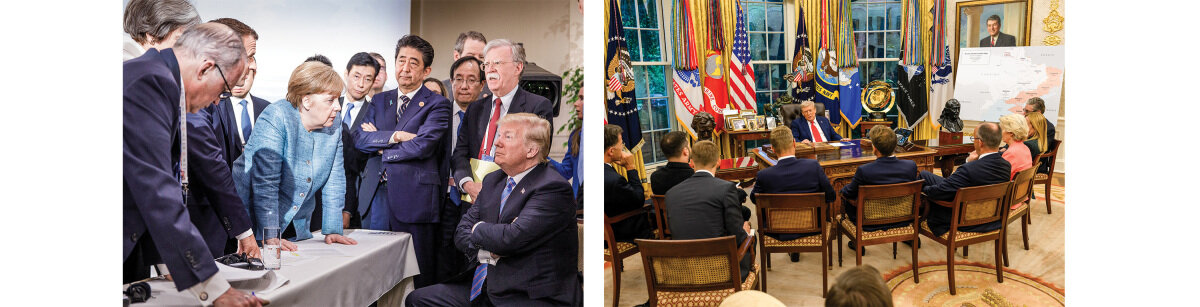
President Donald Trump looked like a naughty schoolboy. Leaders of the G-7 nations, led by German Chancellor Angela Merkel, loomed over him. America’s leader looked back, defiant but outnumbered. The photo of the G-7 meeting in Canada, June 2018, became one of the most iconic of Trump’s first term.
His second term has provided a replacement. Now it’s the European Union’s leaders looking like the naughty schoolkids, sitting before Principal Trump’s Resolute desk.
Backed up by America’s unmatched military and dominant economy, and thanks to his powerful persona, President Trump humiliated Europe’s leaders repeatedly this summer.
Don’t expect them to take this punishment for long. President Trump is giving Europe a good hard look at what a strongman can accomplish.
Trade War I
July 27 was a “dark day” for Europe, said former French Prime Minister François Bayrou. The European Union had been “eaten for breakfast,” according to Hungarian Prime Minister Viktor Orbán. Alberto Alemanno, professor of EU law at hec Paris, said it reflected “Europe’s economic and ideological surrender” (Project Syndicate, July 30). They were horrified by European Commission President Ursula von der Leyen’s announcement of the trade deal she had struck with Trump.
“There is no hiding the fact that the EU was rolled over by the Trump juggernaut,” one ambassador said. “Trump worked out exactly where our pain threshold is” (Financial Times, July 28).
The U.S. will impose a 15 percent tariff on most EU goods. To bring that down from the threatened 30 percent, the EU promised that its businesses will invest $600 billion in the U.S. by 2028. It also promised to spend $750 billion on U.S. energy over three years.
To rub salt in the wound, the deal was worse than the one Britain concluded with Trump, despite Europe’s insistence the United Kingdom would lose out in trade with America, thanks to Brexit.
“[N]o matter how much the euro-fanatics try to spin it, in reality Donald Trump, as he might put it himself, has knocked this one out of the park,” Matthew Lynn wrote in the Telegraph. “… Short of having to ship the Mona Lisa to Mar-a-Lago, it is hard to see how it could have worked out better for President Trump. After two decades of relative economic decline, and with crushing taxes and regulation suffocating the life out of its industry, the EU is now too weak to stand up to the U.S. Its fragility has been painfully exposed—and this deal will only make it worse” (July 27).
A month later, more details revealed that American cars would be allowed into Europe without being modified to meet Europe’s different safety standards. “We almost fell off the chair when we read this,” EuroIntelligence wrote. “This statement reads like a U.S. Commerce Department wish list” (August 22).
Many feared the EU and U.S. would engage in a full-blown trade war. That was avoided—for now—because Europe waved the white flag before the war even began.
Phony Lovers
The other divide between the two blocs is the war in Ukraine. President Trump focused much of his attention this summer trying to forge a new deal there. (See “The Roadblock to Peace,” page 3.) On August 15, he hosted Russian President Vladimir Putin. A few days later, he invited Ukrainian President Volodymyr Zelenskyy to visit. But Zelenskyy didn’t come alone. Many of Europe’s leaders felt he needed moral support.
This showcased the divide between the EU and America: EU leaders didn’t trust President Trump and felt they had to fight for their interests in person. But it also clearly showed that America is in the driver’s seat. European leaders could come to beg or cajole, but what Trump says goes.
Europe’s leaders are not Trump fans, but they’ve not condemned him openly. Instead, their main response has been flattery. They still need the United States, so they are trying to steer President Trump by playing nice. Complaining about the trade deal is fine—President Trump is quite happy to be told he struck a great deal and get everything he could want—just don’t personally attack the president.
This strategy took effect after Zelenskyy’s first visit to Washington in February, which ended with him being chewed out by Trump and Vice President JD Vance.
In April, Italian Prime Minister Giorgia Meloni led the way with a plan to “sweet-talk Trump on tariffs,” as Politico put it.
German Chancellor Friedrich Merz followed suit. The night he was elected, February 23, he spoke of Europe’s need for military independence from an unpredictable U.S. administration: “My absolute priority will be to strengthen Europe as quickly as possible so that, step by step, we can really achieve independence from the U.S.A.,” he said. Yet he sang a different tune on June 5, during his first meeting with Trump. He was all smiles, and the visit was entirely drama-free. Merz presented Trump with a framed copy of his German grandfather’s birth certificate and expressed gratitude for ongoing German-U.S. cooperation.
Carlo Masala, director of the Institute for Strategy and Forecasting at Germany’s University of the Federal Armed Forces, described the European strategy as “constantly giving Trump the feeling that he is a great statesman with a clear vision.” He added, “I believe that this flattery combined with European self-confidence is the appropriate strategy.”
nato Secretary General Mark Rutte epitomized this strategy when he characterized President Trump as “Daddy” trying to get Iran and Israel to stop fighting like children in the schoolyard.
Yet you only have to look at these leaders’ public statements to see through the flattery.
Step by Step
As Merz acknowledged, Europe cannot break from America immediately, no matter how much it wants to. But it is working, step by step, toward that goal.
One thing Europe desperately needs is greater unity. If 27 separate nations go up against the United States, President Trump can play one off against the other. But a united Europe facing off against a united America would be a conflict between equals.
Europe’s failure in trade negotiations “exposes the fundamental weakness of European governance,” wrote Alemanno. “Lacking a true EU-wide governance system, the bloc remains incapable of translating competing national agendas into a unified position” (op cit). With all its conflicting national interests, the EU couldn’t agree on a way to fight back. Retaliation against America would end up hurting Europe, and some countries would suffer more than others. No one would agree to suffer pain unevenly. This is why the bloc had little choice but to do a deal.
However, it is clear that such unity cannot be created with all 27 EU member states included. Thus, former German Defense Minister Karl-Theodor zu Guttenberg told Austria’s Brutkasten in a video published September 5: “We now have to get to a point where we can say that if it doesn’t work with 27, then it will work with 13 or 15 or 17—think of the euro as an example. So we need to be bolder here.”
As long as Europe’s big beasts—Germany, France and Italy—act together with a few others, a united Europe would have the clout to stand up to America. Unity is more important than size.
Another disadvantage for the Europeans is the current dominance of the dollar. The euro so far has been unable to match the dollar’s appeal. But President Trump may solve this for them. By expanding America’s already massive debt and putting political pressure on the Federal Reserve, Trump is hastening the dollar’s end. Delaying tactics could make sense for the EU. Wait long enough, and the dollar will fall.
But the biggest thing Europe needs to fix is its military. At the end of the day, it cannot engage in a trade war against the nation it is relying on to keep it safe.
The unspoken threat behind all of Europe’s dealings with America is that if it chose to do so, America could pack up and leave. It is U.S. troops that make the difference in Europe, as well as the nuclear weapons that Germany, the Netherlands and other nations rely on.
A typical U.S. president would never actually withdraw these benefits. But Donald Trump is not a typical president.
This fear that America could simply walk away has kept Europe from using its so-called nuclear option: its anti-coercion instrument. This is not literally nuclear, but it would mean the legal persecution of American companies across the EU. European politicians boast about its power, but during trade negotiations, they didn’t even raise it as a threat.
“The trade deal is a humiliation for the EU, but it reflects the imbalance of power,” Clemens Fuest, president of the Ifo Institute in Germany, posted on X. “The Europeans need to wake up, focus more on economic strength, and reduce their military and technological dependence on the U.S. Then they can renegotiate.”
“Europe’s dependency on America’s security guarantee was a further argument against trade confrontation, especially for the bloc’s eastern and northern members,” the Financial Times reported. “Fears that Trump would cut off weapons supplies to Ukraine, pull troops out of Europe, or even quit nato overshadowed the talks, diplomats said” (July 28).
European leaders also know they would be better able to stand against America if they had other allies.
At a meeting of EU leaders in June, von der Leyen and Merz called for the creation of an alternative World Trade Organization. “You all know that the wto doesn’t work anymore,” Merz said.
He is right. Starting with Barack Obama, U.S. presidents have sabotaged the wto by refusing to appoint anyone to its Appellate Body, effectively its supreme court. This prevents the wto from ruling on any appeals. Von der Leyen suggested replacing the wto by joining the giant Asian trade bloc, the Comprehensive and Progressive Agreement for Trans-Pacific Partnership.
These nations are seriously considering the creation of a new world trade partnership that limits or excludes the United States.
All of these are necessary steps for Europe to stand a chance in the next round of potential trade war. But something is yet missing, and President Trump is demonstrating it perfectly: a strong leader.
Wanted! A Strongman
While talking to European leaders, Trump decided he also wanted to speak with Putin. Any other leader would have had his people schedule a time with Putin’s people, spend hours prepping, and finally have a conversation some days later. Trump just picked up the phone. Even his critics, outraged at the flood of activity coming out of the White House, have to admit that Trump gets stuff done.
Meanwhile, the Dutch governing coalition fell apart. Then the caretaker coalition that was supposed to manage things until an election could be held fell apart. France has failed to pass any major legislation, and its prime minister was ousted in September for trying to cut spending. Germany’s Merz has been busy with foreign policy but has accomplished little at home. After Trump was elected in 2024, the New York Times ran the headline “Missing in Europe: A Strong Leader for a New Trump Era.” Nearly a year later, that remains the case.
Europeans need a strongman who can get things done. Typically, European leaders avoid putting strong personalities in top EU jobs for fear of them encroaching on their own power. But if it comes to a choice between a strong European leader or kowtowing to Trump, you can be sure they will pick the European.
Intriguingly, there could soon be a vacancy at the top of the EU. European Commission President von der Leyen is plagued with scandals around her conduct during the covid-19 pandemic. Her contacts with Pfizer ceo Albert Bourla were covered up, and various government bodies have launched investigations. She survived a no-confidence vote in the European Parliament this summer. Parliament Vice President Katarina Barley reportedly said this would be her “absolute last chance.”
After President Trump was elected, Mr. Flurry wrote: “There is a big leadership vacuum. Germans know something dramatic must be done, and quickly! You see this in recent election results with the rise of fringe parties like the Alternative für Deutschland. Voters are showing themselves willing to embrace out-of-the-ordinary politics. They are clamoring for a strong leader! …
“This is where Bible prophecy is so invaluable. Prophecy tells us that Germany is about to shock the world with its power” (Trumpet, January 2025).
With all these factors in place, EU trade talks with the U.S. will end very differently the next time around.
Trade War II
The EU may need to stand up against President Trump soon. The Americans say Europe promised to invest billions in America; the EU sees these figures as aspirations. And it is hard to see how the EU could meet them even if they wanted to. As socialist as the EU is, it doesn’t control every business in Europe. The trade bureaucrats have no way to force them to invest $600 billion in the U.S.
The commitment Europe made regarding energy in particular is gigantic. In 2024, the EU imported $75 billion in energy from America. They have promised to raise that to $250 billion annually. To hit that target, the EU would have to get two thirds of its total energy needs from the U.S. Even if it completely stopped buying liquified natural gas from Russia, Algeria, Qatar, Nigeria and Norway and got it all from America, it would struggle to buy half the amount it has committed to. On top of that, the U.S. would struggle to supply that much. Total U.S. energy exports to the entire world last year were $318 billion. Other countries like Japan have also committed to buying much more U.S. energy as part of their trade deals.
What happens when it becomes clear that the EU is nowhere near the $250 billion in energy imports it committed to? What happens if European companies fail to follow through on the EU’s promise of $600 billion in investments? Then the deal will have to be renegotiated. The seeds of the next trade war are already planted.
The EU is certain to prepare for this moment. Soon, its leaders will drop the flattering facade and reveal their true face.
Europe’s leaders despise Donald Trump. Many of them think like Guttenberg. This man is out of office, but as a commentator he speaks for many Germans when he says, “Trump is not a friend of the Germans,” and calls him “the blond maniac,” “bully” and “likely the greatest scumbag that we have ever had in U.S. politics.”
Europe’s true feelings are revealed in Bible prophecy. Jeremiah 1:13 describes them as a “seething pot.”
“This symbolic language is describing modern Germany,” explained Mr. Flurry in “Why Germany Just Betrayed America.” “Beneath the surface, that nation is full of simmering dissatisfaction with the current world order. Germans are angry at the U.S. The imperialistic ambition that prompted Germany to start both world wars is alive and well. It is ‘seething’!”
They may hide it, biding their time—but at some point, the hatred will boil over. Jeremiah describes these same powers as “lovers.” But they are deceitful lovers who “will despise thee, they will seek thy life” (Jeremiah 4:30).
Other related prophecies forewarn that the Europeans are going to get their strongman. This man will unite the world against America in a catastrophic trade war that will bring America down.
The iconic image portraying Europe’s relationship with the U.S. will change radically. Instead of pupil and schoolmaster, it will be an image of master and slave. As unnerving as it may sound, the Bible warns that America’s loftiness will be brought low—and the nation will indeed be enslaved (Ezekiel 5).
This is what the late Herbert W. Armstrong foretold based on Bible prophecy. Much of what he said has already been fulfilled or is nearing fulfillment.
1978: Watch for “a sort of soon-coming ‘United States of Europe’—a union of 10 nations to rise up out of or following the Common Market of today. Britain will not be in that empire soon to come.”
1954: “Germany inevitably [will] emerge as the leader of a united Europe. It will require some spiritual binding force to inspire this confidence—to remove these fears—and that spiritual binding force must arise from inside Europe! All Europe is actually ready—just waiting for the confidence-inspiring leader ….”
1953: “[T]en powerful European nations will combine their forces.”
1959: This European power will set up “a gigantic world-trading system.”
These forecasts are clearly well on their way to being fulfilled.
These statements are backed by specific prophecies. And world events are forcing Europe in this direction. Revelation 17 and 18 describe a “beast power” led by “10 kings,” or 10 nations. Revelation 18 describes this empire’s total dominance of the global economy. Once it falls, the businessmen of the Earth will weep.
This past summer, we witnessed the humbling of Europe by the United States. Bible prophecy warns us to watch for a devastating payback. You can be sure Europe is already preparing to strike back.