
The Roadblock to Peace
Donald Trump wants badly to end the Ukraine war. America’s president has poured himself into the effort. He has repeatedly dispatched negotiation teams. He has brandished carrots and sticks, offering incentives and imposing economic pressure. He has personally arranged and attended meetings. He has risked his credibility as a dealmaker and a peacemaker.
Why has it not worked?
Why does the war keep grinding on with a lasting solution seemingly as elusive as ever?
Within a few intoxicating days in August, he hosted Vladimir Putin in Alaska, then Ukraine’s president and several other European leaders in the Oval Office. His splashiest effort yet sent hopes soaring—then the peaceniks got punched in the mouth. Russia launched some of its fiercest attacks of the war. It struck an American-owned manufacturing firm, then Ukraine’s Cabinet of Ministers building in Kyiv, which houses the prime minister’s office and some government ministries. A couple weeks later, Russian suicide drones crossed into Polish air space, and Poland scrambled jets to shoot them down. nato activated Article 4, a united response to a threat against a nato member.
The contradiction between Putin shaking Trump’s hand and the ruins smoldering after record drone strikes is jarring.
What is President Trump missing?
The Dam Is Breaking
In recent months, it seemed the world was hurtling toward war. All the talk was about the death of nato, the return of nationalism, the surge in militarism, the retreat to the trenches and bunkers, and the looming threat of world war. Cracks in the dam of the international order were springing leaks.
Then in August, it seemed the Western world’s commitment to peace through negotiation enjoyed a resurgence, thanks to Donald Trump. Putin visiting American soil for a chat, Europe’s luminaries rushing to Washington—these looked like extraordinary signs of confidence in a peace process driven entirely by the world’s most powerful man. Finland’s president gushed, “I think in the past two weeks, we’ve probably had more progress in ending this war than we have in the past 3½ years.”
Trump’s efforts to talk his way to peace appeared to have patched the fissures.
Alas. Events proved otherwise.
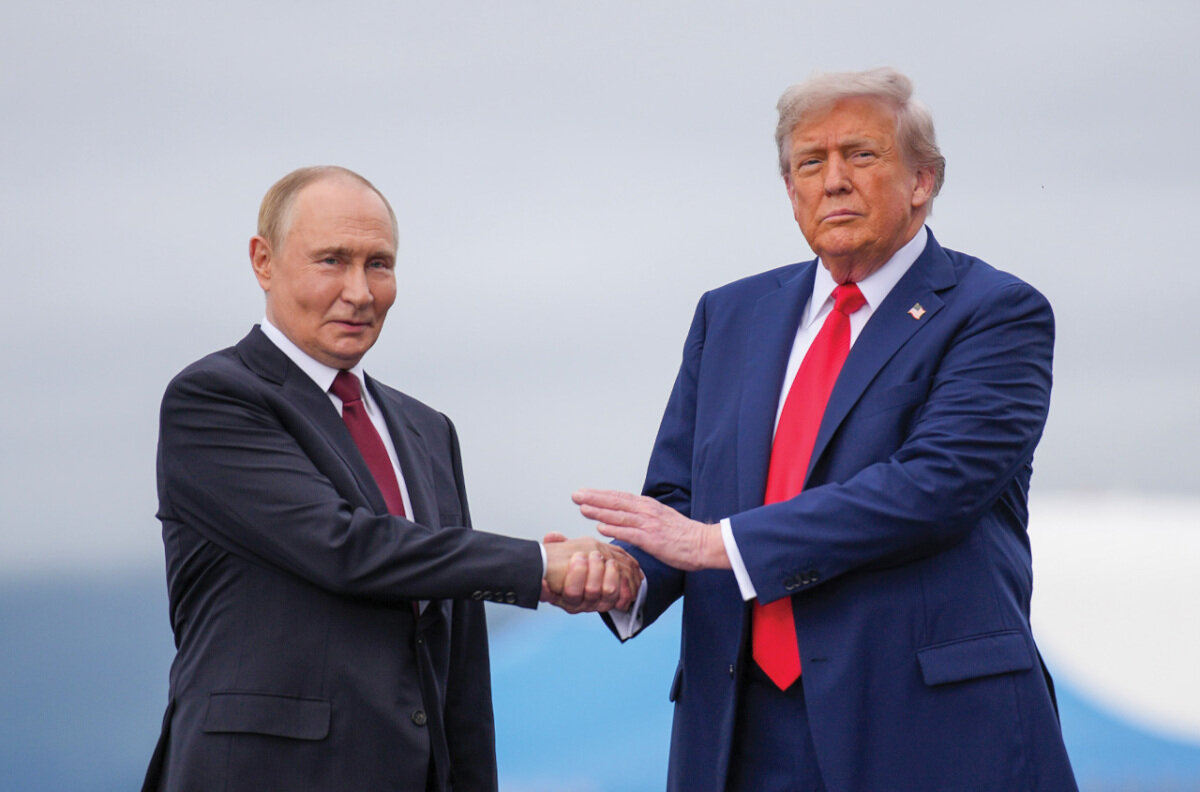
Signs are becoming clearer that all the muscle President Trump is putting toward this peace effort isn’t swaying the Russian despot’s mind one iota. Putin’s actions show that his heart is unchanged. And Putin wants war.
Trump has enjoyed some success in pacifying other hotspots: India-Pakistan, Rwanda-Congo, Thailand-Cambodia, Armenia-Azerbaijan (article, page 15), though the long-term effects will take time to assess. But Russia’s butchery in Ukraine is proving to be a Gordian knot.
Putin is highly skilled at saying what people want to hear—then doing what he wants to do. Remember when President George W. Bush met him and said he was “straightforward and trustworthy”? Now, with an American president convinced of his personal ability to “solve anything” and eager to cement his legacy as a peacemaker, and a team of diplomats with little experience and a lot of credulity, Putin has a lot of leverage.
What Is Putin After?
Consider the man whom Trump believes can be talked into simply calling off his war hounds. The man who planned, orchestrated and launched this war. The man most responsible for the bloodshed, for sustaining and intensifying it for 3½ years.
Vladimir Putin’s justifications that he is “denazifying” Ukraine and preventing “genocide” of ethnic Russians in the Donbas have been widely discredited. However, many believe his claim that nato’s eastward enlargement since the 1990s breaks post-Cold War promises and is meant to encircle Russia.
To whatever degree this is true, what is certain is that Putin aims to restore Russian dominance. Ukraine was the breadbasket of the Soviet empire. Russia’s president views it as an artificial, illegitimate state within his nation’s historical sphere and is fighting to prevent it from becoming a “Western bulwark.”
“Putin has long known that if Ukraine allied with Europe, it would significantly diminish his power. His goal is to resurrect the Soviet empire,” Mr. Flurry writes in his booklet The Prophesied ‘Prince of Russia.’ “The architecture of that empire was built around Ukraine being a part of it. … Putin applied all that pressure on Ukraine because that nation is the linchpin of his goal of a renewed imperial Russia!”
He is wickedly serious about this. Even after Ukraine and the West proved surprisingly strong and his invasion failed to achieve a quick victory as in Crimea, Putin didn’t back down. He dug in. And though Europe and America have committed enough help to keep Ukraine in the fight, it has not been enough to win.
Putin has thus directed his military to bomb residential areas; cut off food, water and electricity; deploy chemical weapons; torture, mutilate and execute civilians; and use sexual violence against women, men and children as young as 4 years old, often in front of victims’ families. He has ordered his soldiers to Russify occupied areas, suppress Ukrainian identity and culture, and conduct the mass kidnapping, deportation and brainwashing of children (see “Your Parents Don’t Want You—but Russia Does”).
And for 1,260 days and counting, he has proved himself willing to expend some 200 of his own countrymen’s lives per day—day after day after day.
Negotiations will not change Putin’s goals. Granted, if he decides that a settlement works to his advantage, he may put his signature to one. But it will not alter the fundamental reality of who Russia’s leader is and what he is willing to do. The “security guarantees” Ukraine’s allies are seeking from Russia are no different from those Putin agreed to before and then broke.
Trump believes he can solve anything. But as he tries to cajole or strongarm Vladimir Putin, he doesn’t realize what he is up against.
As much as these leaders want peace, they are dealing with a man who wants something very different. Everything he does for “peace” is only meant to buy more time and create more opportunity.
Unintended Consequences
What is the real solution to the Ukraine war? These leaders will not admit it, but they do not know.
As Isaiah prophesied, “The way of peace they know not; and there is no judgment in their goings: they have made them crooked paths: whosoever goeth therein shall not know peace” (Isaiah 59:8; also Romans 3:17).
There is a way of peace. World leaders, certainly including President Trump, believe they know it. They believe that the solution to war—the land claims, trade disputes, cultural conflicts, missed opportunities, lost childhoods, poverty, homelessness, malnutrition, disease, rape, crime, torture and slaughter—somehow lies within their own judgment and their own goings. It does not.
In fact, to this point, much of what President Trump has done has had the opposite effect to what he hoped.
He has repeatedly said he just wants to “stop the killing.” That is an important goal—especially given the tragedies unfolding in Ukraine. Some 9,000-plus people have died every month, and will die next month, until this is stopped. Yet after every “perfect phone call” with Trump, Putin has intensified his murderous war.
Trump hoped to pry China and other countries away from Putin to isolate Russia. Instead, over the past 3½ years China has drawn even closer to Russia, as have other Asian nations. While the U.S. threatens and institutes sanctions, these countries are actively saving Russia from economic collapse. In August, President Trump raised India’s tariff rate to 50 percent and insisted that it stop buying Russian oil. India responded by strengthening its commitment and even tightening its defense ties with Russia. Prime Minister Narendra Modi visited the Shanghai Cooperation Organization meeting in China and literally hugged Putin.
Perhaps the most critical unintended consequence of Trump’s peace efforts is the most unrecognized. Trump hoped to increase European security and boost nato’s strength by encouraging European militarization and jump-starting diplomacy. But renewed hope for an agreement could backfire. One could foresee Putin drawing out “peace” talks with a litany of demands that Ukraine and Europe would never agree to—but that Trump would be unwilling to stand against. Right now, the Europeans are trying to appease the president by appearing receptive to whatever he suggests. But in the end, he wants to make a deal and walk away. They don’t have that luxury. When the prospects of peace are exposed as illusory, it will be one more nail in the coffin of the trans-Atlantic alliance (article, page 6).
But dividing Europe from the U.S. isn’t the only hidden danger of Trump’s Ukraine peace efforts. His demand that the Europeans arm themselves more powerfully, they are carrying out—vigorously (article, page 10). And here is the ultimate unintended consequence: Bible prophecy reveals unequivocally that those weapons and forces, before being directed against Russia, are going to be turned against America. (Read about this in our Trend article “Why the Trumpet Watches Europe’s Push Toward a Unified Military.”)
As Mr. Flurry wrote in our April issue, “Peace is a noble goal, but if it is pursued the wrong way, that effort ends up achieving the opposite!” (“Does Donald Trump Know the Way to Peace?”).
In the end, the cracks in the international order are destined to give way.
Dams burst suddenly, furiously. History repeatedly reminds us that assurances of peace are at their most grandiloquent just before the most shocking eruptions of violence. It is as 1 Thessalonians 5:3 says: “For when they shall say, Peace and safety; then sudden destruction cometh upon them ….”
Perils of Human Nature
Human nature resides in all of us. It is inspired by Satan the devil, the father of liars and murderers, who as “prince of the power of the air” broadcasts his attitudes of selfishness, vanity, greed, competition, hatred and malice into human minds (John 8:44; Ephesians 2:2). (You can find a thorough biblical explanation of this truth in our free booklet Human Nature: What Is It?)
One expression of human nature can be seen in the deceitful, murderous actions of the dictator of Russia, grasping for land, lying about his intentions, upending lives.
Here is an insightful paragraph from that April article: “Putin is an evil, ruthless, vindictive agent with Soviet-style methods of psychological warfare, assassination and war. He has disgusting and devastating policies that are sick to the core and even satanic!” In another article, “Should Donald Trump Trust Vladimir Putin?”, Mr. Flurry wrote, “This is a man with beastly power and with a beastly desire to rule the world! He is a vengeful, monstrous friend of the devil with all sorts of anti-God policies. He is steeped in secrecy, deception, manipulation, aggression, intimidation, coercion and force, and there is far more about him that we do not know.”
Another, contrasting expression of human nature is the inability to recognize evil. This causes the erroneous belief that, deep down, everyone really wants peace. Because we don’t want to acknowledge the evil within our own hearts, we can be naive about the reality of evil within others. We are seduced by promises of peace when there is no peace (e.g. Ezekiel 13:10). In its extreme, people reject reality and tell the prophets, “Prophesy not unto us right things, speak unto us smooth things, prophesy deceits” (Isaiah 30:10).
Several episodes in history warn of what happens when individuals embodying the first of those tendencies prey upon individuals exhibiting the latter.
In President Trump, this natural credulity is coupled with yet another mark of human nature: swelling self-confidence. It is a truly toxic combination. “Trump believes he can negotiate with Putin, giving him sections of Ukraine and expecting this to pacify him,” Mr. Flurry wrote in that April article. “That reveals a total lack of comprehension of the man he is dealing with.”
He then asked, “Can God get along with the devil?”
That is a searching question. It exposes the real battle playing out both on the ravaged steppes of Ukraine and in the halls of diplomacy echoing with plans for peace.
The real roadblock to peace is not merely an ex-kgb agent seeking to restore the motherland’s past glories. Nor is it a comedian-turned-commander refusing to capitulate to foreign aggression. Nor is it a security alliance that is encroaching too close, or, conversely, advancing with insufficient force. Nor is it a lack of ingenuity or acumen in finding the precise penalties and ideal incentives to get someone to sign a piece of paper, or in devising the perfect compromise that all parties can live with.
The real roadblock to peace is minds clashing with minds, all saturated with human nature, all inspired and manipulated by the devil.
The way of peace they know not. The results prove it. Yet even in the face of failure, they are not consulting the one Being who does know that way, the Being who authored the way of peace—the Being who promises to restore that way to the whole Earth very soon.
Ambassadors of Peace
The God that these presidents, ambassadors and envoys ignore is allowing them their day. He is giving them their chance to try every pact and plan, to forge every confederation and compact, to deploy every tool of diplomacy they can devise. And ultimately, they will all prove that “There is a way [of peace] which seemeth right unto a man, but the end thereof are the ways of death” (Proverbs 14:12).
The same prophet who condemned our modern-day leaders for their ignorance of the way of peace also foretold the outcome of their labors. When all is said and done, he wrote, “the ambassadors of peace shall weep bitterly” (Isaiah 33:7).
The Bible’s prophecies of the horrors that are about to befall this world—when America has fallen from its perch, when the armies of a hypermilitarized Europe mobilize, when the forces of Putin’s Russia combine with those of the rest of populous Asia to wreak carnage on a scale even the victims in Ukraine cannot now fathom—truly depict conditions that will bring bitter weeping.
But God is allowing all these failures and calamities for a purpose—to teach a lesson that we can learn even today, before conditions get worse: There is no hope in man.
“Thus saith the Lord; Cursed be the man that trusteth in man, and maketh flesh his arm, and whose heart departeth from the Lord” (Jeremiah 17:5). Can you look at the world today and recognize the truth in that scripture? Trusting in man brings curses. And those curses are about to proliferate and overtake the nations and every person on Earth.
By contrast, though, “Blessed is the man that trusteth in the Lord, and whose hope the Lord is” (verse 7).
God knows the way of peace. He reveals that way in His Word. It is rooted in the law of God, His commandments, which define good and evil, distinguish righteousness from wickedness. “And the work of righteousness shall be peace; and the effect of righteousness quietness and assurance for ever. And my people shall dwell in a peaceable habitation, and in sure dwellings, and in quiet resting places” (Isaiah 32:17-18).
God is a God of peace (Romans 15:33; 16:20; Philippians 4:9). He promises, again through the Prophet Isaiah, “I create the fruit of the lips; Peace, peace to him that is far off, and to him that is near, saith the Lord; and I will heal him” (Isaiah 57:19).
When this evil world culminates in a paroxysm of violence, Jesus Christ will return in glory, bringing the peace this world lacks and yearns for. How will He establish that peace and prevent the wicked from shattering it? After all, “the wicked are like the troubled sea, when it cannot rest, whose waters cast up mire and dirt. There is no peace, saith my God, to the wicked” (verses 20-21).
He will not negotiate. He will rule with a rod of iron and bring His enemies to their knees (Revelation 19:15; Isaiah 45:23). Christ will replace Satan as the god of this world (2 Corinthians 4:4; Zechariah 14:9). He will imprison the devil and silence his broadcast (Revelation 20:1-3, 10), enabling the reeducation of mankind and the weeding out of human nature in all its forms. That is the only way the roadblocks to peace can be overcome.
Jesus Christ will demand and enforce the way of peace. Isaiah called Him the Prince of Peace—and foretold that “Of the increase of his government and peace there shall be no end …” (Isaiah 9:6-7). The peace that flows from His governance will increase forever!