
The Next Credit Crisis
“I always say you should buy a house,” my waitress said as I sipped a coffee at the local Denny’s restaurant. She was probably 30 years old but might have been younger.
She was talking with another server, but I couldn’t help hearing her in the mostly empty restaurant. “I haven’t been paying my mortgage for eight months. If you were renting, they would kick you out by now. But they have been working with me. I just pay what I can. I have a loan officer working with me.”
It was a bit surprising. Can you even qualify to buy a home on $20 an hour (the average hourly wage of a local Denny’s worker)? The median-priced house around here is over $400,000. Maybe she was married with two incomes. It didn’t sound like it, and I didn’t see a ring.
Surely there was more to the story. Either way, it seemed the lender was paying the price for making a bad loan.
It made me think of the great financial crisis of 2008, when the banks were making all kinds of bad loans, slapping triple-A ratings on them, and pawning them off on unsuspecting pension funds, college endowments and other investors.
Back then, they had names for all those garbage mortgages they marketed as top-notch investments: “alt-A,” “subprime,” “no-doc.” The few people warning about the dangers before the global financial system almost came to a grinding halt had other names for them. They called them ninja loans (“no income, no job and no assets”) and “liar’s loans.”
Then the loans and everything built on them busted. Almost every major bank in America and the two giant government-owned mortgage lenders, Fannie Mae and Freddie Mac, had to be bailed out with mountains of existing and future taxpayer money.
A 2010 Financial Crisis Inquiry Report highlighted a whistleblower from a major subprime lender who testified that their underwriting guidelines “simply required checking if the borrower had a heartbeat.”
Pulse-based lending practices—no wonder the economic system went into cardiac arrest.
One bank executive attested that if a person could fog a mirror, he could get a loan. It didn’t matter if it was a million-to-one chance that he had the wherewithal to make the payments.
Back at Denny’s, the conversation continued: “Do you want me to look up what houses are for sale? It’s easy, I have an app, and it’s a buyer’s market,” my waitress told her friend. “Houses are just sitting there. Interest rates are too high.”
“If you can buy, do it. Even if it is a crummy trailer, because they will work with you when you can’t make the payments,” she continued. “It’s like cheap rent.”
Her story made me wonder if banks are back to their old tricks. How realistic is it that she could actually qualify for a loan? Or is the fact that some people borrow with the intent of not making the full monthly payments built into the financial models now?
This story could be a one-off, but what if it isn’t?
If it isn’t, how stable is America’s financial system?
My friendly waitress was right about one thing, though. Mortgage rates have gone up a lot over the past couple of years, and homes in many parts of the country are not selling like they used to.
Housing website Zillow confirms. It reported worrying financial news for its shareholders on November 4. The company, which helps people buy and sell homes, said its quarterly profits had swung from a $10 million profit last year at this time to a $158 million quarterly loss. Its stock price has halved during that time. The company blamed declining sales activity and “one of the toughest housing markets in a generation.”
According to the Wall Street Journal, the housing market has almost “ground to a halt.” It said, “Buyers have fled to the sidelines” as borrowing rates have risen over recent months.
Some places are worse than others. The Denver Post reports that fear grips its market as both buyers and sellers pull back. Denver7 News said that sales in September were down a whopping 21 percent from last year and that home sellers are cutting prices as sales volumes have dropped to 2008 recession levels.
2008 levels?
That too brings back memories—or is it post-traumatic stress? Anyone remember Bear Stearns? Lehman Brothers? Countrywide Financial? Those were household names back then—in a bad way. Merrill Lynch, aig, Royal Bank of Scotland, Lloyds and others all went bankrupt or got bailed out.
In Phoenix, where the Denny’s conversation took place, house sales have fallen more gradually, dragging median home prices down with them. In Dallas-Fort Worth, prices are declining a bit more rapidly. The median sales price has declined by a little over $9,000 from this time last year.
But in San Francisco, it is a different story. Prices are up, after falling for the past couple of years. In Chicago, prices have been rising for the past four years in a row.
They say that real estate is all about location, location, location.
That used to be the case—and still is to a certain extent, as the above examples show. But something big appears to have changed in recent years that is drastically impacting America’s economy.
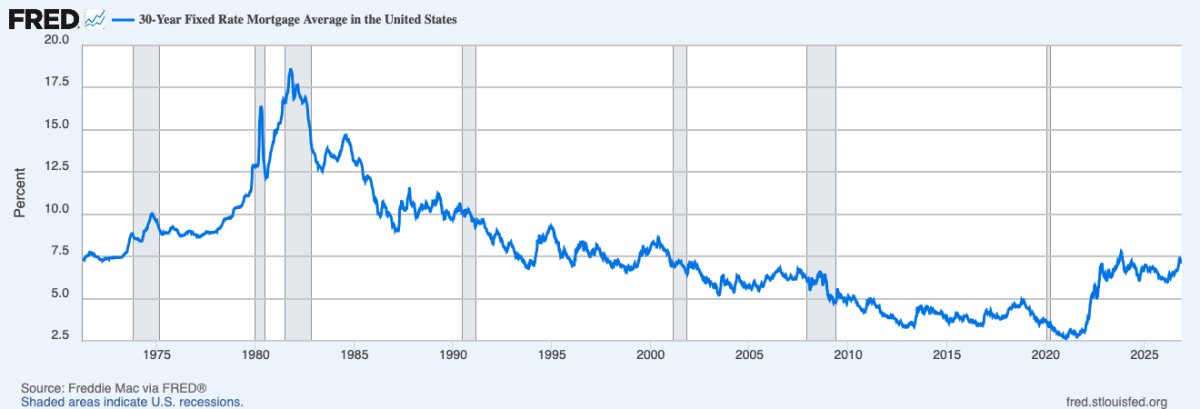
For the past 40 years, interest rates in America have trended down. In 1981, mortgage rates peaked at over 18 percent. In January 2021, mortgage rates hit an all-time low of 2.65 percent.
Since then, mortgage rates have been on the rise—and sharply.
What if mortgage rates continue to trend higher? Worse yet, what if people begin to worry that they trend higher over the next 40 years? What will that do to the housing market? To house sales and prices? And to all those realtor, brokerage and related construction jobs? To all those people who are planning on selling their home to fund their retirement?
And what if rising mortgage rates are just a symptom of something much more dangerous? Maybe it’s just the caffeine—this is my third cup.
“The world is facing a new credit crunch,” reported the Telegraph on November 15. The paper described a situation where the owners of a newly constructed 64-story luxury apartment complex overlooking California’s Hollywood skyline just defaulted on their loans.
The Canadian owner said that property values have fallen and it couldn’t refinance the $360 million construction loan at a rate that made financial sense. Since they couldn’t sell the building for a profit, they mailed in the keys, even though the building was 95 percent occupied and the average monthly rent per unit was $4,200.
Jingle-mail. That too brings back memories.
Well-known bond investor Mohamed El-Erian summarized the looming problem: “For years after the 2008 financial crash, cheap money fueled a global borrowing boom. However, as interest rates have begun to rise while governments and tech giants compete for capital, the tide is turning …. [T]he consequences of a gathering credit crunch are beginning to emerge, and the squeeze has only just started.”
El-Erian once managed the biggest bond fund in the world. When he speaks, people pay attention—and now he is warning about a credit crunch.
According to El-Erian, who used to manage almost $300 billion in assets, everyone is living beyond his means and is now trying to borrow money all at once. This is happening on the government level, corporate level and personal level. This has caused interest rates to rise as lenders demand a higher return for the risks they are taking.
A credit crunch happens when loans come due and the money isn’t there to repay in full. If interest rates have stayed level or trended down, that usually isn’t a problem. Borrowers just roll over their loans and get new ones. Everyone is in debt but happy.
But when interest rates rise, you can’t afford the new rates and higher monthly payments.
That is what happened to the owners of the luxury apartment complex in Los Angeles. They couldn’t afford the new payments. So they just stopped paying and mailed in the keys, and the new landlord is now the bank.
Banks don’t like to become landlords this way. It means they are doing a bad job and are losing money.
The luxury tower is “a cautionary tale about a global financial system being tested to its limits,” says the Telegraph.
According to El-Erian, the stress on the system is growing and getting worse. Everyone is clamoring for loans all at once.
Hence the credit crunch.
Larry Fink, billionaire ceo of BlackRock, the largest asset manager in the world, said in October that we are experiencing “the biggest competition for capital I have seen in 50 years in finance.” About $110 trillion in government debt is now colliding with $13 trillion of corporate debt that must be rolled over within the next five years, reports Yahoo Finance.
There is an old saying: If you owe the bank $1 million and can’t pay, you are in trouble. If you owe the bank $100 million and can’t pay, the bank is in trouble. But if you owe the bank $1 billion and can’t pay—everyone is in trouble.
It has been almost 19 years since the 2008 economic crisis, when everyone was in trouble. Have people forgotten?
The realist in me wonders how many people out there agree with my waitress. In an age of corporate bailouts and a global economic crisis, it is hard not to feel for the average guy on the street who, when it gets right down to it, is just using the same strategies to get ahead as the bigwigs on Wall Street.
But nobody gets away from the laws of cause and effect.