
Germany Is Encircling the U.S.
In its May 5 article “How a German Company Could Bring the U.S.A. to its Knees,” German finance publication WallStreet Online wrote that German “government agencies are preparing a counterstrategy [to United States tariffs] behind closed doors. The goal: to identify strategic weaknesses in U.S. supply chains.”
One major weakness they identified was potash—a key ingredient in fertilizers. No fertilizer means fewer crops, and fewer crops, naturally, lead to food shortages.
America imports as much as 80 percent of its potash from Canada. The German company K+S owns one of the largest potash factories in Canada. Currently, Germany can’t use this as a weapon because it’s out of its jurisdiction. The article suggested the purpose for German Vice Chancellor Lars Klingbeil’s May 7–9 visit to Canada was to see if Canada would support such a motion.
The Trump administration, recognizing the potential threat that could arise if its potash from Canada were cut, is looking to Belarus, the third-largest producer, to provide an alternative. It’s unlikely, however, that Belarus would be able to completely replace Canada’s supply, as it produces less than half the potash Canada does. Besides that, Belarus, largely under the thumb of Russian President Vladimir Putin, would not be a reliable ally.
If Germany could cut off even part of America’s potash supply from Canada, it could greatly hurt American farmers, but in and of itself, it wouldn’t be enough to bring the mighty superpower to its knees. The fact that a German news outlet openly discussed ways the German government could bring the U.S. to its knees is remarkable in light of a specific Bible prophecy.
Isaiah 23 warns that Germany is working to surround and eventually strangle the United States. Potash is just one small potential facet of its plan. To encircle the U.S., influence over Latin America to the south is needed, along with Europe to the east (which Germany has long since conquered), and China, Japan and Russia to the west.
Trumpet editor in chief Gerald Flurry wrote in “Germany Unites the World Against America”:
The indication is that the German-led European Union will join forces with Russia, China and Japan to shut the U.S. out of more and more markets. While on the surface all these countries still make an effort to have good relations with the U.S., they are ready at a moment’s notice to unite against the superpower. The Bible contains many prophecies of a united European power attacking America. With a German-led Europe possessing great maritime power, North America is going to be flanked on the east by Europe and on the south by Latin America.
Let’s take a look at Germany’s ongoing work to encircle the United States.
The Threat From South America
Mexico, America’s immediate neighbor and largest trade partner, signed a free trade agreement on May 22 with the European Union that covers nearly all goods and expands on a 2000 trade pact that cut tariffs on industrial goods. The new agreement could boost Mexican exports to the EU by roughly 50 percent by 2030. European Council President Antonio Costa hailed the agreement as “a true geopolitical statement.”
Not only was it signed as negotiations over a North American trade agreement were underway and somewhat tense, but Mexican President Claudia Sheinbaum Pardo also made clear that it was about pivoting away from the United States.
In World War i’s infamous Zimmermann telegram, Germany secretly asked Mexico to join the war against the United States if America entered the war. In exchange for fighting the U.S., Germany offered it Texas and Arizona. An alliance between Germany and Mexico is incredibly dangerous. If the Zimmermann telegram hadn’t been intercepted and Mexico had allied with Germany, the war would have been very different.
Mr. Flurry wrote earlier this year in “Germany Unites the World Against America” that we are witnessing a “well-calculated German strategy to unite the whole world against America!” He was specifically referring to the EU’s trade deal with mercosur (Argentina, Brazil, Paraguay and Uruguay) that was signed on January 17.
The $22 trillion mercosur agreement came into provisional effect on May 1. That means the EU and the four mercosur members have built the largest economic bloc in history.
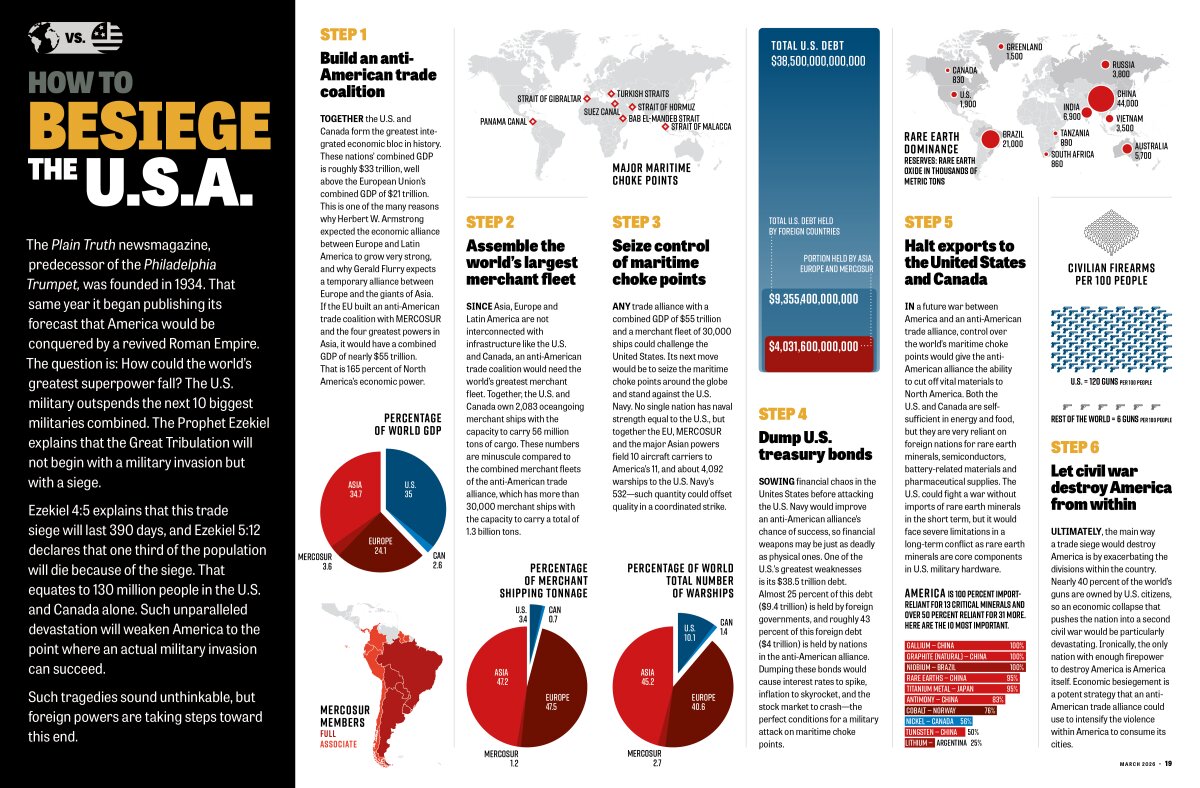
America needs the mercosur nations for resources such as lithium (which is vital for batteries), copper (which is needed for many electronics) and nickel. Brazil, in particular, supplies nearly all of the world’s niobium, which is useful for missile and aerospace development. Twenty-four critical materials are found in South America.
The U.S. relies on imports for 12 of the total 60 critical minerals, and it relies on imports to supplement its supplies of 29 critical minerals as well. If it can’t import these minerals, American industry would come to a halt. A siege would be detrimental.
With this EU-mercosur deal, an increased amount of those supplies will go to Europe rather than the U.S. Why would mercosur nations export them to the U.S., where they’ll be subject to tariffs, when they can export them tariff-free to the EU?
A Base for a Blockade
Up to 40 percent of America’s seaborne imports go through the Gulf of Mexico. Cuba is perfectly located to block much of those. That’s one reason the Trump administration has been working to install a pro-American regime on the island. However, Germany is ensuring that, new regime or not, Cuba will be under its control.
On April 20, speaking to Brazilian President Luiz Inácio Lula da Silva, German Chancellor Friedrich Merz condemned the U.S. blockade on Cuba as unjustified. Facing the ongoing blockade, Cuba would not hesitate to play a role in besieging America.
Germany has been making quiet inroads into that small, yet important, island for years. One sign of that was the 2015 German-Cuba relationship framework, which marked the reopening of ties between the two nations. Frank-Walter Steinmeier traveled to Cuba to sign the deal; he was the first German foreign minister to visit the island since the Berlin Wall.
Germany is one of Cuba’s largest export markets, and Europe, as a whole, accounts for up to 30 percent of all Cuban exports. With an economy as weak as Cuba’s, that gives Germany sway. In 2018, the German government set up an office to support German business in Cuba, championing it as a place for German capital.
The Threat From the West
China is a major part of the global economy, has a larger navy than America’s (measured by sheer quantity of ships, but not quality), and has ties to sea gates around the world. China is Germany’s largest trade partner, yet it wants even closer ties with China, despite opposition in Europe.
German Economics Minister Katherina Reiche visited Beijing from May 26 to 29 to strengthen business ties. This was despite a call, two days before her visit, from France, Spain, Italy, the Netherlands and Lithuania to take a harsher stance against China. Germany continues to push for these closer ties because they share a common enemy: the United States.
While in Beijing, Reiche called for the two nations to have a more “candid and open exchange.” Reiche said she believes that China is “so important and so large” that Germany must “maintain a stable, trusting and forward-looking relationship with the country, one that is also able to withstand critical issues.”
Germany also has a strong trade alliance with Russia. On the surface, Germany appears to be boycotting Russia, but it isn’t. As one example, in 2024, Germany quashed an attempt to sanction Russian gas. Germany has evaded sanctions placed against Russia by exporting its goods to Russia’s neighbors, who then export them to Russia.
German exports to Kazakhstan nearly doubled from $1.7 billion in 2021 to $3 billion in 2024. Kazakhstan didn’t suddenly develop a booming economy; the only catalyst that changed was the sanctions against Russia. Russia is Kazakhstan’s third-largest export market. German exports to Kazakhstan’s neighbor, Kyrgyzstan, have also increased 10-fold since the Ukraine war. And Russia happens to be Kyrgyzstan’s third-largest export market.
Russia’s shadow fleet, comprised of 1,000 to 3,200 vessels, would also be a great asset in encircling the U.S.
Japan has, by some counts, the third-largest merchant fleet in the world. It is also the largest foreign holder of U.S. treasuries, owning over $1.1 trillion of U.S. debt. As the infographic above explains, if U.S. treasuries were dumped quickly, it would sink the American economy. German Defence Minister Boris Pistorius and his Japanese counterpart agreed on March 22 to tighten military ties through more common security consultations, which will better align their military planning.
Pistorius also suggested a Reciprocal Access Agreement (raa), which would see further integration between the German and Japanese militaries. Poland’s Defence24 pointed out that this marks a “major strategic upgrade” in the two nations’ relations, even though the raa was merely a suggestion.
Japan, according to the German government, is Germany’s second-most important Asian trading partner.
Then there’s India. Chancellor Merz met with Indian Prime Minister Narendra Modi and toured India from January 12 to 13, his first trip to Asia since taking office in May 2025. While there, he signed multiple agreements ranging from weapons-sharing to technology partnerships. The two leaders also signed a declaration of intent on critical materials. India is a supplier of four critical minerals. The meeting came just days before the EU-India trade agreement was signed, hailed by European Commission President Ursula von der Leyen as the “mother of all trade deals.” This further cemented Germany’s partnership with the South Asian nation, as a quarter of India’s trade with the EU goes to Germany.
The Northeast
Greenland could play a key part in Germany’s efforts to surround America. In World War ii, America and Germany fought over Greenland due to its incredibly important strategic location. If Germany had been able to secure the island, it would have been used as a launchpad to invade North America. Also, the U.S. wouldn’t have been able to collect weather data from the island, which helped the D-Day invasion.
Does Germany have similar designs for Greenland today? It would explain why Europe was willing to risk war over it earlier this year when, on January 16, it sent a small contingent of soldiers as a warning against the U.S. The soldiers were equipped with explosives to destroy runways and given blood reserves in the event of a conflict with American forces.
The Prophesied Siege
Overlay these alliances on a map, and you’ll see that Germany has encircled the United States. These powers are aligning due to a shared disdain for the Trump administration.
Isaiah 23 warns of a great assemblage of powers that will besiege the end-time nations of Israel, which include the British Commonwealth and the United States. Verse 13 specifically mentions “the Chaldeans” and the “Assyrians,” prophetic names for Europe and Germany today, will play a role in that siege. Verse 1 mentions China by one of its ancient names, “Chittim.” The “ships of Tarshish” in verse 14 are a direct reference to Japan’s naval power that will be used to besiege the American superpower. For a more thorough explanation of this prophecy, read Mr. Flurry’s free booklet Isaiah’s End Time Vision.
Ezekiel 27, a parallel passage, adds more details about who will take part in this siege. Germany and the European superpower under it are mentioned, along with “Tubal” and “Meschech,” ancient names for Russia’s two central cities, Tobolsk and Moscow. Furthermore, “Phut” in verse 10 is an ancient name for India.
As the Bible prophesies in Ezekiel 5, once these nations mesh together to besiege the U.S., it will lead to famine and violence across the nation. The U.S. will finally be brought to its knees, completely impoverished. The siege will precede an invasion, which will see one third of those in the U.S. taken captive. This siege will usher in the worst suffering ever upon the English-speaking countries and, eventually, the world.
These merging alliances show us that war with the U.S. is on Germany’s mind. The groundwork is being laid to usher in the horrifying events described in Ezekiel 5. For more information, read He Was Right.