
One Way the World Can Hit Back
“America will reclaim its rightful place as the greatest, most powerful, most respected nation on Earth, inspiring the awe and admiration of the entire world,” President Donald Trump promised in his 2025 Inaugural Address. “Our power will stop all wars and bring a new spirit of unity to a world that has been angry, violent and totally unpredictable.”
There is a new spirit of unity in the world, but it is not that one.
Europe, Russia, China and Latin America are unified in their anger over President Trump’s reassertion of American diplomatic power, imposition of tariffs on enemies and allies alike, sudden and surprising military strikes on cartels and regimes, threat to take Greenland by force, and tearing up much of the global rule book.
He has his reasons. After all, Europe has taken advantage of American generosity since World War ii. Much of that global rule book has been abused by nations that ignore the rules themselves while using them to weaken America.
Whether Trump’s actions are wise or foolish, it is clear that the rest of the world is seething with hatred toward an increasingly assertive America.
President Trump is unconcerned. As he sees it, the world is divided. America has the world’s mightiest military and a gargantuan economy. What can the rest of the world do against such might?
Well—they do have options. One of the most potent is simply to take advantage of a terrible weapon America has foolishly handed over to them: its terminal addiction to debt.
Economies Are Weapons
“[G]reat powers have begun using economic integration as weapons, tariffs as leverage, financial infrastructure as coercion, and supply chains as vulnerabilities to be exploited,” declared Canadian Prime Minister Mark Carney at the World Economic Forum in Davos on January 20.
This was a bold declaration regarding an undeniable American vulnerability. Its economy is an asset—but only as long as it receives a constant flow of supplies and an endless supply of loans.
Even when American finances are “good,” the United States government must borrow around $2 trillion a year—5 to 6 percent of its gross domestic product—to pay for Social Security, Medicare, Medicaid and that line item President Trump so loves, the military.
The U.S. is often compared to a household, mortgaged to the hilt yet still borrowing more each year just to make ends meet. But that analogy doesn’t fully capture how dire the situation is.
In a regular mortgage, a homeowner pays interest on the debt and pays off the whole thing a month at a time. When the mortgage term expires after 15 or 30 years, the debt is paid off. But it is possible to get an interest-only mortgage: Each month the homeowner pays only the interest, and at the end of the term, he must repay the full amount he borrowed.
America has an interest-only mortgage—or rather, 150 million or so interest-only mortgages. Every month, to make ends meet, America borrows more money. But it must also pay back debt that becomes due. It does this by borrowing still more.
The U.S. borrowed $2 trillion in new debt last year. But as the Telegraph’s Ambrose Evans-Pritchard points out, when you include the amount America borrowed to pay back old debt, that figure soars to a staggering $30 trillion.
If every good and service produced by the U.S. economy—the money from every car made, haircut given or meal served—was added together, it would barely pay off the old debts that had to be repaid in 2025 and cover the new borrowing.
In other words, America’s gross financing equates to around 100 percent of its gdp every year.
All economies operate this way, but no other country borrows and pays back on such an enormous scale. For France, that figure is 19 percent; for the United Kingdom, it’s 10 percent.
Other sources don’t put America’s figure as high as Evans-Pritchard (there are different ways of calculating it), but it’s still far higher than other developed countries. The International Monetary Fund generally considers any figure above 20 percent to be risky. It’s easy to see why. The U.S. government received $5.2 trillion in revenue last year. Without the ability to borrow tens of trillions a year, it would go bankrupt within weeks.
And the situation is worsening rapidly. Interest rates on American bonds are rising. Investors see U.S. debt as becoming more risky, so the government needs to offer higher interest rates to persuade them to buy U.S. treasury bonds, thus lending more cash to the U.S.
Last year, the U.S. spent $1 trillion on debt interest alone. That is more than it spent on its military. And over the next decade, that amount is forecast to almost double.
To address this crisis, Treasury Secretary Scott Bessent is resorting to dangerous short-term tactics, mainly by borrowing still more money.
Debt that will be paid back in 10, 20 or 30 years carries a higher interest rate than debt to be repaid within a year or two. Buy a 30-year treasury bond, and the government won’t pay you back until 2056. If the U.S. goes bust, a world war breaks out, or an asteroid wipes out America, you won’t get back your money. Because a longer-term bond means taking a bigger risk, the government pays you a higher interest rate.
Short-term debt is less risky. If your money is due to be repaid next year, there’s much less time for things to go wrong. So Bessent has been issuing more and more short-term debt. This reduces the interest bill America has to pay. But it means borrowing more and more money to pay back loans that are expiring more and more quickly. With each passing month, America becomes more and more reliant on even greater amounts of borrowing.
This is a glaring vulnerability for America—and the world sees it.
Blood in the Water
“For all its military and economic strength, the U.S. has one key weakness: It relies on others to pay its bills via large external deficits,” said George Saravelos, Deutsche Bank’s head of global currency research. “[I]t is not clear why Europeans would be as willing to play this part.”
President Trump is threatening trade war with the world. The world is planning to strike back. But as Saravelos wrote, “It is a weaponization of capital rather than trade flows that would by far be the most disruptive to markets.” Europe could fight Trump’s tariffs by levying their own tariffs. But Saravelos is suggesting what he believes is a more effective approach: Refuse to loan America money, and the U.S. will be brought to its knees.
One financial institution, Danish pension fund AkademikerPension, has already taken action. Upset by Trump’s threats to take Greenland from Denmark, it announced that it would sell its U.S. treasury bonds.
Bessent dismissed the threat, remarking, “Denmark’s investment in U.S. treasury bonds, like Denmark itself, is irrelevant.”
He’s probably right. But other nations’—other angry nations’—investments in U.S. treasury bonds couldn’t be more relevant. If China and Belgium and Canada—all major holders of U.S. debt—were to react in the same way, demand would plummet, the Treasury would be forced to offer even higher rates to get anyone to buy American debt, and even then the rest of the world could say no. The debt binge would be over, and the most catastrophic crash of the most gigantic addiction imaginable would commence.
Carney threatened this at Davos, reasoning, “[M]iddle powers must act together, because if we’re not at the table, we’re on the menu.”
In December, the Wall Street Journal reported that European officials are privately discussing how to coordinate a dump of U.S. treasury bonds for maximum damage to the U.S. and minimum collateral damage to Europe and other economies.
“The way to hold Trump’s feet to the fire is for the whole world—Europe, China, Japan, Brazil, central banks, sovereign wealth funds, pension funds, insurance companies and banks—to sit out the next auction by the U.S. Treasury and see how easy it is for U.S. domestic capital markets to cover debt sales running at $2.5 trillion a month,” wrote Pritchard. “Impossible to coordinate? Yes, of course. But it is time to start floating such ideas in public. The only language Trump understands is money, so let us cut off his global credit card” (Telegraph, January 21).
It would be hard for these nations to act in this way without harming their own economies. But Europe and other nations are actively working to change their dependence on and connection to the U.S. economy so they can launch a war against it.
America’s GENIUS Response
Bessent and others in the Trump administration may be complacent, but they’re not stupid. They see the danger here, and they are proactively working to counter it. Not by reducing spending and paying off debt, but by passing the genius Act.
They’re not weening themselves off debt. Instead they’ve found a new dealer.
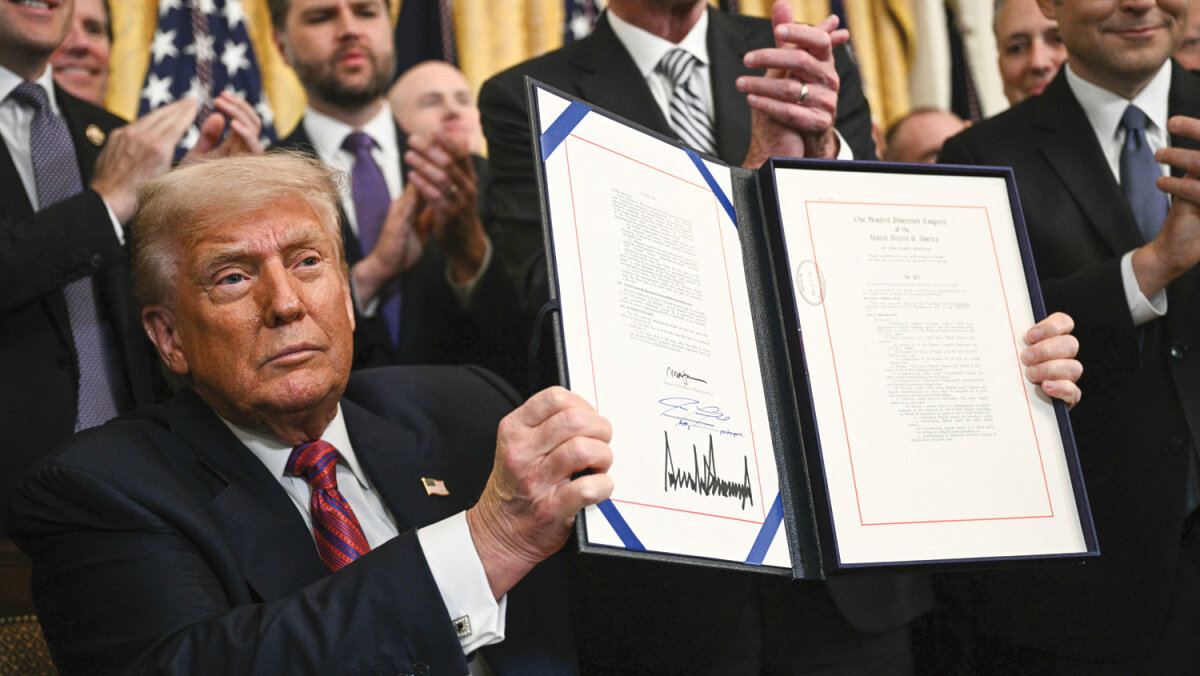
The new law, signed on July 18, 2025, is designed to open up a whole new market for U.S. debt: cryptocurrency.
Moving money internationally is expensive, with banks charging hefty fees to switch currencies. This is one of the problems that Bitcoin and other cryptocurrencies were designed to bypass. They introduced other problems, however, especially the fact that cryptocurrency values fluctuate wildly.
The solution is stablecoins: cryptocurrencies with values that remain pegged to dollars or other traditional currencies or assets. Stablecoins have all of the upsides of crypto and none of the downsides—in theory.
In practice, cryptocurrencies are generally unregulated. Because of this, supposedly “stable” coins have failed catastrophically. Too many people wanted to swap their virtual coin for real currency at the same time, the coin’s creators ran out of cash, and people who thought they were investing in a “stable” asset lost everything.
The genius Act is meant to solve this. It allows institutions to issue stablecoins in a way that is regulated by the federal government. To ensure that users can be paid back, each stablecoin must be backed by U.S. dollars, U.S. treasury bonds or another similar liquid asset. Most will choose treasury bonds.
This promises a safe, regulated way to cheaply circulate money internationally. These could be very popular and give foreign investors and governments yet another reason to loan money to the U.S.
“The planned issuance of stablecoins will constitute a large and permanent expansion of U.S. debt and lower interests in the U.S.,” wrote EuroIntelligence. “We think that the recently passed genius Act, which regulates the U.S. domestic stablecoin industry, is one of the economically most consequential piece[s] of legislation in our time. … The big economic consequence is that they will allow the U.S. government to borrow a lot more money” (Nov. 17, 2025).
Extending the Addiction
Problem solved? No. The genius Act does not solve America’s addiction to debt; it enables it. At best, it buys America more time. It has also prompted Europe and others to accelerate their own digital currency experiments, which are more and more openly aimed at replacing the dollar (or dollar-backed stablecoins) as the world’s reserve currency.
If the genius Act were buying America more time to reduce its spending, pay its existing debts and stop piling on additional debts, perhaps it could be part of the solution. But there’s no sign that the U.S. government, led by the man who has called himself “the king of debt,” plans to significantly reduce its borrowing.
Meanwhile, investors worldwide are clearly watching the ever rising debt load and looking for alternatives. Gold, for example, briefly reached an all-time high of $5,615.10 per troy ounce on January 29.
If government debt becomes unsustainable, a government could go bankrupt. But it’s far more common for governments to inflate the debt away; in other words, print more dollars and you can pay $36 trillion in debt more easily. The downside is that the value of each dollar plunges and grocery shoppers have to pay $100 for a carton of eggs. Record-high gold prices are a sure sign that investors fear the U.S. government could start printing dollars.
That fear subsided somewhat after President Trump announced his choice of Kevin Warsh to succeed Jerome Powell at the Federal Reserve. Warsh is known to oppose inflation and advocate for a strong dollar. But America’s all-consuming debt addiction limits what he can do.
After the 2008 financial crisis and during covid, the Federal Reserve printed money and loaned it to the U.S. government. Warsh wants to do the opposite by selling treasury bonds, then destroying the money. That reduces the number of dollars in circulation, somewhat closer to what it was before 2008, but it inherently makes it more expensive for the U.S. government to borrow money. Can he follow through? President Trump is trying to hound Powell from office because he blames him for, among other things, high interest rates on U.S. debt—the very thing that Warsh’s measures would produce. Warsh may have little choice but to go Trump’s way.
President Trump clearly wants to do everything possible to keep the injections of debt coming.
Warnings Ignored
“Central banks are buying gold to back up their currencies,” warned economist Peter Schiff on Fox News. “They’re getting rid of dollars. They are getting rid of treasuries. We are headed for [an] economic crisis, again, that will make the 2008 financial crisis look like a Sunday school picnic.”
“We depend on the world. They provide us with the goods that we don’t produce. They loan us the money we don’t save. Trump has it backwards. The world economy doesn’t work because of us—our economy works because of the world,” Schiff warned. “We have a dysfunctional consumer-based credit economy that rests on the foundation of the U.S. dollar’s reserve currency status, and the world is now pulling the rug out from under the U.S. The dollar’s going to collapse. The dollar is going to be replaced by gold.”
“The biggest difference between the crisis that we’re about to have and the one we had back then is this one is all in America ,” he concluded. “It’s not going to be exported to the rest of the world. It’s not a global financial crisis. It’s an American financial crisis. The rest of the world is actually going to benefit from it.”
That is a powerful warning, and it’s the same one the Trumpet has been sounding for decades.
Proverbs 22:7 warns, “The rich ruleth over the poor, and the borrower is servant to the lender.” Donald Trump believes the first part of that verse. America has a lot of wealth, and he wants to use it to dominate the world. But he misses the second part.
There are many creative ways to keep feeding the addiction, but America’s massive borrowing cannot continue forever.
In Deuteronomy 28, God lists a number of fearsome curses. One of them says, “He shall lend to thee, and thou shalt not lend to him” (verse 44). Being indebted to foreigners is a curse. Why? “[H]e shall be the head, and thou shalt be the tail,” it concludes.
Donald Trump believes he is the head. Soon he will have a rude awakening.
Herbert W. Armstrong wrote in 1984 that a major banking crisis in America “could suddenly result in triggering European nations to unite as a new world power larger than either the Soviet Union or the U.S.”
The Trumpet has continued that warning. In December 1995 we wrote: “Soon there will be no one to buy our debt and bail us out, and then the United States will go into full bankruptcy!” That article continues to warn that Europe, led by Germany, “will see to it that not only is our credit card canceled, but also that we do not keep our nation! The United States will be repossessed and taken away from us like an old car that the loan company drags down the street with a tow truck while the ‘owner’ runs screaming after it but is unable to do a thing about it!”
All of these warnings are based on Bible prophecy. Deuteronomy 28 lists, precisely, the blessings America was given that made it a great nation. And it lists the coming curses. These include besiegement, the U.S. being cut off from world trade (verse 52); and the weaponization of debt by foreign powers (verse 44). You can now read in the daily news about these exact, rapidly approaching curses.
Many will ignore the current developments because they’ve heard these warnings for decades. The U.S. has certainly experienced financial trouble, but that total collapse has not yet happened. But it will.
In today’s interconnected world, many of the nations America is indebted to are themselves indebted to others. The entire system is unsustainable. But America, both uniquely indebted and uniquely hated, is uniquely vulnerable.
Ultimately, all the world’s economies are built on debt. The whole system will fail. The Bible prophesies of a time when circumstances get so bad that even gold is thrown into the streets (Ezekiel 7:19). That’s what it will take for us to let go of our addiction to debt, and a host of other sins, and to finally build an economy and a world on a sure foundation.