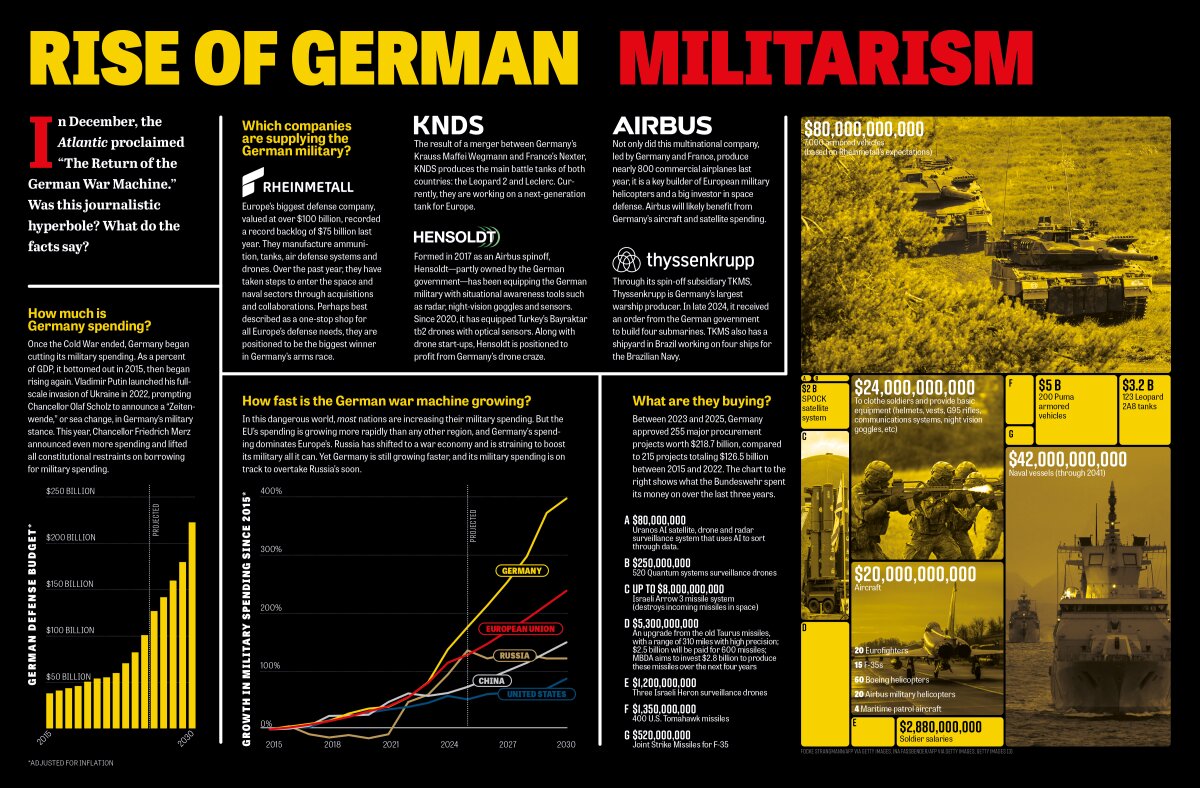
In December, the Atlantic proclaimed “The Return of the German War Machine.” Was this journalistic hyperbole? What do the facts say?
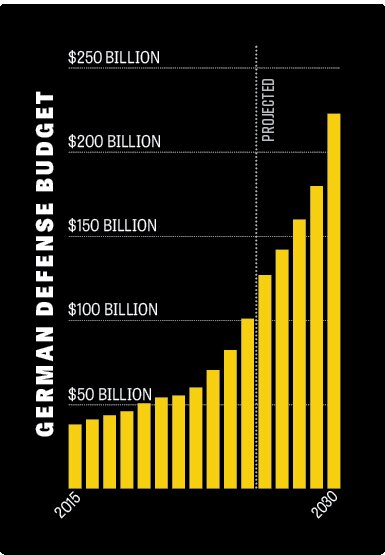
How much is Germany spending?
Once the Cold War ended, Germany began cutting its military spending. As a percent of gdp, it bottomed out in 2015, then began rising again. Vladimir Putin launched his full-scale invasion of Ukraine in 2022, prompting Chancellor Olaf Scholz to announce a Zeitenwende, or sea change, in Germany’s military stance. This year, Chancellor Friedrich Merz announced even more spending and lifted all constitutional restraints on borrowing for military spending.
Which companies are supplying the German military?

Europe’s biggest defense company, valued at over $100 billion, recorded a record backlog of $75 billion last year. They manufacture ammunition, tanks, air defense systems and drones. Over the past year, they have taken steps to enter the space and naval sectors through acquisitions and collaborations. Perhaps best described as a one-stop shop for all Europe’s defense needs, they are positioned to be the biggest winner in Germany’s arms race.

The result of a merger between Germany’s Krauss Maffei Wegmann and France’s Nexter, KNDS produces the main battle tanks of both countries: the Leopard 2 and Leclerc. Currently, they are working on a next-generation tank for Europe.

Formed in 2017 as an Airbus spinoff, Hensoldt—partly owned by the German government—has been equipping the German military with situational awareness tools such as radar, night-vision goggles and sensors. Since 2020, it has equipped Turkey’s Bayraktar tb2 drones with optical sensors. Along with drone start-ups, Hensoldt is positioned to profit from Germany’s drone craze.

Not only did this multinational company, led by Germany and France, produce nearly 800 commercial airplanes last year, it is a key builder of European military helicopters and a big investor in space defense. Airbus will likely benefit from Germany’s aircraft and satellite spending.

Through its spin-off subsidiary TKMS, Thyssenkrupp is Germany’s largest warship producer. In late 2024, it received an order from the German government to build four submarines. TKMS also has a shipyard in Brazil working on four ships for the Brazilian Navy.
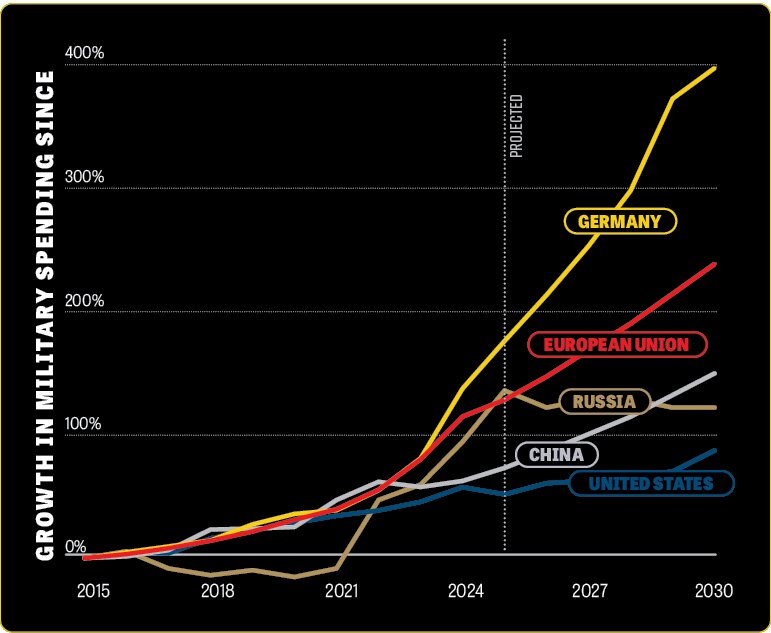
How fast is the German war machine growing?
In this dangerous world, most nations are increasing their military spending. But the EU’s spending is growing more rapidly than any other region, and Germany’s spending dominates Europe’s. Russia has shifted to a war economy and is straining to boost its military all it can. Yet Germany is still growing faster, and its military spending is on track to overtake Russia’s soon.
What are they buying?
Between 2023 and 2025, Germany approved 255 major procurement projects worth $218.7 billion, compared to 215 projects totaling $126.5 billion between 2015 and 2022. The chart below shows what the Bundeswehr spent its money on over the last three years—or as indicated is projected to spend.
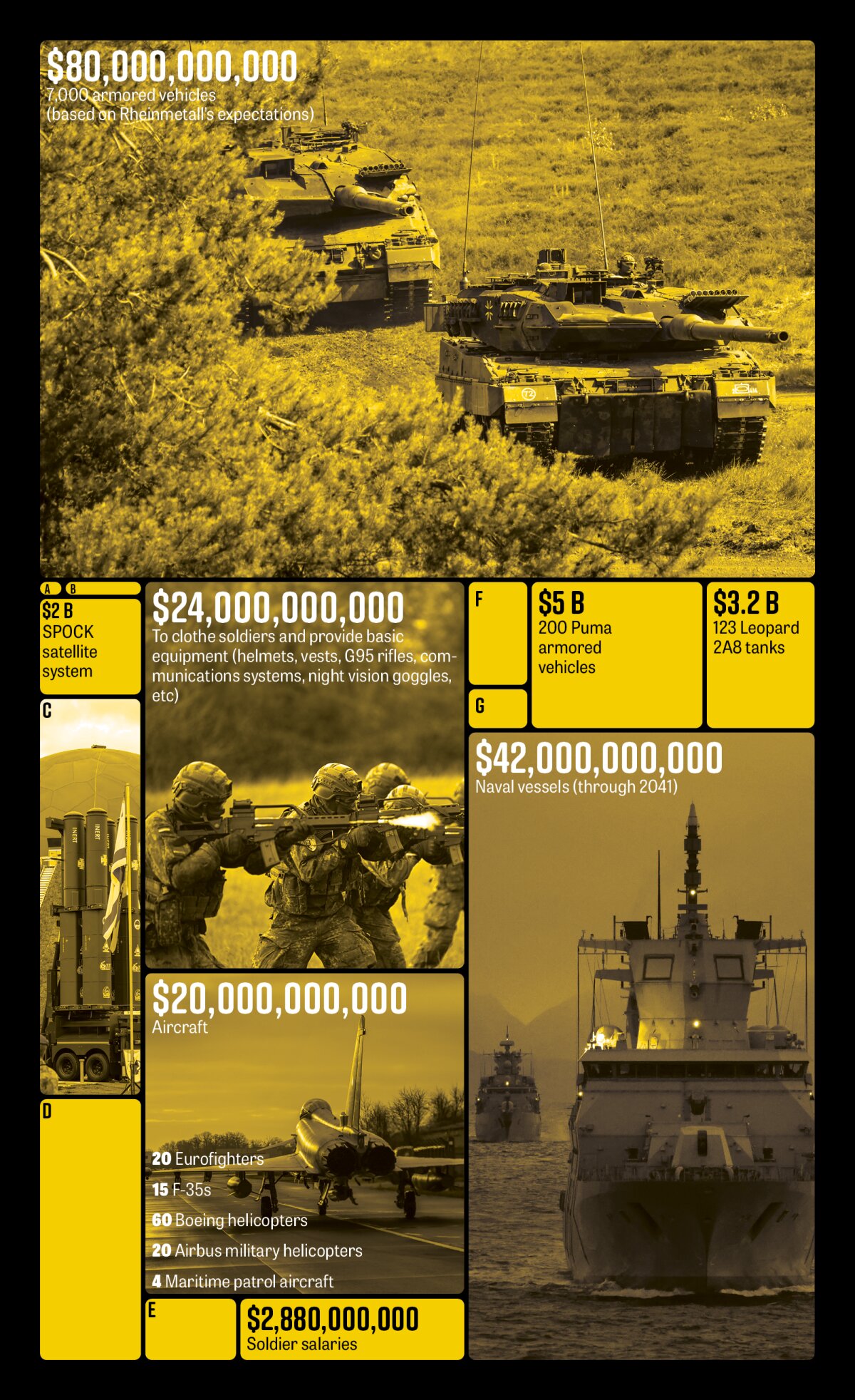
A $80,000,000 - Uranos AI satellite, drone and radar surveillance system that uses AI to sort through data.
B $250,000,000 - 520 Quantum systems surveillance drones
C Up to $8,000,000,000 - Israeli Arrow 3 missile system
(destroys incoming missiles in space)
D $5,300,000,000 - An upgrade from the old Taurus missiles, with a range of 310 miles with high precision; $2.5 billion will be paid for 600 missiles; MBDA aims to invest $2.8 billion to produce these missiles over the next four years
E $1,200,000,000 - Three Israeli Heron surveillance drones
F $1,350,000,000 - 400 U.S. Tomahawk missiles
G $520,000,000 - Joint Strike Missiles for F-35
See complete infographic.